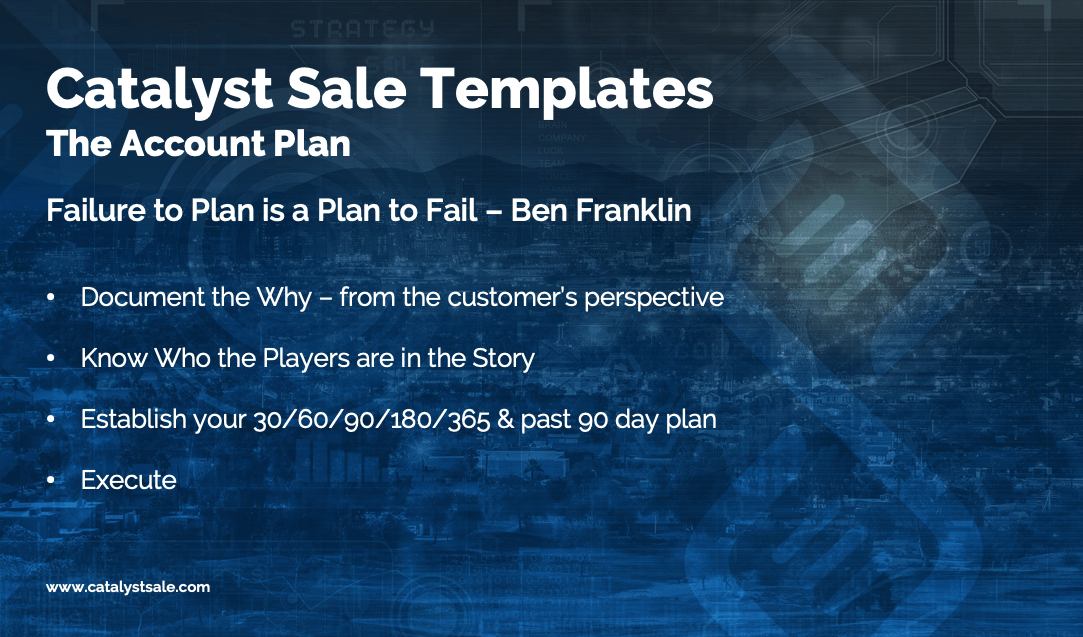

Where Does Revenue Come From?

Where Does Revenue Come From?

Better yet – where does your revenue come from?

Can you draw it up on a whiteboard?

If everyone in the org drew their version of the model, equation, funnel, etc – would it look the same?

This is a challenge I’ve been working on in one way or another for the past 20 years. Replace revenue with “audience or learners”. We could ask the question – Where do learners come from? Where do end-users come from? Where do our customers (internal or external) come from?

These are my thoughts process and perspectives on this.

Ingredients in the Revenue Equation

What are the ingredients that make up your revenue equation?

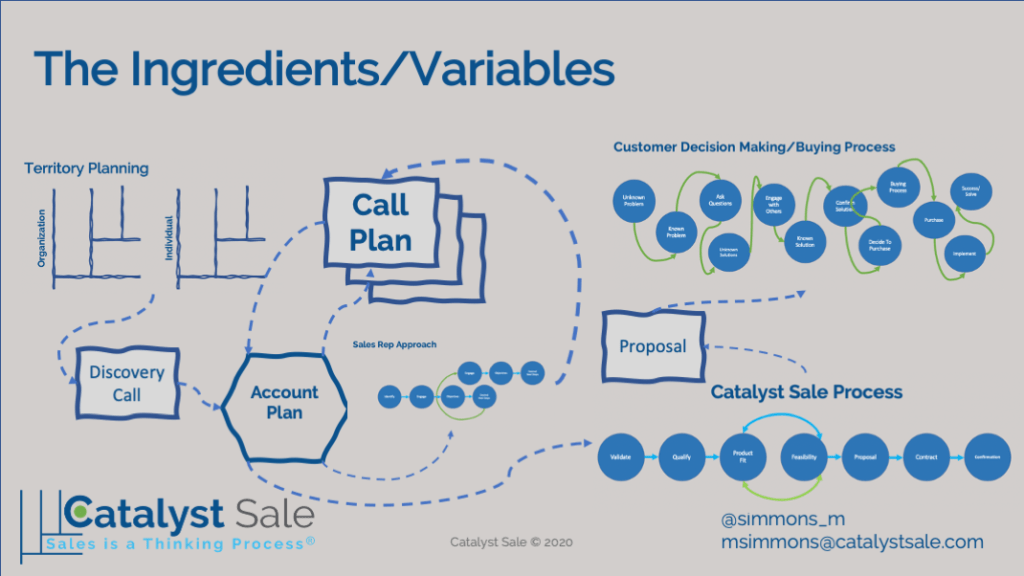
There are a handful from my perspective, and they fall into the following two categories – Tools and Process.

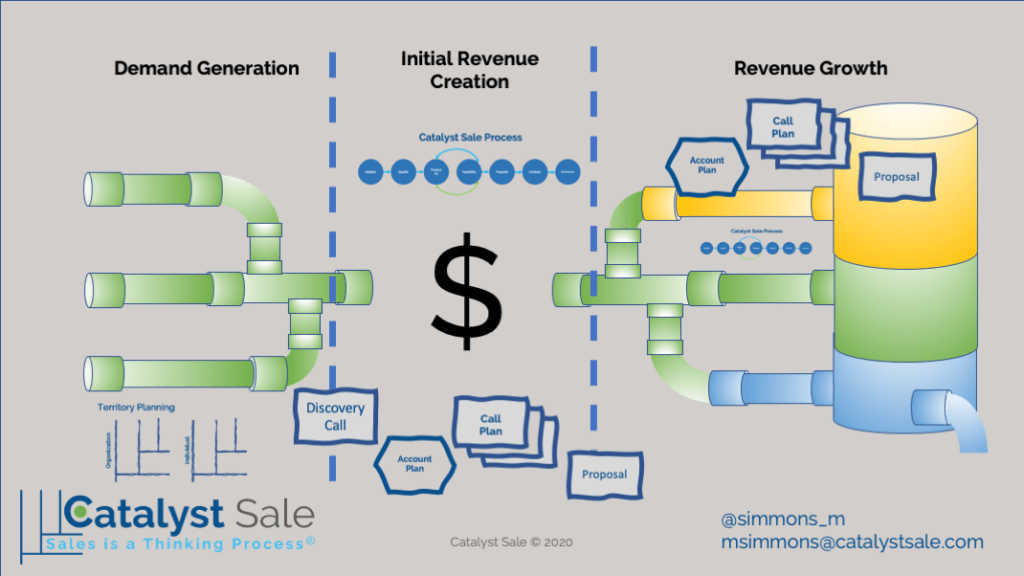
Tools for Revenue Growth

  • Territory Plan – Knowing who your customer is at an individual and organization level are important distinctions. Tools like a Territory Plan, can help create both clarity and focus.
  • Call Plan – Preparing for interaction, knowing who will be in the room, anticipating their objectives, knowing your objectives, and having a list of desired next steps, can put you on the path to success.
  • Account Plan – Knowing the what, who, why, how, and when, followed by creating a plan & executing can help reveal risk, and improve impact.
  • Proposal – Knowing the problem that exists, why it is important to solve, how you solve it, and how much it will cost.

Processes that Create Revenue

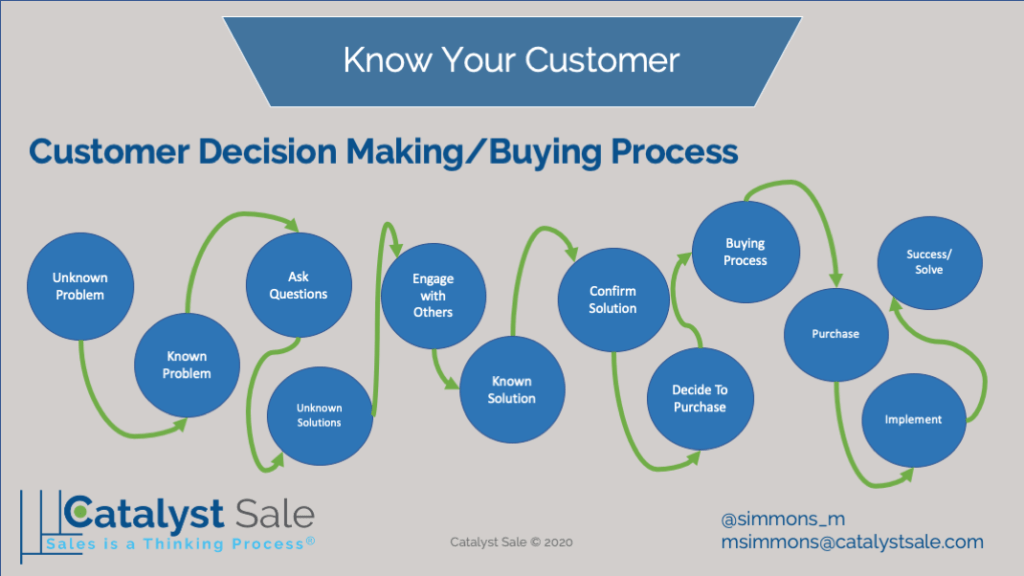
  • Customer Decision-Making Process – How your customer makes the decision to change, and how they purchase.
  • Sales Process – How you forecast and improve predictability while reducing risk.
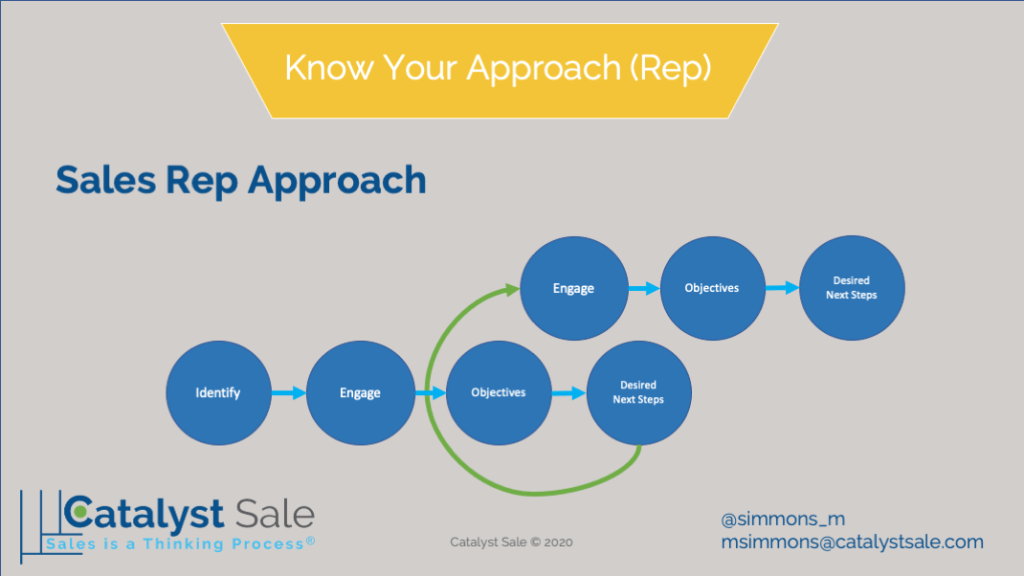
  • Sales Rep Approach – How you execute.

Revenue Operations & Foundational Skills

“If you know the enemy and know yourself, you need not fear the result of a hundred battles. If you know yourself but not the enemy, for every victory gained you will also suffer a defeat. If you know neither the enemy nor yourself, you will succumb in every battle.”

― Sun Tzu

Know Your Customer, Know Your Business, Know Your Approach as a Rep. and apply foundational skills – If you do these things, you will leave fewer things up for chance, and put yourself and your team in a position to be successful.
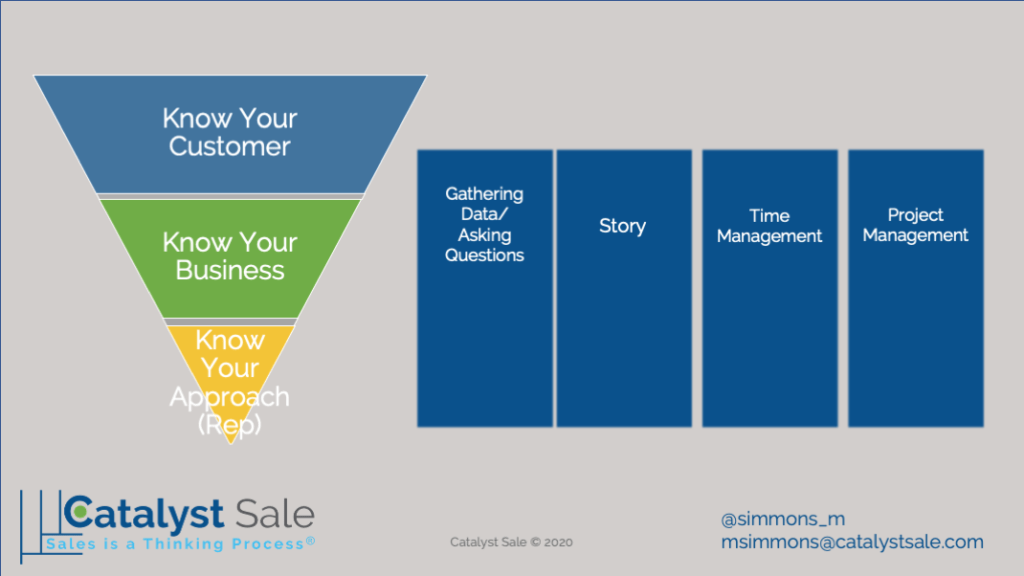

Know Your Customer

  • How do your customers go through the process of making a decision to purchase, and how do they actually buy things?
  • What series of events, obstacles, barriers, traps do they need to navigate?
  • Where do they go for help?

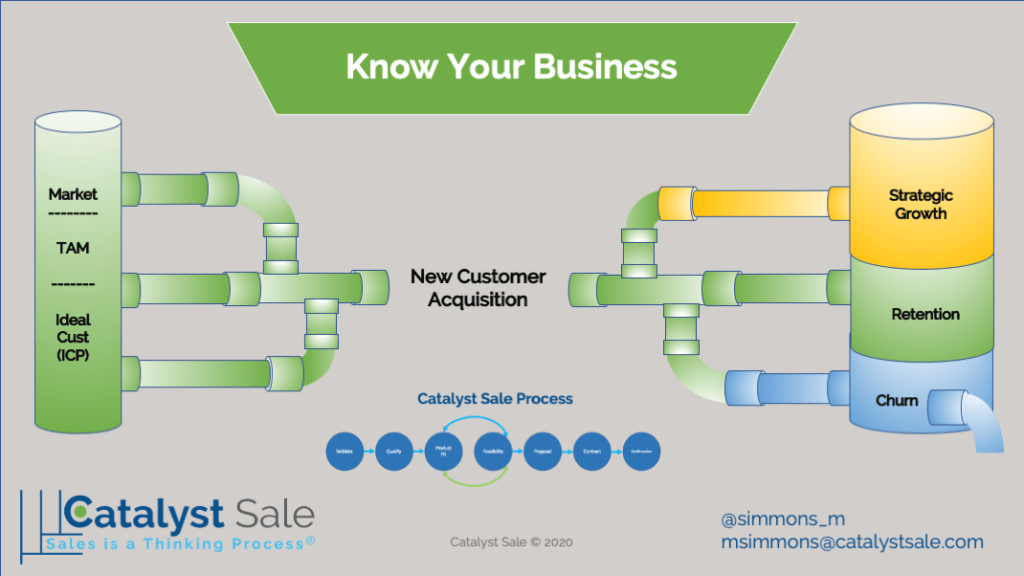
Know Your Business

  • What is the size and scope of the market you serve?
  • How will you tap into that market?
  • How do you transition from demand generation to conversion, or initial revenue generation?
  • What happens next?
  • How do you grow?
  • What do you lose?
  • Where is the balance?

Know Your Approach

  • How does your team execute?
  • What repeatable process do they follow?
  • How is this different from what you might call your “Sales Process“?
Putting the pieces of the puzzle together

  • Is your ideal customer profile defined?
  • How does it impact your demand generation strategy?
  • Is demand fueling your ability to acquire new customers?
  • Are you growing at a level that excites you?
  • If not – is there a leak in your people, your process, your tools, your approach?
So What?

I get it, many of these questions are tough to answer. They become more complex when you attempt to solve the problem from different perspectives. When problem-solving, it is important to deconstruct things. Isolate for given variables, test, and adjust.

The above visuals should help you deconstruct, and isolate issues. They help me, and organizations I work with.

Now What?

Put this work into practice, gain the perspective of multiple folks within your teams, see where you are aligned, identify your gaps, and address them one at a time.

I’d like to hear how you apply this in your business, in your role. Sales is a Thinking Process® – How are you Thinking Differently About Yours?

If you’d like to learn more about this stuff, or download the tools discussed above – check out the Catalyst Sale Podcast, or send me a note.
Clarity and Focus – Lead to Execution

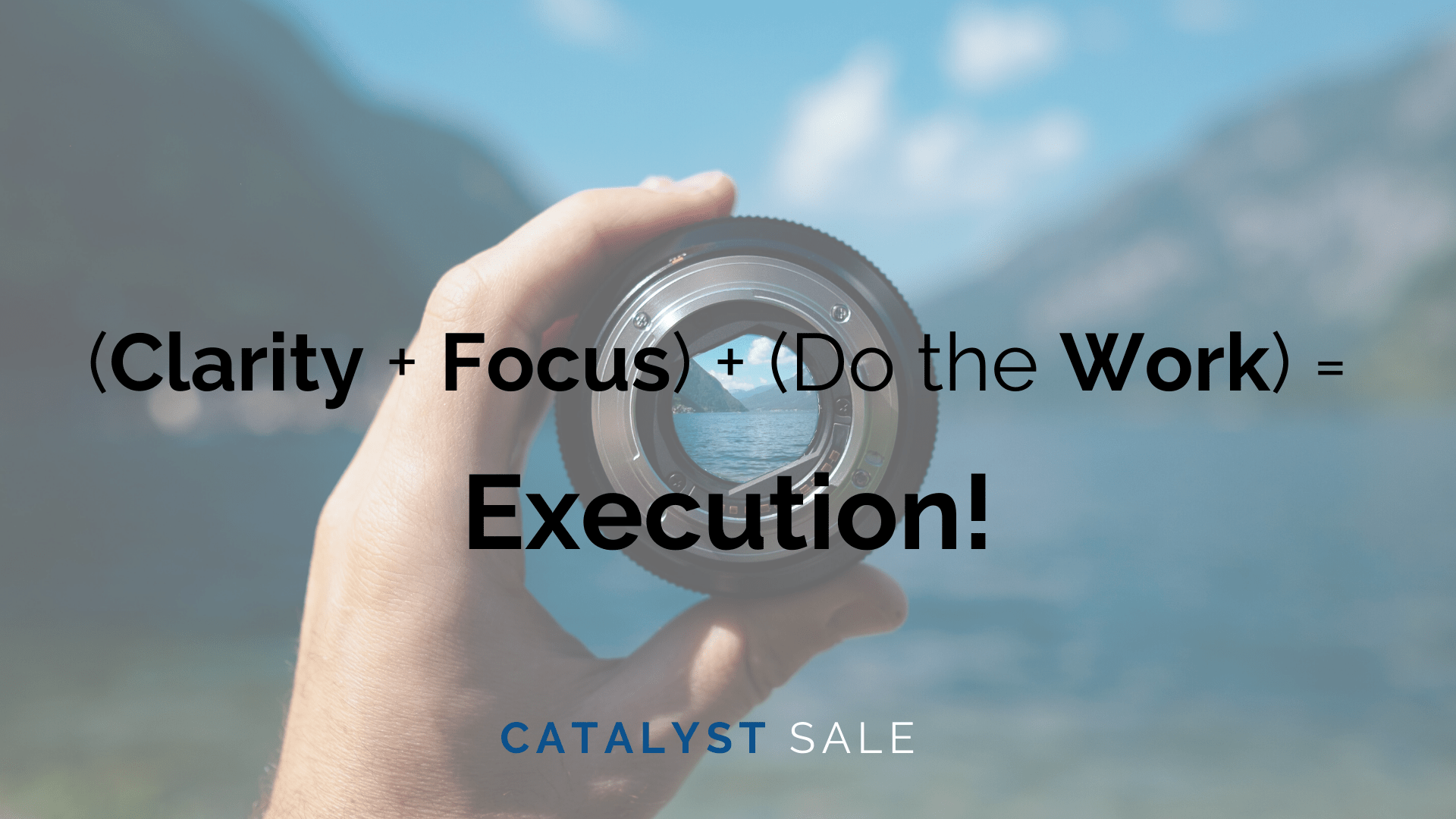
Clarity + Focus, lead to execution. Well – they do, if you do the work…

I get it most of us do not like math. However, there are a couple of us out there who do. I’d like to start this journey by looking at the execution problem as an equation.

This one is going to be a relatively simple equation that will lead to predictable results. Predictable results in relation to goal setting and execution.

(Clarity + Focus) + “Do The Work” = Execution

Net/Net – With Clarity and Focus, we will execute on more of our Goals. Small goals, aligned with big goals, lead to better execution

Think about a time where you established a goal. Maybe the goal was to serve an amazing Thanksgiving Dinner. Did you start by putting a Turkey in the Oven? Likely not.

You likely started with a couple of smaller goals, ideally each were aligned with cooking the dinner. This is a really rough simplification.

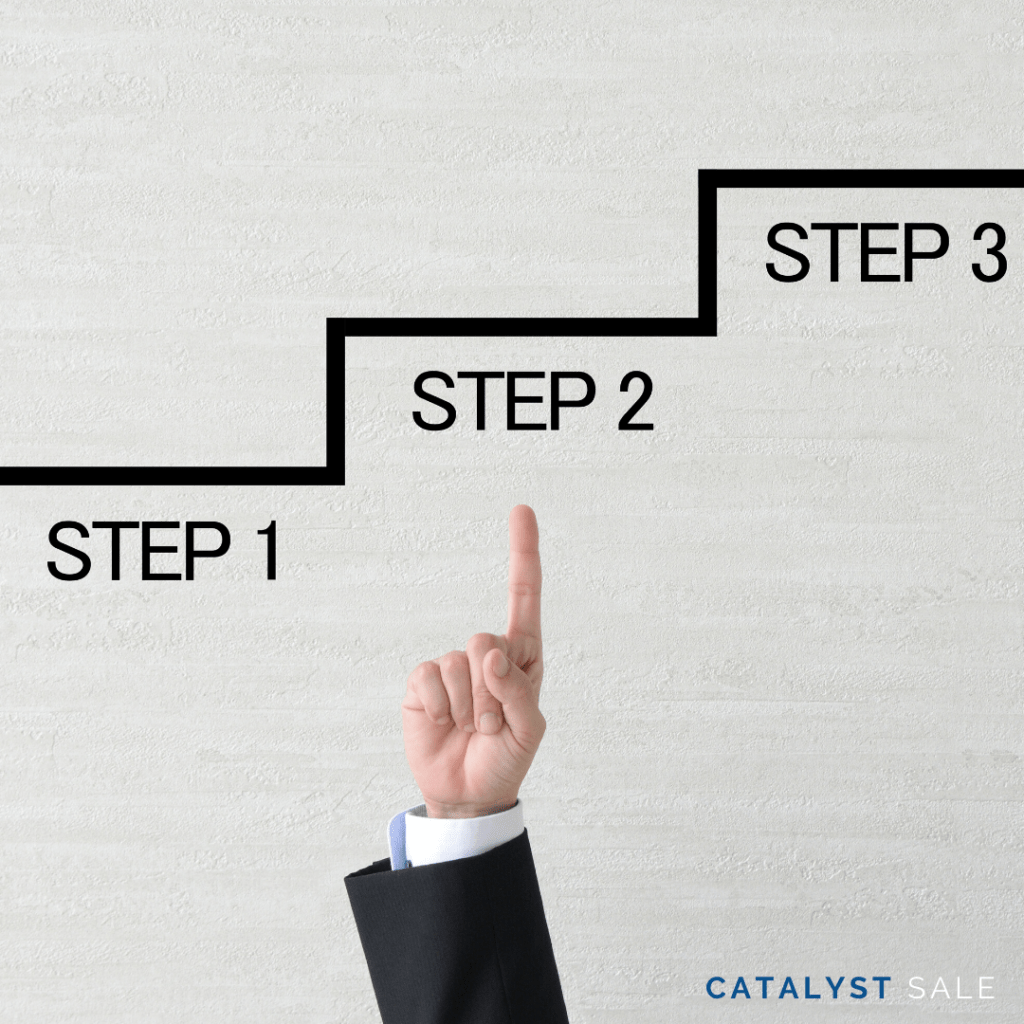
  • Goal #1 – Decide what will be served
  • Goal #2 – Buy the ingredients
  • Goal #3 – Cook the Dinner
Three Steps

It probably would help if we define the word Goal. Here is a post I shared on LinkedIn.

If/Then Statements

I’ve talked about this in the context of leading teams. If our individual roles align well with team goals/objectives, and our team goals/objectives align well with organizational goals/objectives, then we create clarity – this clarity reduces friction, reduced friction allows the flywheel to continue to gain speed/momentum.

What is Clarity?

According to the Oxford Dictionary – Clarity is a a quality. When I think about this, I think of clean pane of glass. If it is clean and clear, I can see through it. If it is muddy or murky, I’m not able to see what is on the other side.

Things like jargon, acronyms, industry terms can get in the way of communication – and can ultimately create fiction. This friction can be ok if we are considering change or inspiring change, but it can prevent our ability to build momentum.

Breakthrough the Jargon

The clarity in our goal of serving an amazing Thanksgiving dinner, occurs when we create smaller goals that align with the dinner. It’s clear we need to decide what we are going to cook, when we decide to purchase those ingredients, and start cooking the dinner.

Within each of these goals, we provide additional clarity around the things – let’s think about buying the ingredients. The clarity at the sub-goal allows us to create greater focus/attention on execution.

What is Focus?

Now we get to Focus – focus is the activity of attention – how do you know where we should put our attention? Well, before we go further, let’s define Focus with the help of the Oxford Dictionary.

If focus is about putting attention toward something, how does it apply to the Thanksgiving dinner example? By creating clear goals that are aligned with our broader goals and objectives, we can focus our attention directly on the things that matter. Not only the things that matter, but also working on these things in the order that they should occur.

If we focused our attention on cooking the meal before we had the food in the house, how far would we get?

So What?

Ok, we have talked about 3 words. Goals, Clarity, and Focus. If you want to improve on execution in your business there are three things you can do now.

  • Identify GOALS that align with where you want to take your business and/or your role within the business.
  • Create CLARITY on how those goals are defined, what they mean, and how they will impact the business
  • Determine FOCUS – which goals need to be accomplished and in what order should you apply your attention.
  • And, DO THE WORK

Now What?

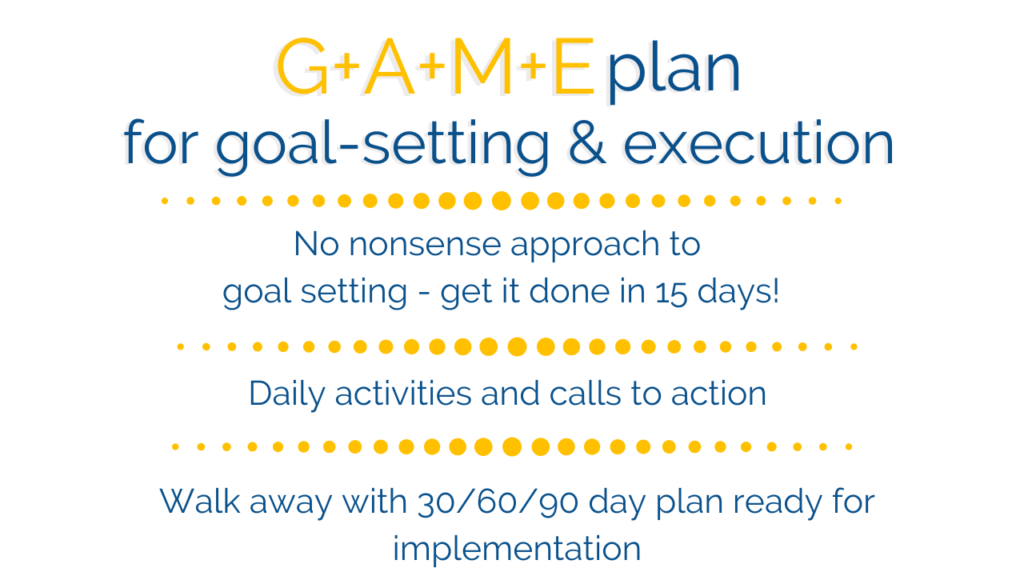
If you’d like some help with Goals Setting and Execution – please enroll in our recent course – “The GAME Plan”

The GAME Plan – a Catalyst Course

Timely Topics – The What, Why, How, and Impact as We Adopt Remote Work

Timely Topics

Many of us are making the transition to remote work, work from home, or varied hours as we adopt social distancing and work to combat the current pandemic. We are all in this together. However, some of us are further along the “work from home” journey than others. Some having worked this way for years while others of us are just starting.

Break Through the Noise

There is a fair amount of noise out there. There is also some great advice from experts. One challenge, don’t allow yourself to get caught up in the negative headlines. A number of folks, myself included, have worked in a remote/work from home environment for years. Yes, there are systems we have adopted, there are processes we have adopted and there are checks we have put in place.

However, those of us who have historically worked from home, have done so while our spouse/partner has gone into an office, and/or our kids head to school. We are now faced with working in an environment where work, home, life, and school are all being pushed together.

Again, we are all in this together. So, how do we manage?

Start By Defining the Challenge

When I think of problem solving, one of the first objectives I attempt to accomplish is to define the problem. For instance, many of us face the current problem/challenge/obstacle of how to effectively lead, calm and motivate a remote team in uncertain times. How do we maintain focus and sharpen clarity? What message do we send to our internal as well as external customers? What is the right tone?

In this series, I speak with many experts that help define a number of different topics. We discuss common mistakes, ways to avoid those mistakes, how to take care of ourselves and those we lead, how the topic/concept changes in a work from home environment, and how thinking around the topic changes when we look at it through the lens of our team, our customers, and our self.

I want to extend a heartfelt thank you to the experts who gave their time to contribute to this series. Please note, these recordings are un-edited.

The Experts

Empathy – Dr. Ehrin Weiss

Community – Brent Schlenker

Leadership – Dan Cockerell

Communication – Jody Maberry

Anxiety – Lee Cockerell

Mindset – Jeff Noel

Collaboration – Myra Roldan

Clarity and Focus – Mike, Dan, Jody

This one is unique, it was recorded before putting this series together – this is the one episode where the questions are not the same, and it takes more of a conversational tone.

Support – Eric Harrington

Execution – Mike Simmons

Resilience – Alanna Fincke

Thank you

I hope you found this information valuable. Please let me know via the chat on the Catalyst Sale website, or via direct message on twitter, if there are other topics that you’d like us to discuss on the podcast.

Leaders provide guidance, direction, motivation. They do not contribute to the noise. The time to lead is now.

What Do Christmas Movies Have to Do with Sales?

Merry and Bright

25 Days of Sales Tips

The 25 to 30 days between Thanksgiving and Christmas are my favorite of the year. It’s a time to give thanks, reflect, connect, prioritize, and execute.

In November you reap the rewards of work, the foundation, you put in place at this time last year.

It’s also a time where it makes sense to watch a couple of my favorite holiday movies. To celebrate this time of year, have a little fun, and share some lessons learned, we are kicking off 25 days of Sales, Business, and Life tips, in the context of some of my favorite holiday movies.

Each day, I’ll release a new video – keep an eye out for the details – you should see proper nods to the original movies.

I have a couple of goals with this.

  • Demonstrate the simple messages in movies that we love, and how they apply to the work we do
  • Get better with video
  • Execute on a daily commitment
  • Have fun

What’s Your Favorite One?

Let me know which of these episodes hit the mark for you. Which was your favorite and why?

3 entries will be drawn randomly, and will receive a Catalyst Sale t-shirt – the first one selected will receive a $25 Starbucks gift card.

https://forms.gle/C8nxTpjxzoK6zap48

Day 1 – Don’t Be a Washing Machine

Day 2 – Simplify

Day 3 – Guiding Light (find your snow globe)

Day 4 – Without Words (Communication)

Day 5 – Reflection

Day 6 – Bias

Day 7 – Find Your Advocate

Day 8 – Creativity & Innovation

Day 9 – Teamwork Makes the Dream Work

Day 10 – Guiding Principles

Day 11 – Break the Pattern

Day 12 – Level Up

Day 13 – Overcoming Fear

Day 14 – Question Timing

Day 15 – Building Rapport

Day 16 – Narrative and Story

Day 17 – Know Your Strengths

Day 18 – Problem Solving

Day 19 – “A Cruddy Commercial”

Day 20 – Expectations

Day 21 – Let Your Team Dance

Day 22 – Know Your Metrics

Day 23 – Island of Misfit Toys

Day 24 – World’s Best Coffee

Day 25 – Yippee Ki Yay

Continue the Discussion

If you like the videos – please check out the Catalyst Sale Podcast – We go into more detail about many of these concepts. If you have a question or have a suggestion about a video we should include in the series – just click on the live chat or fill out our contact us form – thanks!

Friction in Your Process – Is this Good or Bad?

  • Friction is necessary when you want to create, and build momentum.
  • Friction is less interesting when you want to maintain momentum.
  • Friction is part of the process of change.

Organization Friction

What about organization friction?  How can it be used to create momentum?

Friction is a powerful tool if you want to create change, shift direction, or create movement.  It is required. It is the reason we use cleats on the field, or sharp skates on the ice, tires that have grip. That fine blade though, one that does not have any rough edges, allows you to glide, and build up speed.  

There is a bit of a dichotomy here, a yin and a yang, a balance that we want to achieve.  This is necessary to start the forward progress, increase speed, and build toward results.

What about friction in your Sales Process?

Friction may be necessary in an early sales process, it may ignite the flame, or generate a catalyst to change.  As the process gains momentum though, we want to reduce friction as much as possible to reduce the risk of stalls.

Something that can create friction in your Revenue Operations team, without you realizing it, is a lack of alignment.  This lack of alignment may be driven by blind spots, or role/team specific goals. Marketing looks at the revenue generation problem through one lens.  Operations, considers another lens. While customer success uses yet another. These various views create potential risk, however they can also lead to opportunity.  In your role, you may have created a bias to a specific action, and you may be reinforcing blind spots.

One way to overcome blind spots, is to shift your perspective.  You can do this by calling in other members of the team, bringing in outside resources, or asking questions.  I like to start with a question, sometimes many questions. These questions can, and should provoke thought.

Let’s take a look at some questions specific to Sales Process.

  • What is your definition of Sales Process?
  • How does this definition change depending on who you ask?
  • How would your customer describe the Sales Process?
  • How would your rep describe the Sales Process?
  • How does your organization describe the Sales Process?

I know, that’s a lot of questions, all using similar words, and each shift the perspective a bit.  Let’s start with the definition. The next two definitions are from Webster’s dictionary.

Sales (plural) “a: operations and activities involved in promoting and selling goods or services”

Process (noun): “a series of actions or operations conducing to an end 
especially : a continuous operation or treatment especially in manufacture”

Sales Process – (combined) operations and activities involved in promoting and selling goods or services in a series of actions or operations conducing to an end 

Catalyst Sale Definition – the sales process is a series of stages used to identify progress in a sales cycle.  

The definition above is organization/company specific.  The sales process, as we define it through this lens, is intended to provide an accurate forecast. In order to exit a stage you should be able to answer a single question with a Yes.  If you are unable to answer the question with a Yes, you are not in the next stage of the process and you cannot sit in two stages at once. Progress through stages may be linear, however you may fall back into a previous stage if new information is uncovered.

Let’s say we define the process from the perspective of the customer.  This may be more similar to a decision making process or buying process.  This could be a series of gates that the customer may need to go through to justify a purchase.  It may be a series of gates the customer may need to go through to access or release funds. The decision process and the buying process may be directly related, may operate in parallel, or may be completely disconnected. 

What about the Sales Rep – Do they have their own process?  I certainly hope so. The sales rep should have a predictable, repeatable process that they follow.  This can be rep dependent or it can be managed and adopted across an organization. The objective with the rep process is to advance to the next step or “end”.  That next step may be another call. It may be more information. It may be a demo, or a trial, or something else. The key here is that this repeatable process creates forward momentum that can be measured.  If it cannot be measured or reflected on, it is not a valid process. It is not moving you closer to an end.

Next time you think or talk about  “Sales Process” clarify the lens you are using to describe it.  Are you thinking about this from a rep perspective, organization perspective, or your customer’s perspective?  Does this perspective create the right friction or decrease friction? Is that positive or negative?

Back to Friction 

Friction may be necessary in an early sales process, it may ignite the flame, or generate a catalyst to change.  As the process gains momentum though, we want to reduce friction as much as possible to reduce the risk of stalls. 

Understanding how you define your process, gathering clarity and consistency across the teams that are involved, analyzing data, and reflecting on these processes, can help you create friction where required and reduce it when necessary.

The questions you ask can be the catalyst you are looking for.

Catalyst Sale Account Plan Template

“If you don’t know where you are going, you’ll end up someplace else.” – Yogi Berra

This week we discussed the Catalyst Sale Account Plan template. This was the third in a series of discussions where we will focus on the tactical aspects of Sales. Many of the concepts discussed can apply to project planning, program management, and strategic initiatives within your organization.

Catalyst Sale Account Plan Template

What are some of the uses of an Account Planning Document?

  • Helps the account rep/account executive/account manager maintain focus.
  • It can be used as a project management tool
  • It can be used for reflection
  • It can support collaboration
  • It can be used as an Executive Summary

Revisit and Update Periodically

  • The Account Plan is a living document, it should not be static
  • Update your Account Plan periodically
  • The Account Plan is useful if the information is current and relevant

Looking for Ways to Improve your Planning and Execution?

Execution is critical for a high performing team. In sales, it is easy to determine success. Did you achieve your number or not? Forecasting is another important aspect. Accurate forecasts help your team with investment decisions, accurate forecasts create predictability in revenue, accurate forecasts build trust.

We discussed the importance of process and why your Sales Process and the Customer Decision Making Process are different, on the following episode of the Catalyst Sale Podcast.

Do the Work

Want to learn more, put the work into practice, and build out your own process that is repeatable. Check out Demystify Sales – a Catalyst Sale course for you and your team.

Nail Those B2B Sales Leads With Industry Research

Sales. A word and a concept which can conjure up images of people in suits, knocking on doors, and putting on elaborate shows with their wares (often knives or vacuum cleaners). Or maybe, if you were born after 1980, you think of an endless stream of cold calls and cold email campaigns that feel more like throwing darts in the dark than the carefully planned operations they are.

In reality, sales is a process that requires both skill and an understanding of how to sell a product to a person or company that genuinely needs it. From B2B sales lead generation to the moment when your prospect signs on the dotted line, you need to understand what value your goods or services are providing them.

This isn’t a matter of pitching a product in the dark. There’s a science behind sales that will turn a salesperson into the Sherlock Holmes of nearly any industry. They need to understand how the product or service they’re selling directly and indirectly impacts their targeted list of prospects.

Research is your friend.

According to HubSpot, it takes an average of 18 phone calls between the salesperson and the prospect before a sale is finally complete. So, what are you going to talk about?

The key is in understanding the product and how it relates to the target audience; this can all be accomplished through the use of careful research. B2B and B2C sales research happen in very different arenas and have different priorities.

B2B research means that you’re attempting to sell something to another company in a potentially unrelated industry. It’s like trying to learn a new language and become persuasive in it all at once. B2C sales allow companies to sell directly to a customer, and require a different research approach.

Market research is closely related to sales. More so than many people realize at first. It’s not just a matter of making a few calls and closing a new customer. In the B2B sales industry, the budget is a closely guarded piece of information.

The entire company operates within this budget, and spending money on anything requires justification. Before approaching a potential prospect, consider the following:

Undertake a holistic study of the industry

It’s not enough to read through the website of a quality lead that you believe will be a great sales prospect. A cursory glance won’t give you the information you need to really build the trust that inspires them to sign over any sum of money to your company.

You need to go into that sales’ call or meeting with an in-depth view of their industry. Not only does this improve your credibility, but it also allows you to understand how your goods or services can better benefit the company you’re trying to sell to.

It all starts with Google—as simple as that sounds, an initial internet search can expose residual information about a company and the larger industry that it’s a part of. Just looking at their website can give you an idea of how they’re presenting information to their target audience, but it can’t give you much insight into what that audience is actually looking for.

Take notes and prepare a brief report on the industry, why it matters, and where it’s going in the near and predictable future. Take the time to understand the target audience of your target audience, and you’ll be able to lead a more convincing sales call.

Discover how your product will improve their competitive advantage

Once you have a better understanding of the industry, it’s time to take a look at their top competitors. Ask yourself why these companies are doing better in the same industry as your sales prospect. Why do they have an advantage?

When you can clearly explain how your goods or services will help your prospect become more competitive to decision makers, you’ve found a way to address their pain points. Gaining that market share and overtaking competition leads to an increase in revenue, and this is always a positive selling point.

Speak their language

As you get deeper into industry research, you should be prepared to learn and adopt the jargon. This industry jargon will help you to establish a better relationship with your sales prospect. It’ll also show them that you understand the needs of their industry, and care enough to do your research.

Believe it or not, one of the best ways to see this jargon in action is through social media. Look at message boards and social media accounts of industry related companies and topics. The banter can also provide additional information on the pain points that may not be apparent at first. There’s nothing quite like getting the research straight from the source!

When in doubt, ask.

Industry research doesn’t have to be cold and impersonal. If you’re struggling to find the information you need, consult with industry insiders; this can be a contact from the company you’re targeting or someone who works within the field and has a proven track record of expertise.

Ask about pain points, and how your goods or services can help address them. This is the solution that should be presented during the sales efforts. The better prepared you are at the very beginning of the sales process, the faster you’ll be able to convince your prospect to go through with the purchase.

If you don’t have the resources to do it right, get help.

Not everyone is a born salesperson. If you’re struggling to train and maintain a sales team, it may be time to call in the experts! Reach out to Catalyst Sale for more information. We use a system of personal accountability to help you and your team learn to be more effective.

Use Thought Leadership Marketing to Jumpstart Your Business Growth

Thought leadership has become a common topic in content marketing circles. But, do you really know what it means? One of the best definitions comes from Denise Brosseau’s Thought Leadership Lab:

“They (thought leaders) are changing the world in meaningful ways and engage others to join their efforts. They create evolutionary and even revolutionary advancements in their fields not just by urging others to be open to new ways of thinking, but when they create a blueprint for people to follow – they provide a method, process, guidelines or a set of best practices.”

That may sound overwhelming, but you’re probably already doing these things within your company. Thought leadership just means sharing that expertise with the outside world. And why do you need to share your learning with the world? Used correctly, thought leadership marketing can be a great way to jumpstart business growth and sell your products and services.

What is thought leadership marketing?

If thought leadership is knowing everything there is to know about your industry (and where things are going), thought leadership marketing means sharing that knowledge with others to help them achieve their own goals. It’s in high demand, too: According to Social Media Today, 96% of B2B companies want more content from industry thought leaders.

How can thought leadership marketing grow your business?

Getting your thoughts out of your head and into the world to build thought leadership can help your business to grow in several ways. These are just a few of them.

1. Building trust

People who aren’t sure of what they want or need usually love to have an expert let them know. And, if that expert shares knowledge freely, it builds personal trust. Your goal should be to become the go-to source in your field, the authority people turn to when they have questions.

Consumers who count on your thought leadership pieces for guidance are more likely to choose your product when they’re ready to make a decision. If you’ve been engaging with them on social media and answering questions about challenges they’re facing, you could (for example) even invite them to give you or your sales team a call to discuss how you can help more directly.

2. Gaining a better understanding of your audience

Your market data is a valuable asset, but it’s not the same as engaging with your target market on a personal level. This is why politicians host town hall meetings—so they can look at their constituents face-to-face and hear about their concerns straight from the proverbial horse’s mouth. When you engage with your followers directly, you’ll learn about their thoughts, questions, and points of view in their own words.

3. Shaping the conversation

You can also use thought leadership marketing to shape the conversation about topics of interest to the company or industry—for example, advocating for or against proposed regulations by explaining what the impacts would be. That’s thought leadership at its most powerful—not just establishing yourself as a subject matter expert, but guiding interested parties in the direction that is right for them.

4. Gaining exposure

Successful thought leadership creates a self-perpetuating cycle. The very best get calls from industry publications asking for quotes, and get invited to speak at conventions and seminars or to participate in panel discussions. That third-party recognition increases your status and authority even more.

How to get started with thought leadership marketing

Thought leadership marketing should be part of your overall marketing strategy, have its own place on your editorial calendar, and integrate with the rest of your marketing stack. Remember, the end game is to drive business growth by capitalizing on the fact that consumers feel more confident buying from someone with proven experience, knowledge, and vision.

Here are some of the most common channels for thought leadership marketing:

Bylined articles

Bylined articles are an extremely effective type of thought leadership marketing. You’ve probably read dozens of them in publications like Entrepreneur, Inc., etc. Rather than being written by a staff reporter, they’re written by a “contributor”—a thought leader offering expert insights on a topic that’s timely and relevant to the target audience.

Since these publications often have strict guidelines for the articles they accept, many bylined articles are written by a ghostwriter. The key, however, is to make sure the content and the “voice” are those of the thought leader; the ghostwriter’s job is to write the content in a way that will get it past the editor’s desk (instead of being thrown out for not adhering to their guidelines) and garner serious consideration.

LinkedIn

LinkedIn is another great place to publish thought leadership blog posts as well as to engage with other users by making comments or answering questions. Lastly,  don’t overlook LinkedIn Groups, which provide plenty of opportunities to engage with others who share your interests.

Social media

Social media is perhaps one of the quickest and easiest ways to offer thought leadership. For one thing, you can use it to promote your latest content. But, an even more effective use of social media is to engage with other users: join conversations, answer questions, and ask questions of your own to learn more about what your audience is interested in. You can even provide a link to one of your posts for additional information. Get some brand awareness and continue to build trust.

Webinars and podcasts

Webinars and podcasts have become increasingly popular, especially when they’re published on a regular schedule, because then the audience knows when to come back for the latest industry news, a deep dive on a particular topic, etc. Another good tactic is to participate in a well-known series on another site, like Moz’s Whiteboard Friday.

Using thought leadership marketing to drive business growth

Thought leadership marketing can help drive business growth by building trust in both your organization and in you as a leader. Moreover, taking just a few extra steps can turn it into a real growth machine:

  • Send your sales team every piece of content (preferably in a digital format they can share) before it’s published. That will give them time to absorb it so they can discuss the information with leads.
  • Provide them with a schedule of upcoming events, such as the dates of conferences where you’ll be a presenter or attendee.
  • Since they’re in direct contact with customers every day, ask them for suggestions on future thought leadership topics.

In a time of content overload, true thought leadership stands out like a guiding light, something real and substantive that makes customers want to do business with you. We here at Catalyst Sale can show you how to use thought leadership marketing to drive business growth, and we’ll be right by your side as you do it, adding our expertise to yours. Give us a call today to find out more.

Sales and Marketing Mastermind

Learn from your peers

“None of us is as smart as all of us”
– Ken Blanchard

Have you ever felt like you were the only one struggling with your current challenge?

The collective intelligence and experience of your peers will help you shift perspective and overcome blind spots. Masterminds are a great catalyst for change, provide an awesome opportunity to network, and a chance to think differently about the challenges you are facing.

This year we will kick off a series of Masterminds in select cities.

Our first mastermind will be held on August 17th in Orlando.

  • Do you know where your sales growth will come from in the next 6, 12, 18, 24 months?
  • Are you struggling with clarifying your message within the marketplace?
  • Is Sales, Marketing, or Revenue Operations a black box in your organization?

Mastermind Interest List

How can a team of motivated professionals help you succeed?

You are not alone. Most sales and marketing challenges are a function of understanding your organization and how you execute, understanding your customer and how they identify problems and uncover solutions, or understanding your customer-facing team and how they repeat success.

Let’s stop overcomplicating things, and execute.

Never doubt that a small group of thoughtful, committed citizens can change the world; indeed, it’s the only thing that ever has.
– Margaret Mead

Join a group of highly motivated CEOs, Founders, Business Professionals who are interested in thinking differently about addressing the challenges associated with marketing and sales.

We hope to see you there.

Jody & Mike

Looking for Ways to Improve your Planning and Execution?

Execution is critical for a high performing team. In sales, it is easy to determine success. Did you achieve your number or not? Forecasting is another important aspect. Accurate forecasts help your team with investment decisions, accurate forecasts create predictability in revenue, accurate forecasts build trust.

We discussed the importance of process and why your Sales Process and the Customer Decision Making Process are different, on the following episode of the Catalyst Sale Podcast.

Why Startups Must Prioritize Marketing & Sales Strategy

According to the U.S. Bureau of Labor Statistics, 2017 showed an increasingly high birth rate for startups: 415,266. However, most startups fail—while there is currently some debate regarding the startup failure rate, most sources put it somewhere between 60% to 90%. That’s a huge gap, but it still serves to remind us that there are many factors that contribute to success or failure, and a highly disruptive idea alone may not be enough.

There are, of course, many factors that cause businesses to bite the dust, starting with perhaps the most obvious: products and services that people don’t want to buy. There are many good ideas that don’t gain traction, however, and one of the key factors for failure in these cases is a lack of focus on marketing and sales strategy from the beginning. Poor market research, for example, is often cited.

The problem is that many people think of marketing purely in terms of messaging: Getting the right message to your customers at the right time to achieve great sales. But this type of thinking is that there are two other groups of stakeholders startups have to market to in addition to their potential users and customers. And, if they get those wrong, startups can risk never getting off the ground.

Investors

Not all startups need investors; Craigslist is one example. It’s relatively simple to start, self-funding the equipment and tools needed to get it up and going. However, the more complex your idea is, the more assets and equipment you need, and if you want to scale your startup fast, it is likely you will need external funding.

So how do you convince investors that your idea is worth their money? Effectively, you are selling it to them just as you will sell it to customers, taking a slightly different angle. Whether you’re putting together a deck or an in-person bells-and-whistles presentation, there are specific things they’ll want to know. (The bonus is that going through these steps will help you solidify your business plan and sales process). A good way to go about it would be to ask yourself the following questions.

  • What is our product/idea? What is it designed to do, and does it do it well?

  • What pain point does our product or idea solve? Is there a need and/or desire for it (or do we just think it’s cool)?

  • Are there similar products? If so, what makes ours better and/or different?

  • Who is our target audience, and how big is the market? Is there enough opportunity to be profitable? Will there be an opportunity to expand to additional markets down the road?

  • Will our target customers be willing to pay enough to allow us to make a profit?

  • Is our idea scalable?

  • How much money do we need to get this off the ground, and when do we expect to be profitable?

  • What obstacles can we expect to encounter, and how do we plan to solve them? Case studies can come in handy.

In a nutshell, you won’t have to worry about marketing or selling to customers if you don’t start by selling to potential investors. And, while you may think you have a brand-new, disruptive product that your target customers will gobble up, competition for funding is fierce. You’ve got to have a sales and marketing plan that’s on point from the start.

Beta testers

Although many people think of beta testers as something that only tech startups need, that’s not really true. Authors frequently seek people to read a draft of their book before it goes to market, seeking constructive criticism and/or a quote that they can use on the cover. If you’re making a “high-quality indestructible toy that dogs will love,” you’ll want to round up some testers to see how your toy performs in the jaws of a real canine.

This requires marketing and market research, starting with defining your ideal clients.

First, you’ll have to find testers that most closely match your intended market. That’s not a huge challenge for tech products, because there are entire websites where you can post your beta product and accept applications from people who want to test it. Dog toys are a little different. If your dog toy is supposed to be indestructible, testing it with a five-pound fuzz ball won’t provide you with the information you need. To do that, you’ll need to prepare “marketing” materials that clearly explain what your product is, who it’s for (in this case, a large dog with strong jaws), and what pain points it will resolve.

Once you’ve identified your beta testers, you’ll need to convince them that your product is worth their time. You’ll also need to communicate what it’s supposed to do and what kind of feedback you’re looking for. That part is important. Are you willing to go back to the drawing board if your product doesn’t do what it’s supposed to do? If so, you should ask for feedback on how to improve the product.

Alternatively, you may already know that you want to go to market with the product as it is and want your testers to give you feedback on how accurate your description was and whether the product met the expectations that were set.

At this stage, “marketing” means figuring out whether your product works and how to package and present it so that you’ll get the feedback you need to successfully take it to market.

Customers

This is where most startups start thinking about marketing and using sales strategies to accelerate business growth, but, as you can see, it’s really the third step. There’s a lot of work to do first! Putting in the required effort in the first two stages will set you up with the knowledge (and perhaps the funds) required to launch excellent “traditional” marketing strategies.

Right from the beginning, you will need to develop your brand voice and aesthetics. A strong marketing and sales strategy starts with planning: creating customer personas, thinking about colors and design for your content, setting up social media channels and choosing the language you want to use when making sales. It should be thoughtfully considered at each and every stage of starting up your startup.

Get your marketing started

The startup life is packed with both thrills and challenges. To paraphrase a common saying, “it ain’t for sissies.” Fortunately, there are experienced professionals you can turn to for guidance and a helping hand.

At Catalyst Sale, we can offer processes that have been proven to provide accelerated, predictable growth. Each business is unique, so we tailor our advisory services, sales training, and tech tools to what you need to succeed in your startup—right from the beginning! Get in touch to find out how we can help.