
Building a Sales Technology Stack that Works with Your CRM Program

If you’re like most business leaders, you keep a close eye on sales—not just the numbers (that goes without saying), but the process, as well. You want your sales staff to be as efficient as possible. You know that technology is the answer and that the choices are endless, with new solutions and services being launched all the time. Even your salespeople frequently advocate for their favorites.

No wonder it’s so hard to resist the lure of each new release that promises to solve all of the problems that keep you up at night.

But it doesn’t take too long for that sales technology stack to get tall and wobbly. So instead of focusing on the things that drive your business, you find yourself in a never-ending game of Jenga, trying to keep that stack from collapsing even as you add more pieces to it.

Relax. It doesn’t have to be that way. It’s possible to have a technology stack that works for you rather than the other way around.

If you’re starting from scratch, your job is pretty easy, because you have nothing to undo. But if you’ve already got an unwieldy skyscraper on your hands, we can help you keep the things that support your strategy and get rid of the things that don’t, all while keeping your sales team functioning as usual.

The secret is in deciding what you want your sales stack to do (other than play nicely with your customer relationship management [CRM] process, of course). According to Smart Selling Tools, today’s offerings solve almost 50 different pain points, with multiple contenders in each category. The best way to sort through them all and design a coordinated stack is to identify your particular pain points and make sure your technology stack includes the right solutions.

Which tools should be in your technology stack?

Some things are just non-negotiable in today’s environment. A tool that doesn’t offer these capabilities isn’t worth the investment.

The non-negotiables

  • Playing nicely with your CRM: Sure, you can change your CRM system if you hate it. But most companies have invested a lot of time and money into their CRM processes, and they are too effective to ditch them and start over. If that’s the case for your company, anything you add to your technology stack should integrate smoothly with your CRM solution.
  • Keeping you compliant: The internet (including cloud services) is becoming increasingly regulated, both from privacy and security standpoints. Organizations that operate in more than one country have the additional burden of multiple sets of requirements (some of which might be contradictory). Any tool you add to your stack should be able to easily prove its compliance, because if one of your tools is non-compliant, so are you.
  • Freeing sales staff from mundane tasks: There are simply too many opportunities for sales and marketing automation to have your sales employees doing mundane, repetitive tasks. If any particular solution doesn’t help move your staff from low-revenue to high-revenue tasks, it’s probably not worth bothering with.

The ones that resolve your particular pain points

Like Grandma always said, “If it ain’t broke, don’t fix it.” If your team is exceptionally good at a certain part of the sales process, leave it alone. There’s no point in adding cost and complexity to something that’s working well just so you’ll have the latest in digital wizardry.

At the end of the day, building your sales stack is about identifying your pain points and finding the remedies that best fit your organization and your CRM program.

Most organizations can build a technology stack that fills their needs by concentrating on the following pain points.

Inaccurate customer data

Everything from typos to double entries can bog down our sales processes. So can the outdated data that results when someone changes jobs and your contact information is no longer accurate.

If this is affecting your sales staff, look for tools designed to clean up your customer information. Solutions like Cloundingo and Ringlead work in the background, standardizing the format of entries, eliminating or merging duplicates, verifying contact information, etc. Cloud-based CRM software and applications are always a good bet. Some solutions even have permissions-based logins, so that only authorized people can make changes to records, eliminating the possibility of erasing critical records.

Lost leads

If your database of leads and contact information is static and not interacting with other data, you’re missing out. The same is true if your sales staff ignores the leads generated by marketing campaigns, deeming them a waste of time. If that’s happening in your business, your technology stack should include a lead-scoring solution. These tools score leads on a number of hard and soft data points:

Hard data

  • Company size and revenue
  • Industry, product, and market
  • Products and solutions already in use
  • News articles, press releases, etc.

Soft data

  • Completing online forms
  • Downloading white papers, ebooks, podcasts, etc.
  • Signing up for a demo
  • Activity on your website
  • Email clicks
  • Engagement with your social media efforts (shares, likes, mentions, etc.)

If your sales and marketing team isn’t understanding the value of your data, you need a solution like DataHero (designed to work with Salesforce) that combines data from a variety of hard and soft sources and turns them into a list of scored leads, as well as providing additional insights, like the best times and ways to engage them.

This is where another helpful integration comes in: Your content management system (CMS). The right tool uses insights about leads and their position in the sales funnel to match specific pieces of content, like blog posts or white papers, with the buyer’s journey. The content should, at the very least, be easily accessible for the salesperson to use. At best, it can be automated.

Difficulty closing sales

While some organizations conduct business completely online, many need the human touch to close a sale. Your technology stack has an important role to play there, too. It starts with letting your sales staff know when it’s time to pick up the phone based on insights gleaned from your analytics.

But even when it’s time to get a real person involved, the right technology stack and CRM platform can make things easier.

  • Apps like PandaDoc integrate with many CRM tools and help you submit professional-quality proposals
  • Calendly, which integrates with the most popular calendar apps, lets sales staff share their schedules with prospective customers, eliminating the need to play phone tag just to set an appointment.
  • Tools like DocuSign enable electronic signatures, eliminating the need to chase people down to get them to sign documents by hand.

Get stacked

Whether you’re building your sales stack from scratch or trying to gain control of one that’s on the verge of collapse, the key is to build it around the specific pain points affecting your bottom line. Reduce friction and make it easier for your salespeople to identify qualified leads and turn them into customers.

So if you’ve got a lot of junk cluttering up your sales stack, it’s time for some spring cleaning! Get rid of anything you’re not using and/or don’t need. If you’re not sure, don’t hesitate to give us a call at Catalyst Sale; we’d love to discuss the possibilities!
Coaching – Is a Coach the Right Fit?

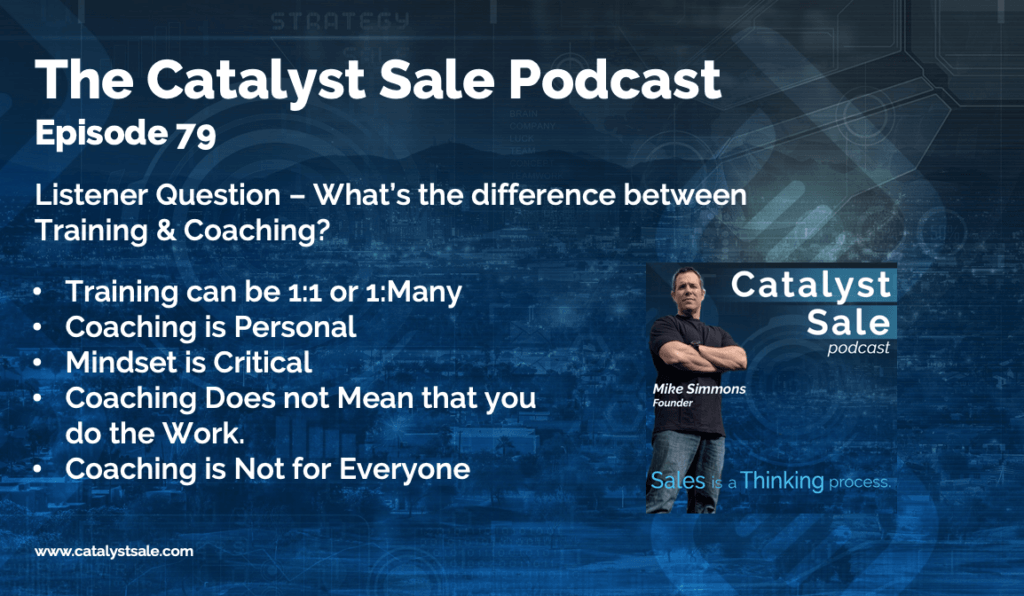
Is this a job for Coaching, Training, or Mentoring?

Getting better every day is something that many people discuss, however they fail in execution. The greatest athletes in the world rely on coaches every day – do you?

It is one thing to aspire to grow, aspire to improve, it is another thing to take action. Action starts with a single step, it requires movement. How do you know which direction to go? How do you know if you are taking the right actions?

“I suppose it is tempting, if the only tool you have is a hammer, to treat everything as if it were a nail.” – Abraham Maslow

A coach could be the critical tool in your toolset, but like most projects, you need to assess the situation and determine the best tool. It has been said that when you have a hammer, everything looks like a nail.  Other tools for consideration include training and mentoring, but how do you determine which is the best fit for the situation?

When I think about coaching, I think about finding someone who can help me make the subtle adjustments necessary to improve the things I do well today.  This could be as simple as foot position on a bike pedal, or as detailed as body language and voice inflection when speaking in front of a crowd. A coach is there to help you see the things that you cannot see yourself.  Sure, you can look in the mirror, but that is one perspective.  The mission of the coach, from my perspective, is to accelerate growth and performance. This happens by improving technique.  In order to make these improvements and recommendations, the coach must be there.


Talk with a Coach


What if it is too soon for a Coach?

Sometimes, you are too early in your career progression or the skill development progression to leverage the value of a great coach. You may be just starting out with a new skill or in a new role. If this is the case, training may be a better fit. Training provides a structured opportunity to learn a new skill or capability. The training should be focused on the reason behind the skill. It can be designed to introduce you to the topic, create an environment to put concepts into practice, and test retention.  Training can work really well 1:1 or 1:many.  Coaching, on the other hand, is better in a 1:1 environment.  Even with large groups or teams, the specific coaching you receive is personal.

What about a Mentor?

Mentoring is much more relationship-driven than coaching or training.  Sure, a coach should have a solid presence, however, it is not critical that you get along with your coach or the trainer.  The relationship you build with your mentor is critical. This relationship is mutual, it evolves over time. The mentor is there to help inspire thought, provide guidance, and share their personal and direct experience.

This is the first post of a series of posts focused on the differences between coaching, training, and mentoring.  Share your comments and personal experience with us at hello@catalystsale.com.

Interested in learning more – please check out this episode.

Fundamentals in Sales

The Fundamentals in Sales are Fundamental

Zig Ziglar is known for a number of things, including the foundational sales skills he shared with others.  How have the fundamental skills changed or evolved over time?  Have they, or are we simply repackaging many of the same old concepts?

Here are some notable Zig Ziglar quotes.

  • Your Attitude, not your aptitude, will determine your Altitude – Ziglar
  • You can have anything you want in life if you help others get what they want in life – Ziglar
  • If you can dream it, you can achieve it – Ziglar

We discussed Zig and the fundamentals in the above podcast – here are some of the questions addressed

  • How do the timeless classics impact development today?
  • How important is it to look back to the fundamentals of selling?
  • How did you cut your teeth in sales?
  • Who are the new leaders in this type of content?
  • Community Question – who do you recommend?

Key Takeaways

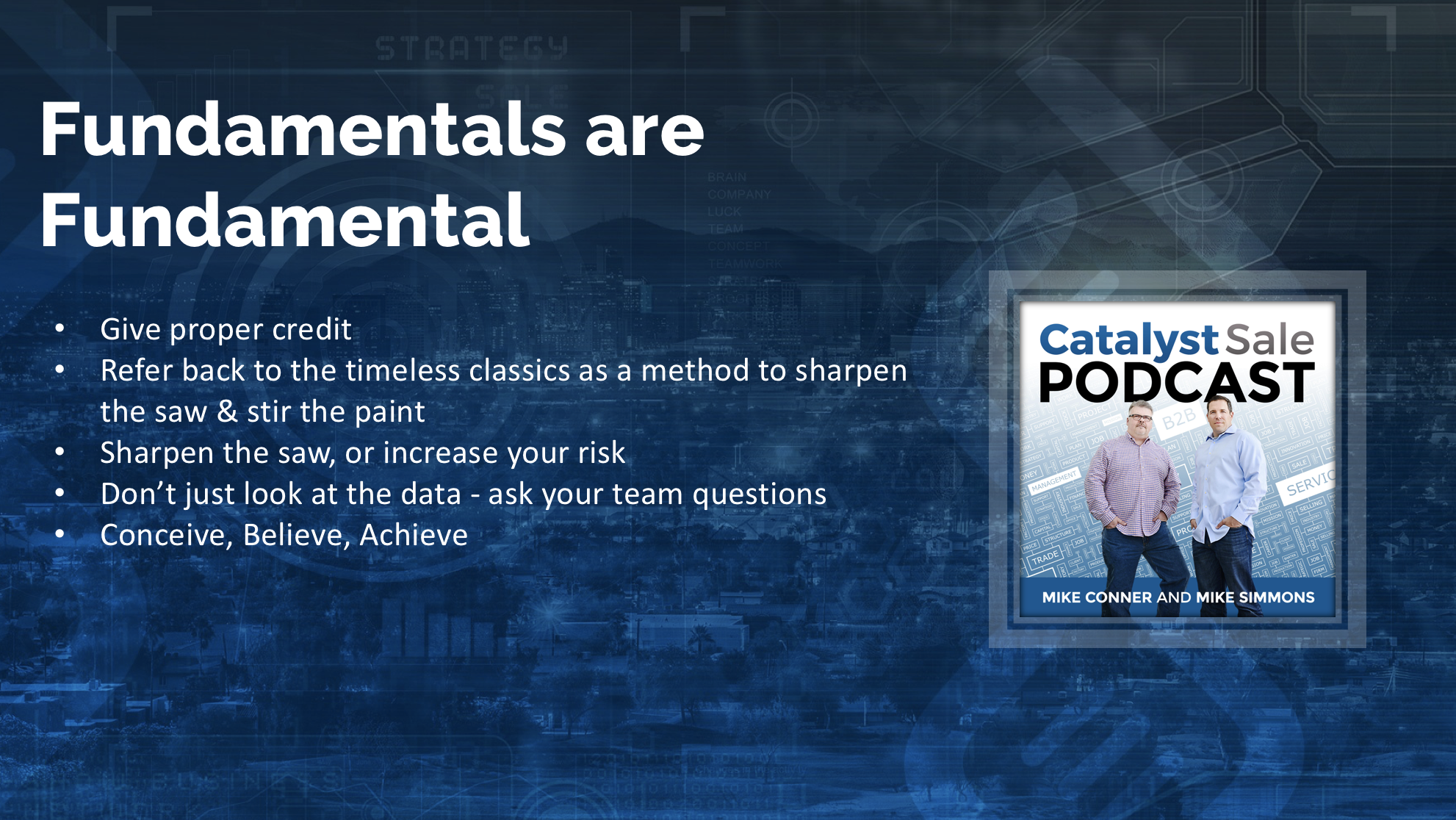
  • Give proper credit
  • If you do not go back and sharpen the saw, you increase your risk
  • Refer back to the timeless classics as a method to sharpen the saw & stir the paint
  • Ask the leaders in your organization for their thoughts on the fundamentals that have helped them get to where they are today. Ask them for their story.
  • Zig would not take 100K for his cassette player if he could not replace it – what are some of the things you would not give up for 100K, if you could not replace them?
  • Don’t just look at the data – ask your team questions
  • Conceive, Believe, Achieve

Thank you for sharing this episode.  If you like what you heard, please provide a rating and/or review via Apple Podcasts, Google Play Music, Stitcher, or your favorite podcast app.

Related Links

———————-

Catalyst Sale

In every business, in every opportunity, there is someone who can help you navigate the internal challenges and close the deal. There is a Catalyst.  We integrate process (Catalyst Sale Process), technology and people, with the purpose of accelerating revenue. Our thoughtful approach minimizes false starts that are common in emerging markets and high growth environments. We continue to evolve our practice based on customer needs and emerging technology. We care about a thinking process that enables results versus a process that tells people what to do.

Sales is a Thinking Process.

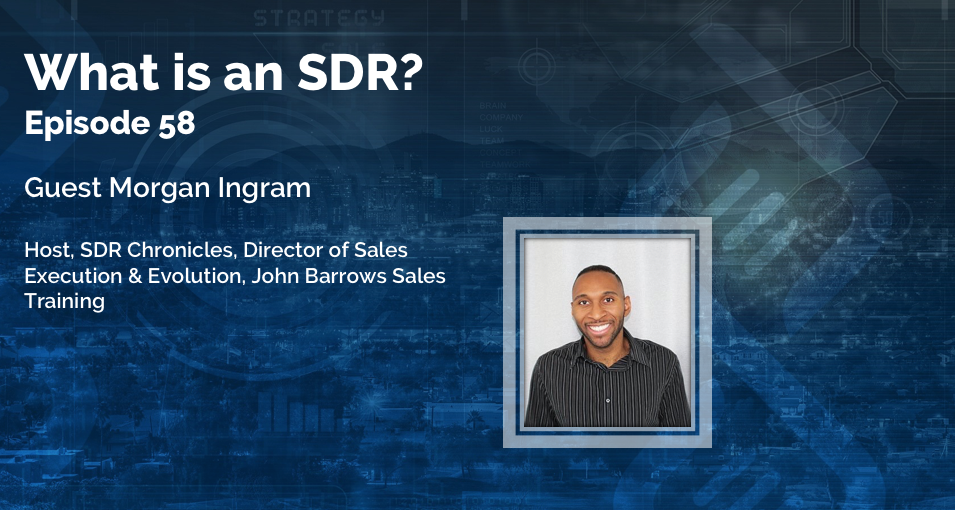
Episode 58 – What is an SDR? Guest Morgan Ingram

SDR - Morgan Ingram

Guest – Morgan Ingram, Host of the SDR Chronicles

The Sales Development Representative (SDR) role is another level of specialization within the sales function.  Some organizations have adopted this role and successfully integrated the position into their teams, while others struggle with success.  Many of the organizations who struggle with success have identified a breakdown in transition process between the SDR and the Account Executive role.  Sometimes this hand-off feels forced and is not customer focused.

This week on the Catalyst Sale Podcast, Morgan Ingram, host of the SDR Chronicles joins us to discuss the SDR, the evolution of the role, mindset, and being persistent.

What is an SDR?

SDR stands for Sales Development Representative (SDR) this is the tip of the spear from a sales team perspective.  In many organizations, the SDR is the first person the prospect speaks with.  The SDR is responsible for gathering initial qualification data from the customer.  Who are they, what do they do, what brought them to your website, what are they looking to accomplish, etc.

Once the initial information is gathered, the focus moves to establishing next steps, including scheduling the next call and transitioning the prospect to an Account Executive.

Where Does the Transition Fail

This seems pretty straightforward and should be seamless to the customer/prospect.  However, this is where things can get awkward.  Think about those times when you are working with customer service, you speak with the first rep, they escalate to the second or the third, and each time you have to repeat your story.  Don’t make this your customer’s problem.

Share clear notes with your teammates, set expectations with the customer/prospect, and execute.

Onboarding a new SDR/AE

When onboarding an SDR within your team, or an Account Executive, start with clarifying success criteria and expectations.  Each AE/SDR will have their own personality to apply to their role.  If you are an SDR and a new AE has joined the team, schedule a 1:1 conversation with the new rep.  Gain perspective from them regarding what type of data they would like to see on each customer as part of the hand-off.  Find out why the information is important to them, and how they plan to use it.

If you are a new Account Executive in an organization, and the SDR role is part of the structure of the sales team, get to know the team.  Ask what has worked in the past when it comes to SDR/AE transitions.  Be clear about your expectations, and how the information that is transferred impacts the sales process.

Remember you are a team – teams perform well when roles are defined, communication is clear, expectations are set, and adaptation is allowed to occur based on changing information.

Building Rapport

Building rapport is a skill, a skill that is customer focused, and requires that you take a personal interest in others.   Who are they, where do they live, why do they do what they do, etc?  This is not about pitching your product, you’ve not earned the right.  Take a breath, and learn about what is important to your customer.  (Dan Tyre talks about this in a previous post)

Making the transition from Colleague to Manager

The transition from colleague to manager is common.  Unfortunately, many people make this transition for the wrong reasons.  If your transition is driven by ego, and not based on a foundation of service, you are likely setting yourself up for failure.  As you make the transition into leadership, focus on how you can work for others.  Leadership is a service, not a mandate or right.

Success

Throughout this Morgan shared a number of concepts that have led to his success.  Some of these are mantras we all may want to consider integrating into our approach.

  1. Consistency Brings Results – If you don’t show up, you can’t show out.  You have to be there to be successful.  Yes, it’s a grind, but if you don’t show up, you cannot succeed.
  2. Sweat the details – the little things count
  3. Expand your view of Data – Monthly data may skew your perception of results, look at the quarterly numbers to help minimize the impact of anomalies.
  4. Steady mindset – good things will happen, or bad things will happen – know that the one constant is change. Trust your process.

———————-

Thank you

Thank you for rating and reviewing the podcast via iTunes, Google Play, or your favorite podcast platform.  Ratings & reviews help others discover the podcast – thank you for helping us get the message out to the community.

Please send listener questions and feedback to hello@catalystsale.com or contact us directly on twitterfacebook or LinkedIn.

Catalyst Sale Service Offerings

Growth Acceleration – Plateau Breakthrough

Product Market Fit

———————-

Subscribe to the Catalyst Sale Podcast

Subscribe via iTunes

Subscribe via Google Play

Catalyst Sale

In every business, in every opportunity, there is someone who can help you navigate the internal challenges and close the deal.  There is a Catalyst.  We integrate process (Catalyst Sale Process), technology and people, with the purpose of accelerating revenue. Our thoughtful approach minimizes false starts that are common in emerging markets and high-growth environments. We continue to evolve our practice based on customer needs and emerging technology. We care about a thinking process that enables results versus a process that tells people what to do.

Sales is a Thinking Process.

Sales Territory Planning That Works

the catalyst sale territory template

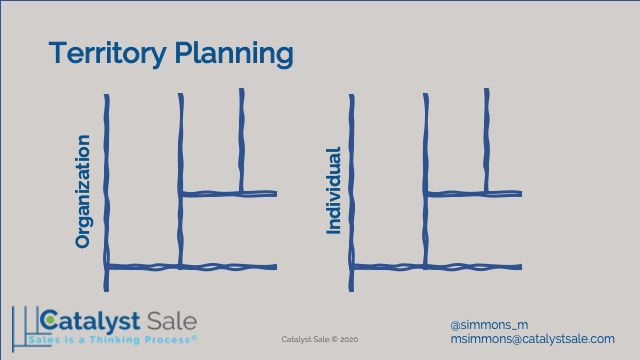
Territory Planning – A Catalyst Sale Approach

Territory planning is where it all begins.  You establish the outer guideposts for where you will focus your attention.  The broader this range is, the higher the risk.  The more targeted, based on data, the lower the risk.

How to Create a Sales Territory Plan from Scratch

Let’s say you have joined a new team, you have picked up a new territory, or you are asked to build your plan from a clean slate.  In this scenario, we’ll start with a blank whiteboard.

On the left side of the whiteboard, write down what you know about your “Ideal Customer”.  Who are they, why do they buy, what do they care about, why do they care about it, how does it impact their company (team, line of business, their role)?  (the who & the why.)

On the right side of the whiteboard, start with what you do really well.  Not an all-encompassing everything you do for your customers, but the three to five things that you do really well. (the what)

Use the middle of the board to start refining your target.  In the following scenario, we are delivering a sales enablement technology that supports onboarding of new sales professionals & educating existing professionals on new products that the company is bringing to market. Follow along to see how to complete your planning board.

Remember – Don’t Boil the Ocean

Who is your ideal customer?  The optimistic rep might say “anyone who has a sales team”.  This likely describes most organizations you are familiar with, and sounds good, but targeting this base would be the equivalent of trying to boil the ocean.

There are a number of organizations out there that have seen minimal growth in their sales teams over the past 24 months.  Some, through technology and specialization, may be shrinking this audience.  Others may be selling the same product to the same market for the past five to 10 years. These organizations are neither expanding their team nor rolling out new products to market.  They likely do not have a need for a sales enablement platform that supports onboarding new team members or educating existing team members on new products.

1. Defining Your Target Audience

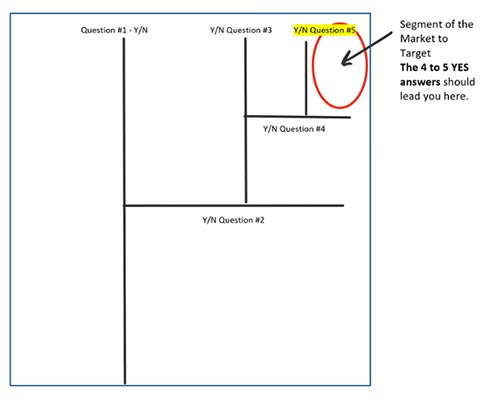
Now draw a vertical line down the center of the whiteboard – ask a Yes/No question that helps you distinguish between those who are in your market, and all others.  Your targets should fall to the right.  (An illustration follows)

Draw a perpendicular line to the first line, just to the right of your first line. Then, ask a second Y/N question that helps to further distinguish your target market. Your targets should now fall above the second line.  You are further segmenting your target market, and creating focus.  Repeat this process with a minimum of 4 questions.  This will help keep you and your team focused.

For Example
  • Question #1 – Organization has a sales team (Y/N)?
  • Question #2 – Sales team has grown in the past year, and based on organization growth, looks like they will continue to do so (Y/N)?
  • Question #3 – Organization continues to roll out new product capabilities to the market (Y/N)?
  • Question #4 – Organization has a “Sales Enablement” function (Y/N)?
  • Question #5 – Organization is located within my territory (Y/N)?

Territory segmentation

Our goal is to identify a singular target customer profile. Through this we will be able to focus our attention on a segment instead of attempting to boil the ocean.

The benefit of taking this type of focus is that customers who fit this segment should care about the same things. Their vocabulary may differ, but their business requirements are likely very similar.

2. Set Your Focus

Now you have identified your ideal customer.  The next step is to determine how many of these customers you should focus your attention on.  Again, the first response might be “every one of them” – why would I limit my success by only going after a handful?  This gets back to some of the discussions we have had around time management and to paraphrase a quote from Gary Keller & Jay Papasan in “The One Thing,” if you prioritize everything, you prioritize nothing.

If little is known about the market, I like to start with a simple number such as 10.  I will research 10 organizations, identify 10 targets, and focus there for the first 30 days.  For this example, let’s assume you already know these important things:

  • Average deal size is 250K
  • The length of Sales Cycle is 6 months
  • Your number for the year is 800K in new business.
  • Historically, you’ve closed 25% of the deals you have moved into Qualification
  • Your pipeline is empty

You will need to close 4 deals at an average of ~250K to hit your number this year to exceed your quota or close 3 deals to live to fight another day.  At a 25% success rate historically, you will need to have 16 opportunities in qualification by the mid-year point.  Based on taking a targeted approach, expect that 50% of the companies you target will move through validation to qualification.  This is the benefit of segmenting your market.  Using this math, within the first 6 months, you will need to engage with 32 companies.

You’ll notice – we worked the math out to target ~10 companies per month in the first quarter of the year.  This is intentional, it allows focus on 3 companies per week in the first month.

This approach scales, if the average deal size is 500K and the number is 1.2M, you need 3 deals.  If the average deal size is 10K, and your number if 300K for the year, you will need ~90 deals over the course of the year.  On the lower end of the spectrum the sales cycle is likely shorter.  On the higher end, it may be longer.

Contact us if you would like to schedule some time to discuss territory planning in your organization or your individual territory.

Let’s Talk

3. What if?

The numbers look great on paper, anyone can come up with some math to support an approach, but what happens if things change?  What if, when you begin engaging with your first 10 targets, you find that a competitor is in the market, and has already penetrated this target?  What if you find that no one is interested in the story, or the pain is not what you expect?

Adapt, Iterate, Repeat

John Boyd introduced us to the OODA loop – Observe, Orient, Decide, Act – REPEAT.  Today, we talk about Agile in the context of software development.  Historically, we have discussed agile in the context of sales.

Your territory plan is a living breathing document, just like the account plan. Take time to adjust and adapt your plan based on the things you learn, as you engage with your customers.

Is the sales cycle shifting to a 9 to 12-month sales cycle?  Increase the number of customers you engage with.

Are deal sizes larger than expected, but more complex than anticipated? Back off your number of targets, and focus on those who are further along in the sales process.

4. Dedicate the Time

The territory plan impacts your long term success.  It is something you control.  Yet so many of us look at this as a one-time event, driven by sales management at the beginning of each year.

Take 30 min to an hour, each week to revisit your territory plan.  Ask yourself what’s changed?  How is the plan working?  Is it still relevant?  If you do this for 1 hour a week, it is less than 2.5% of your workweek, assuming a 40-hour workweek.

As sales professionals, we do not clock in and clock out.  We ultimately are not measured by the number of hours we work, but by the sales we close.

Do the important things. 

If you do not have an hour per week to revisit your territory plan, I would argue that you probably need to allocate two to three times as much time to re-build your territory plan, or you need to expand your team because you are missing out on opportunities.

Looking for more direction? Let’s Talk.

SHOW LINKS
THANK YOU

Thank you for rating and reviewing the podcast via iTunes, Google Play, or your favorite podcast platform.  Ratings & reviews help others discover the podcast – thank you for helping us get the message out to the sales, account management, startup, sales enablement and customer experience community.

Please send listener questions and feedback to hello@catalystsale.com or contact us directly on twitterfacebook or LinkedIn.

Catalyst Sale Offerings

Growth Acceleration – Plateau Breakthrough

Product Market Fit

G+A+M+E Plan

Click Here to see our additional Catalyst Sale Podcast Topics

———————————-

Subscribe to the Catalyst Sale Podcast

Subscribe via Apple Podcasts

Subscribe via Google Play

Catalyst Sale

In every business, in every opportunity, there is someone who can help you navigate the internal challenges and close the deal. There is a Catalyst. We integrate process (Catalyst Sale Process), technology and people, with the purpose of accelerating revenue. Our thoughtful approach minimizes false starts that are common in emerging markets and high growth environments. We continue to evolve our practice based on customer needs and emerging technology. We care about a thinking process that enables results versus a process that tells people what to do.

Sales is a Thinking Process.

The LinkedIn SSI Score – Does it Correlate to Sales Success?

the proposal step

Host Question – What is an SSI Score?

Jody threw us a curveball this week, with his own question.  He has heard Mike and I give each other a hard time about our individual SSI score, and finally asked – what is an SSI score?  This prompted a discussion and a Catalyst Sale Research Project.

There’s an old saying in business – “Be careful what you measure, because what you measure is what you will get”. In the sales profession, we measure a number of things – from booked revenue, which is a lagging indicator of success, to several leading indicators tied to sales process velocity and opportunity valuations based on sales process execution.

We discussed some of these metrics on a previous podcast with Matt Ostanik

Click Here To Discuss How You Can Use Data to Address the Disconnect Between Sales & Marketing
There are also a slew of other things we measure, many of which are activity-based metrics. Ideally, these are things that if we complete them in a consistent way, can become predictors of our eventual sales success.

This final category can be the most daunting as we have to be certain that what we measure actually drives desired outcomes. For example, if we think that making a hundred outbound calls a day will result in our desired sales results, we will begin setting expectations and measuring outbound call activity. Or, we could measure the number of opportunities a sales development representative hands off to an account executive on a weekly basis. The possibilities are endless, and normally, the devil is in the details as a single metric rarely tells the whole story.

Not only do we measure certain activities, but we then model compensation plans and incentives around these metrics to ensure sales reps are focused on the right things. In some cases, we have gone as far as adding a “gamification” element into the mix to leverage our sales reps competitive nature. When done right, this can be a good thing. When done poorly, we can drive the wrong behaviors and ultimately miss our most important objective which is generating revenue.

LinkedIn SSI Score

Which brings us to a topic we have found very interesting in recent years. The LinkedIn Social Selling Index score. From a product perspective, it is a brilliant idea. Most sales leaders have bought into the fact that leveraging tools like LinkedIn to help drive social selling strategies is a necessary component of any B2B selling strategy, and the Social Selling Index score is designed to reward sales reps with a higher score if he or she engages with the platform. Due to our competitive nature as sales reps, we seem pretty motivated to obtain a higher score. In fact, for some people, it has become a badge of honor – many “social selling experts” often tout their scores, and mention how they rank among other gurus.

So this begs a few questions – and the reason for the Catalyst Sale SSI score survey. We want to answer the following question: Is there an optimal SSI score?  Some would suggest that the higher the better, but in our own experience in managing sales teams, we hypothesize there is a point of diminishing return in attempting to elevate your SSI score.

On this week’s episode of the Catalyst Sale Podcast, we discuss a research project we are kicking off at Catalyst Sale.  We are interested in gathering industry data on the LinkedIn SSI score.  Is there a direct correlation between the SSI score and individual or team sales performance?  Is there an ideal SSI score?

Important Links

Thank you for participating in the survey.  We will share the results with all participants who provide their contact information.  Data will be reported anonymously.

Thank you for listening to this week’s podcast. Please send listener questions and feedback to hello@catalystsale.com or contact us directly on twitterfacebook or LinkedIn.

Thank you for rating and reviewing the podcast via iTunes, Google Play, or your favorite podcast platform.  Ratings & reviews help others discover the podcast – thank you for helping us get the message out to the community.

———————-

Click Here to see our additional Catalyst Sale Podcast Topics

Catalyst Sale Service Offerings

Growth Acceleration – Plateau Breakthrough

Product Market Fit

Subscribe to the Catalyst Sale Podcast

Subscribe via iTunes

Subscribe via Google Play

Catalyst Sale

In every business, in every opportunity, there is someone who can help you navigate the internal challenges and close the deal. There is a Catalyst. We integrate process (Catalyst Sale Process), technology and people, with the purpose of accelerating revenue. Our thoughtful approach minimizes false starts that are common in emerging markets and high growth environments. We continue to evolve our practice based on customer needs and emerging technology. We care about a thinking process that enables results versus a process that tells people what to do.

Sales is a Thinking Process.

Episode 44 – Partnerships in Business, Sales, and Life

agile sale

CatalystSalePodcast

Teamwork Makes the Dream Work

John Maxwell famously wrote, “Teamwork makes the dream work”.  This is critical to our success as individual sale reps (account executives, account managers, SDRs, BDRs, sales leaders), and to Catalyst Sale as an organization.

This week on the Catalyst Sale podcast we talk about the importance of partnerships in business, and how finding the right business partners allows you to divide and conquer when necessary.  A good partnership, where the same skills are shared by those involved, can help you amplify your capabilities when needed.  A great partnership where skills and capabilities are complimentary, can allow you to spread resources and deliver more value than either person(s) could accomplish on their own.

In sales, and in life, it is important to leverage the strengths of the team.  The collective intelligence of the group provides an opportunity to learn from experience, minimize failures, prevent stalls, and increase your success.

A couple of important points discussed on today’s episode include
  • Identifying your internal partners
  • Building Rapport (also discussed with Dan Tyre)
  • The importance of diversity in partnerships (Dan Peter)
  • Never failing alone
  • Building your partnerships network before you need it.
We would love to hear from you
  • What are you doing in your organization today to foster a culture that leverages partnerships?
  • What partners have made an impact in your career?
  • How do you identify partners in your organization?
  • What impact can the community have on establishing partnerships?

Thank you for listening to this week’s podcast.  If you have questions about the Catalyst Sale approach, how we help organizations validate and identify product market fit and break through plateaus, you can reach us at hello@catalystsale.com

Please send listener questions and feedback to hello@catalystsale.com or contact us directly on twitter, facebook or LinkedIn.

Contact us today to learn more.

Schedule a Product Market Fit Discussion

Please send them to hello@catalystsale.com or contact us directly on twitter, facebook or LinkedIn.

Subscribe to the Catalyst Sale Podcast

Subscribe via iTunes

Subscribe via Google Play

Catalyst Sale

In every business, in every opportunity, there is someone who can help you navigate the internal challenges and close the deal. There is a Catalyst. We integrate process (Catalyst Sale Process), technology and people, with the purpose of accelerating revenue. Our thoughtful approach minimizes false starts that are common in emerging markets and high growth environments. We continue to evolve our practice based on customer needs and emerging technology. We care about a thinking process that enables results versus a process that tells people what to do.

Sales is a Thinking Process.


You can find us via LinkedIn, Twitter, & The Catalyst Sale Website on the links below

Mike Conner on Twitter

Mike Simmons on Twitter

Mike Conner on LinkedIn

Mike Simmons on LinkedIn

Catalyst Sale Twitter

Catalyst Sale on LinkedIn

Catalyst Sale Website

Episode 43 – Personality Data and Sales – Drew from Crystal Knows

TheConfirmationStep

CatalystSalePodcast

Guest – Drew D’Agostino – Founder, Crystal Knows

This week on the Catalyst Sale podcast Drew D’Agostino, Founder, Crystal Knows joins us to talk about building trust with your customers, prospects, and team members by understanding their perspective, tendencies, and personality type.

Crystal Knows works at the intersection of social science, technology, and communication. They use machine learning & natural language recognition to deliver personality assessments based on DISC.

Crystal Knows is embedded into our sales technology stack at Catalyst Sale.  We discuss how we use this technology to prepare for meetings, and communicate in general.   Our sales team and the teams we work with perform better as a result of this tool.  Crystal Knows is part of our call planning process.

Drew discusses how various personality types can work well together, and where conflict can occur.  We discuss common behaviors/tendencies of each of the 4 DISC profiles and touch on a couple of the 64 combinations of DISC profiles.

We share our DISC profiles, and how knowing this information helps Catalyst Sale communicate better with our clients, and internally.  It also helps us when we need to divide and conquer.

Why DISC

Because it teaches empathy. Empathy is the ability to share and understand another person’s feelings. To employ empathy is to be able to view another perspective in an authentic way.

The DISC personality assessment is the best resource for an individual to understand how to cater their behavior to the situation. The DISC framework gives us a more flexible, adaptive assessment and tools to understand and communicate more effectively as you go about your busy, hectic life.

To employ empathy is to be able to view another perspective in an authentic way.

Impact on Building Trust, Rapport, and Improving Relationships

The more you learn about the other types, the better you can understand how to remain approachable, how to be more assertive, how to lower your guard, and how to attract others to get your ideas heard.  As you improve communication, you can build rapport, accelerate trust, and build better relationships.

You need to earn the right to ask the questions you use when considering the Journalist Approach, or preparing for a Negotiation, or working through Qualification.

Learn More About Crystal Knows

Crystal helps you communicate more effectively. They build email and business apps on top of the largest, most accurate public personality database on the web. You can learn more about Crystal Knows by going to their website.  http://crystalknows.com/ On their website you can create your Crystal Knows profile, take the DISC assessment (Signing up is Free), learn about the application of DISC in the workplace, and search for people you know.  You can also connect with Drew via twitter @drewdagostino

Thank you for listening to this week’s podcast.  If you have questions about the Catalyst Sale approach, how we help organizations validate and identify product market fit and break through plateaus, you can reach us at hello@catalystsale.com

Please send listener questions and feedback to hello@catalystsale.com or contact us directly on twitter, facebook or LinkedIn.

Contact us today to learn more.

Schedule a Plateau Breakthrough Discussion

Please send them to hello@catalystsale.com or contact us directly on twitter, facebook or LinkedIn.

Subscribe to the Catalyst Sale Podcast

Subscribe via iTunes

Subscribe via Google Play

Catalyst Sale

In every business, in every opportunity, there is someone who can help you navigate the internal challenges and close the deal. There is a Catalyst. We integrate process (Catalyst Sale Process), technology and people, with the purpose of accelerating revenue. Our thoughtful approach minimizes false starts that are common in emerging markets and high growth environments. We continue to evolve our practice based on customer needs and emerging technology. We care about a thinking process that enables results versus a process that tells people what to do.

Sales is a Thinking Process.


You can find us via LinkedIn, Twitter, & The Catalyst Sale Website on the links below

Mike Conner on Twitter

Mike Simmons on Twitter

Mike Conner on LinkedIn

Mike Simmons on LinkedIn

Catalyst Sale Twitter

Catalyst Sale on LinkedIn

Catalyst Sale Website

Key Performance Indicators

tracking key performance indicators on a website

Key Performance Indicators – what works, what doesn’t, and where to start

This week on the podcast, we have a listener question from Jared in Florida.  Jared is questioning the Key Performance Indicators (KPIs) that are being measured by the organization and wonders how do you determine if you are measuring the right things.

What are KPIs?

Key Performance Indicators, in sales, refers to the way salespeople’s success is measured.

When it comes to sales, most of us are ultimately measured by performance vs. the number we are accountable to deliver.  Performance vs Quota or Plan is a good measure of success on a monthly, quarterly, and annual basis depending on your product, solution, or service. What if you want to go beyond the financials?  What are some of the other metrics you can track to illustrate or confirm success/failure?

How to choose Sales KPIs

It has been said many times, most attributed to Peter Drucker – “What gets measured gets managed.”  It has also been our experience that you need to be careful what you measure, because it may create unintended consequences.

When thinking about KPIs, begin with the end in mind.  

From a traditional sales perspective, you can look at each stage in the funnel, have a clear set of objectives and expectations, measure performance against each stage, and identify gaps/risk.  As an example, we use Funnelwise to help report on these metrics and help us identify opportunities for growth within individual territories and verticals.

Help Me Dertermine the Correct KPIs to Track

Traditional Sales KPIs include

  • Performance vs Plan
  • Performance vs Previous Year
  • Cost of Sale
  • Number of Opportunities Created
  • Number of Proposals delivered
  • Number of Presentations delivered
  • Number of Calls Made
  • Number of Meetings Scheduled
  • Number of Prospects Identified
  • Number of Pilots/Trials Started

What happens if you are pre-revenue, or you are still in the process of confirming product-market fit?  You can apply KPIs to user behavior.  As an example in a SaaS based product where engagement is expected, you may want to consider the following metrics.

User Behavior KPIs can include

  • Number of times a user shares content
  • Number of times a user clicks shared content
  • Number of times a user views content
  • Number of times a user enters the site per day/month/quarter
  • Number of new users who access the product per day/month/quarter
  • Number of users who return to the product per day/month/quarter
  • Number of times a user performs X behavior

When we think of these metrics we usually begin with the end in mind, what is the desired behavior, desired state, how do we measure success, what do we expect to see to indicate success.

You need to consistently be evaluating the KPIs that you choose and determining whether or not they are truly impacting the success of the business.

How often should you measure your KPIs?

Once the KPIs are defined, the next step is to establish frequency.  Is it critical that you look at your KPIs on a daily basis?  Depending on the business, it may be necessary.  KPIs should be segmented into Daily (if necessary), Weekly, Monthly, Quarterly, & Annual segments.  Investing time in the process of establishing KPIs, and tracking them over time, will help you to identify where you are succeeding, and where there are opportunities for improvement.

Many times we have seen situations where KPIs are established but are not being measured consistently.  This lack of consistency makes it difficult to evaluate success and make decisions based on data.

Create Personal KPIs

As an individual contributor, you can establish your own set of KPIs.  If you are interested in doing so, make sure they align with the organization’s objectives.   Communicate with your leadership team and colleagues to validate what you are measuring.  Continue to evaluate the viability of the measures, and share the data with your leadership team as you identify interesting trends.  Establishing individual KPIs can keep you on track, and drive performance.

When Key Performance Indicators are known throughout the organization, Performance vs Plan is shared, an environment can be created where the team (organization) is working toward a common goal.  There is nothing like being on a team who is in the know, who is brought in, and who is working toward a common objective.

Thank you for listening to this week’s podcast.  If you have questions about the Catalyst Sale approach, KPI definition, or have a question you would like us to answer on the podcast,  you can reach us at hello@catalystsale.com or, schedule a call with us to discuss our practice areas.

Set Goals and Achieve them with The Reset

Episode 30 – Sales Leadership: Can Transparency be a Productivity Killer?

agile sale

CatalystSalePodcast

Communication with your team is critical.
But, what’s the risk of over communicating?

Many times, leadership requires creating a buffer.  A need to shield your team from information, to improve focus. At the same time, your team can reach new levels in both creativity and impact if they have all of the details.

The importance of transparency is recognized by both new leaders, and those who have recorded a number of years of experience.    A common topic addressed by Jocko Willink, in his book Extreme Ownership & on his podcast, is decentralized command.  Decentralized command is impossible if the team does not understand the commander’s intent. Commanders intent requires transparency.

Is there risk in over communicating?  If so, are you being less than transparent?

In this weeks’ episode of the Catalyst Sale Podcast we discuss why transparency, from a sales leadership perspective, is important at Catalyst Sale.  We also discuss the risks associated with transparency, and why providing a buffer is critical when leading a high performing team.

Download the Sales Planning Templates Discussed on the Podcast
You can find us via LinkedIn, Twitter, & The Catalyst Sale Website on the links below

Mike Conner on Twitter

Mike Simmons on Twitter

Mike Conner on LinkedIn

Mike Simmons on LinkedIn

Catalyst Sale Twitter

Catalyst Sale on LinkedIn

Catalyst Sale Website