
Use Thought Leadership Marketing to Jumpstart Your Business Growth

Thought leadership has become a common topic in content marketing circles. But, do you really know what it means? One of the best definitions comes from Denise Brosseau’s Thought Leadership Lab:

“They (thought leaders) are changing the world in meaningful ways and engage others to join their efforts. They create evolutionary and even revolutionary advancements in their fields not just by urging others to be open to new ways of thinking, but when they create a blueprint for people to follow – they provide a method, process, guidelines or a set of best practices.”

That may sound overwhelming, but you’re probably already doing these things within your company. Thought leadership just means sharing that expertise with the outside world. And why do you need to share your learning with the world? Used correctly, thought leadership marketing can be a great way to jumpstart business growth and sell your products and services.

What is thought leadership marketing?

If thought leadership is knowing everything there is to know about your industry (and where things are going), thought leadership marketing means sharing that knowledge with others to help them achieve their own goals. It’s in high demand, too: According to Social Media Today, 96% of B2B companies want more content from industry thought leaders.

How can thought leadership marketing grow your business?

Getting your thoughts out of your head and into the world to build thought leadership can help your business to grow in several ways. These are just a few of them.

1. Building trust

People who aren’t sure of what they want or need usually love to have an expert let them know. And, if that expert shares knowledge freely, it builds personal trust. Your goal should be to become the go-to source in your field, the authority people turn to when they have questions.

Consumers who count on your thought leadership pieces for guidance are more likely to choose your product when they’re ready to make a decision. If you’ve been engaging with them on social media and answering questions about challenges they’re facing, you could (for example) even invite them to give you or your sales team a call to discuss how you can help more directly.

2. Gaining a better understanding of your audience

Your market data is a valuable asset, but it’s not the same as engaging with your target market on a personal level. This is why politicians host town hall meetings—so they can look at their constituents face-to-face and hear about their concerns straight from the proverbial horse’s mouth. When you engage with your followers directly, you’ll learn about their thoughts, questions, and points of view in their own words.

3. Shaping the conversation

You can also use thought leadership marketing to shape the conversation about topics of interest to the company or industry—for example, advocating for or against proposed regulations by explaining what the impacts would be. That’s thought leadership at its most powerful—not just establishing yourself as a subject matter expert, but guiding interested parties in the direction that is right for them.

4. Gaining exposure

Successful thought leadership creates a self-perpetuating cycle. The very best get calls from industry publications asking for quotes, and get invited to speak at conventions and seminars or to participate in panel discussions. That third-party recognition increases your status and authority even more.

How to get started with thought leadership marketing

Thought leadership marketing should be part of your overall marketing strategy, have its own place on your editorial calendar, and integrate with the rest of your marketing stack. Remember, the end game is to drive business growth by capitalizing on the fact that consumers feel more confident buying from someone with proven experience, knowledge, and vision.

Here are some of the most common channels for thought leadership marketing:

Bylined articles

Bylined articles are an extremely effective type of thought leadership marketing. You’ve probably read dozens of them in publications like Entrepreneur, Inc., etc. Rather than being written by a staff reporter, they’re written by a “contributor”—a thought leader offering expert insights on a topic that’s timely and relevant to the target audience.

Since these publications often have strict guidelines for the articles they accept, many bylined articles are written by a ghostwriter. The key, however, is to make sure the content and the “voice” are those of the thought leader; the ghostwriter’s job is to write the content in a way that will get it past the editor’s desk (instead of being thrown out for not adhering to their guidelines) and garner serious consideration.

LinkedIn

LinkedIn is another great place to publish thought leadership blog posts as well as to engage with other users by making comments or answering questions. Lastly,  don’t overlook LinkedIn Groups, which provide plenty of opportunities to engage with others who share your interests.

Social media

Social media is perhaps one of the quickest and easiest ways to offer thought leadership. For one thing, you can use it to promote your latest content. But, an even more effective use of social media is to engage with other users: join conversations, answer questions, and ask questions of your own to learn more about what your audience is interested in. You can even provide a link to one of your posts for additional information. Get some brand awareness and continue to build trust.

Webinars and podcasts

Webinars and podcasts have become increasingly popular, especially when they’re published on a regular schedule, because then the audience knows when to come back for the latest industry news, a deep dive on a particular topic, etc. Another good tactic is to participate in a well-known series on another site, like Moz’s Whiteboard Friday.

Using thought leadership marketing to drive business growth

Thought leadership marketing can help drive business growth by building trust in both your organization and in you as a leader. Moreover, taking just a few extra steps can turn it into a real growth machine:

  • Send your sales team every piece of content (preferably in a digital format they can share) before it’s published. That will give them time to absorb it so they can discuss the information with leads.
  • Provide them with a schedule of upcoming events, such as the dates of conferences where you’ll be a presenter or attendee.
  • Since they’re in direct contact with customers every day, ask them for suggestions on future thought leadership topics.

In a time of content overload, true thought leadership stands out like a guiding light, something real and substantive that makes customers want to do business with you. We here at Catalyst Sale can show you how to use thought leadership marketing to drive business growth, and we’ll be right by your side as you do it, adding our expertise to yours. Give us a call today to find out more.
Sales and Marketing Mastermind

Learn from your peers

“None of us is as smart as all of us”
– Ken Blanchard

Have you ever felt like you were the only one struggling with your current challenge?

The collective intelligence and experience of your peers will help you shift perspective and overcome blind spots. Masterminds are a great catalyst for change, provide an awesome opportunity to network, and a chance to think differently about the challenges you are facing.

This year we will kick off a series of Masterminds in select cities.

Our first mastermind will be held on August 17th in Orlando.

  • Do you know where your sales growth will come from in the next 6, 12, 18, 24 months?
  • Are you struggling with clarifying your message within the marketplace?
  • Is Sales, Marketing, or Revenue Operations a black box in your organization?

Mastermind Interest List

How can a team of motivated professionals help you succeed?

You are not alone. Most sales and marketing challenges are a function of understanding your organization and how you execute, understanding your customer and how they identify problems and uncover solutions, or understanding your customer-facing team and how they repeat success.

Let’s stop overcomplicating things, and execute.

Never doubt that a small group of thoughtful, committed citizens can change the world; indeed, it’s the only thing that ever has.
– Margaret Mead

Join a group of highly motivated CEOs, Founders, Business Professionals who are interested in thinking differently about addressing the challenges associated with marketing and sales.

We hope to see you there.

Jody & Mike

Looking for Ways to Improve your Planning and Execution?

Execution is critical for a high performing team. In sales, it is easy to determine success. Did you achieve your number or not? Forecasting is another important aspect. Accurate forecasts help your team with investment decisions, accurate forecasts create predictability in revenue, accurate forecasts build trust.

We discussed the importance of process and why your Sales Process and the Customer Decision Making Process are different, on the following episode of the Catalyst Sale Podcast.

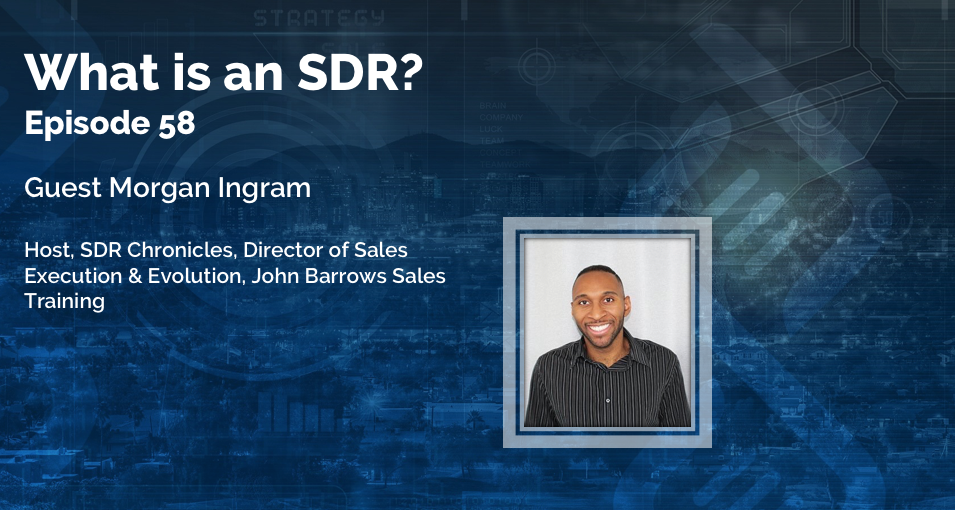
Episode 58 – What is an SDR? Guest Morgan Ingram

SDR - Morgan Ingram

Guest – Morgan Ingram, Host of the SDR Chronicles

The Sales Development Representative (SDR) role is another level of specialization within the sales function.  Some organizations have adopted this role and successfully integrated the position into their teams, while others struggle with success.  Many of the organizations who struggle with success have identified a breakdown in transition process between the SDR and the Account Executive role.  Sometimes this hand-off feels forced and is not customer focused.

This week on the Catalyst Sale Podcast, Morgan Ingram, host of the SDR Chronicles joins us to discuss the SDR, the evolution of the role, mindset, and being persistent.

What is an SDR?

SDR stands for Sales Development Representative (SDR) this is the tip of the spear from a sales team perspective.  In many organizations, the SDR is the first person the prospect speaks with.  The SDR is responsible for gathering initial qualification data from the customer.  Who are they, what do they do, what brought them to your website, what are they looking to accomplish, etc.

Once the initial information is gathered, the focus moves to establishing next steps, including scheduling the next call and transitioning the prospect to an Account Executive.

Where Does the Transition Fail

This seems pretty straightforward and should be seamless to the customer/prospect.  However, this is where things can get awkward.  Think about those times when you are working with customer service, you speak with the first rep, they escalate to the second or the third, and each time you have to repeat your story.  Don’t make this your customer’s problem.

Share clear notes with your teammates, set expectations with the customer/prospect, and execute.

Onboarding a new SDR/AE

When onboarding an SDR within your team, or an Account Executive, start with clarifying success criteria and expectations.  Each AE/SDR will have their own personality to apply to their role.  If you are an SDR and a new AE has joined the team, schedule a 1:1 conversation with the new rep.  Gain perspective from them regarding what type of data they would like to see on each customer as part of the hand-off.  Find out why the information is important to them, and how they plan to use it.

If you are a new Account Executive in an organization, and the SDR role is part of the structure of the sales team, get to know the team.  Ask what has worked in the past when it comes to SDR/AE transitions.  Be clear about your expectations, and how the information that is transferred impacts the sales process.

Remember you are a team – teams perform well when roles are defined, communication is clear, expectations are set, and adaptation is allowed to occur based on changing information.

Building Rapport

Building rapport is a skill, a skill that is customer focused, and requires that you take a personal interest in others.   Who are they, where do they live, why do they do what they do, etc?  This is not about pitching your product, you’ve not earned the right.  Take a breath, and learn about what is important to your customer.  (Dan Tyre talks about this in a previous post)

Making the transition from Colleague to Manager

The transition from colleague to manager is common.  Unfortunately, many people make this transition for the wrong reasons.  If your transition is driven by ego, and not based on a foundation of service, you are likely setting yourself up for failure.  As you make the transition into leadership, focus on how you can work for others.  Leadership is a service, not a mandate or right.

Success

Throughout this Morgan shared a number of concepts that have led to his success.  Some of these are mantras we all may want to consider integrating into our approach.

  1. Consistency Brings Results – If you don’t show up, you can’t show out.  You have to be there to be successful.  Yes, it’s a grind, but if you don’t show up, you cannot succeed.
  2. Sweat the details – the little things count
  3. Expand your view of Data – Monthly data may skew your perception of results, look at the quarterly numbers to help minimize the impact of anomalies.
  4. Steady mindset – good things will happen, or bad things will happen – know that the one constant is change. Trust your process.

———————-

Thank you

Thank you for rating and reviewing the podcast via iTunes, Google Play, or your favorite podcast platform.  Ratings & reviews help others discover the podcast – thank you for helping us get the message out to the community.

Please send listener questions and feedback to hello@catalystsale.com or contact us directly on twitterfacebook or LinkedIn.

Catalyst Sale Service Offerings

Growth Acceleration – Plateau Breakthrough

Product Market Fit

———————-

Subscribe to the Catalyst Sale Podcast

Subscribe via iTunes

Subscribe via Google Play

Catalyst Sale

In every business, in every opportunity, there is someone who can help you navigate the internal challenges and close the deal.  There is a Catalyst.  We integrate process (Catalyst Sale Process), technology and people, with the purpose of accelerating revenue. Our thoughtful approach minimizes false starts that are common in emerging markets and high-growth environments. We continue to evolve our practice based on customer needs and emerging technology. We care about a thinking process that enables results versus a process that tells people what to do.

Sales is a Thinking Process.