A Failure to Plan is a Plan to Fail – Ben Franklin
Would you like to improve communication across your team? What about with your customers? How does this change when thinking about internal vs external customers?
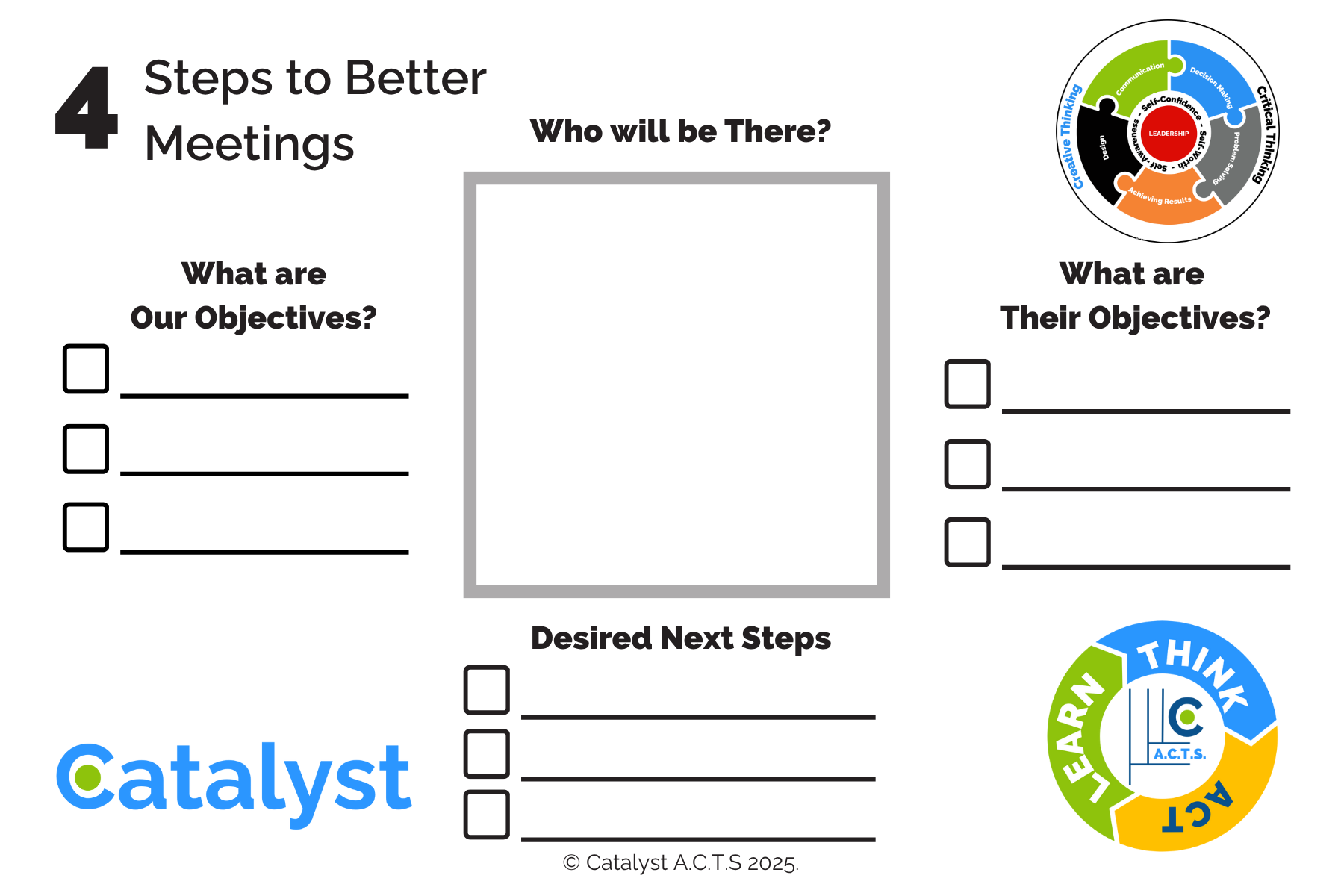
These questions can inform next steps. This call plan tool is how I improve communication quickly within the teams that I work with. And, it is how we prepare for meetings, events, and content creation
Looking for Ways to Improve your Planning and Execution?
Execution is critical for a high performing team. In sales, it is easy to determine success. Did you achieve your number or not? Forecasting is another important aspect. Accurate forecasts help your team with investment decisions, accurate forecasts create predictability in revenue, accurate forecasts build trust.
We discussed the importance of process and why your Sales Process and the Customer Decision Making Process are different, on the following episode of the Catalyst Sale Podcast.
As we near the end of another year, it is natural for people to feel a bit apprehensive.
Some have had a great 2021 and are unsure if they can equal or top what they have accomplished. Others have had a year they would rather forget and wonder if they are in for more of the same in the coming year. Individuals, families, companies – all have the potential to feel unsure about what is ahead.
Catalyst Sale in 2022
At Catalyst Sale, we have decided that in the New Year, we are going to cut through the BS and noise, meet people where they are and help in whatever capacity we are able.
Find My Catalyst exists to help individuals, teams, coaches, athletes, and families find the light and the spark that makes them, them. And, once that spark is found, provide them with the tools necessary to make an impact and a difference in their lives, their family’s, their community, and beyond.
Additionally, we have a soft spot in our hearts for student athletes (having two ourselves) and so a section of Find My Catalyst will be focused on reaching athletes, teams and coaches.
The Podcast
For those of you that have been following us for awhile, you may have noticed that we recently changed the name of our podcast to Find My Catalyst. We believe this offers us the opportunity to reach more people and to bring you more diverse content. For you sales folks, don’t worry, sales content will still be included.
We are looking forward to 2022 and a year full of Catalysts who aren’t afraid to find and share their light, their shine and their spark with others.
Please take a moment to share with us what you are looking for in the New Year via this Survey
Golf is one of those games where your mindset can make or break a round. There are a number of correlations between golf and life, golf and sales, sales and life, and life and business.
How do you approach the pin? Well, if you have never played golf, this might be a tough question, or it may not be very clear. The pin is a specific objective. It’s known by a number of names including the hole, the flag, or the stick.
The late great golf pro Harvey Penick, has a saying – “Take dead aim.” This is a mindset, a mindset of focus.
“Take Dead Aim” Harvey Penick
The above image is the 17th hole on a golf course in Arizona. It is inspired by the 17th hole at TPC Sawgrass. It is a pure 9-iron to the middle of the green. All-day, every day. Some days, noise can enter the equation. It is the type of noise that gets in the way. It could be wind, rain, or the large amount of water between the tee box and the island green.
This noise does not change the fact that there is still a pin you are shooting for, a ball that you have addressed, and a golf club in your hand.
Have a mindset of focus. The ability to clear your mind of distractions can help. When you see your objective – Take Dead Aim.
What happens when adversity strikes?
Do you take advantage of every opportunity? Do you commit? or… Do you fold?
Excerpt from “The Obstacle is the Way” – Ryan Holiday
The above story from Ryan Holiday’s The Obstacle is the Way – is a personal favorite. If you witnessed your work, your dreams, go up in flames, would you take advantage of the opportunity to see something amazing, or miss out on the experience?
Internal vs External Locus of Control
Carol Quinn – in her book on Motivation Based Interviewing discusses internal vs external locus of control. She also discusses this on episode 96 of the Catalyst Sale Podcast.
External Locus of Control – believe that failure/success/rewards/outcomes in life are generally outside of their control.
Internal Locus of Control – believe that their own actions determine the success/rewards/outcomes that they obtain.
I like to summarize this as “Oh crap, Not again. Why does this happen to me” = External Locus of Control.
While, “Ok, I understand the situation – Let’s Go” = Internal Locus of control.
Shift Your Perspective
The next time you run into a challenge, you experience conflict or something does not go your way, pause, take a breath – and ask “Is this happening to me? – Is it truly out of my control?” – or “Is this simply happening around me, and are there aspects I can control or influence to move things forward?”
So What?
If you Take Dead Aim, and Take Control of Your Thinking, and Shift Your Perspective – you will put yourself in a position to win.
Sales targeting is the practice of setting objectives for your team. Most folks will think about this in the context of setting quotas. Quotas are really another way of looking at goals. The target, quota, goal – may be a daily, weekly, monthly, quarterly, or annual goal.
This is usually dependent on the nature of the business. In the enterprise space, with longer sales cycles, annual targets make the most sense from my perspective. In a more transactional environment (i.e. Point of Sale, Fast Food, etc), with shorter sales cycles – one could argue for daily objectives.
The real answer is likely someplace in between for your business.
Examples of Sales Targets
When thinking about sales targets – I prefer to use financial targets. Specifically, the financial target for the Month, Quarter, or Year. In an emerging market, it might make sense to use non-financial targets. i.e. Meetings, Opportunities, Commitments. As you gather data, determining your financial targets will get easier.
For a mid-market sales professional, with an annual plan of 600K in new business, they might have a 50K per month target, or a 150k quarterly target.
These targets might be modified based on seasonality in the business. Let’s say 50% of your annual number comes from the 4th quarter of the year. The mid-market sales professional above might have 100K Q1 target, 100K Q2 target, 100k Q3 target, and 300k Q4 target.
Adjust based on what you know about your business.
Why is Sales Targeting Important?
Establishing targets is important, it’s the first step in clarifying your goal & your teams goal for the year. Once the goal is established, the team can design their approach to execute on the goal. This plan will help you create focus on what you (and your team) will do next. It will also be useful when you reflect on progress to date.
How to Set Sales Targets
If you ask 10 VPs or Directors of Sales how they set targets, you’ll likely get the following three responses:
Start with your annual objective for the organization, add 20%, and distribute the objective across the team.
Take your annual objective for the organization, and distribute across the team
Use the performance from last year, add x% of growth, and distribute it across the team.
There are many ways to address this challenge. My preference is to take a combination of 1 and 3.
The individual plan/target for each member of your team, should equal more the 20% of the organization’s plan for the year. I like to use historic performance to refine modeling and expectations across the unique teams and individuals.
Sales Comp Plan Calculator
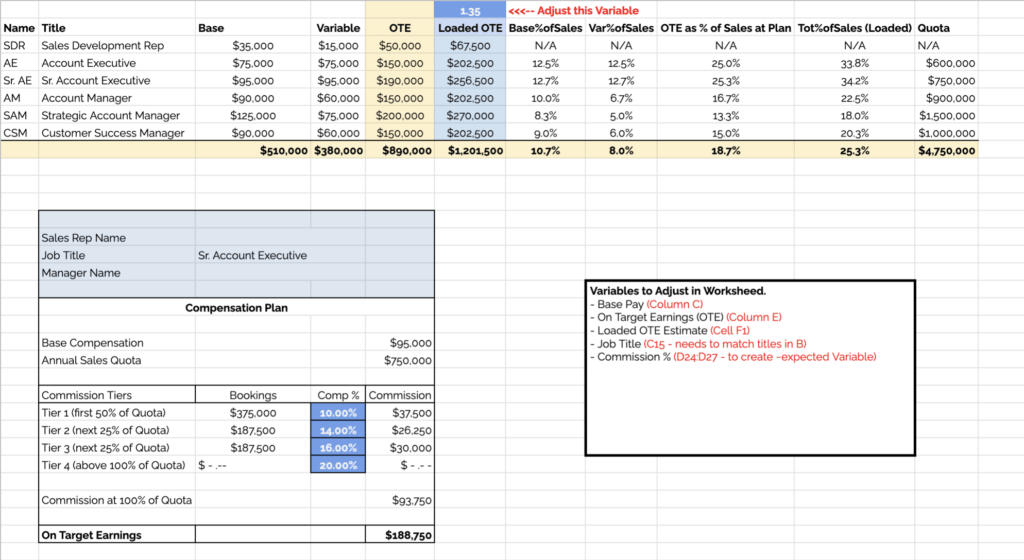
I have created this sales comp plan calculator for easy calculations of sales targets at every level. In this calculator, we take into consideration base pay, commission, and variables when determining the quota for each position.
When Should Sales Targets Be Set?
Sales targets should be established in the last month before the end of your fiscal year and should be finalized within 30 days after the beginning of your fiscal year.
Ideally, you and your finance team should begin conversations about the following year plan at the beginning of the last quarter of your current fiscal year. You can leverage forecasting to begin to set expectations and consider how the team should be organized going into the following year.
Sadly, it is common for organizations to delay the launch of comp plans and targets for the current fiscal year/sales year, until late into Q1. This highlights a gap in planning, coordination, and preparation.
How to Exceed Sales Targets
In order to hit your sales target, you have to have a strategy.
FIRST – What is the number you want to hit? SECOND – What is your average deal size? THIRD – What is your close rate? FOURTH – How long is the sales cycle?
Now, do the math. With what you currently have in the pipeline, what is your current projection? How many people do you need to add to the pipeline?
Set Your Sales Targets for 2021
Now is the time. If you operate using a traditional calendar year, it’s time to get those 2021 Sales Targets in place.
Take the next 24 hours. Review your performance to date, and compare it against where you thought you would be at this point. Are you ahead of plan, behind plan, right on target?
Once you have your current state established, it’s time to take a look at the future. Do you expect 20% YoY growth? 100%?
Establish your desired state, and let’s build the plan.
Create a Sales Plan for 2021
We know our current state (historic performance), and we have established our desired state (next year’s goal). How can you improve the likelihood of success?
It starts with Focus (the goal), Clarity (the metrics), and Action. If you align the actions that will help you achieve your goal, and the metrics that you will use to hold yourself accountable, you will improve the likelihood of your success.
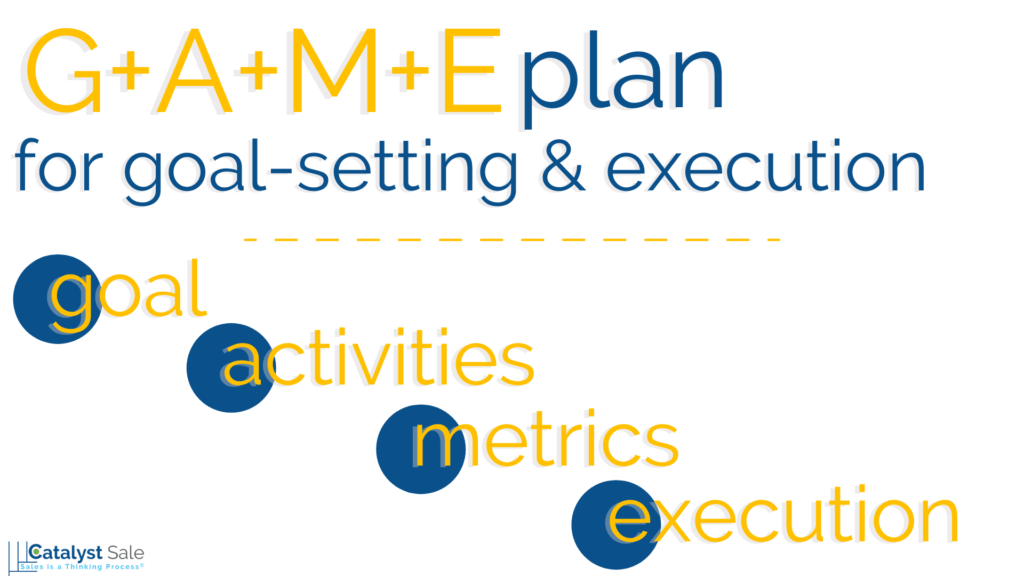
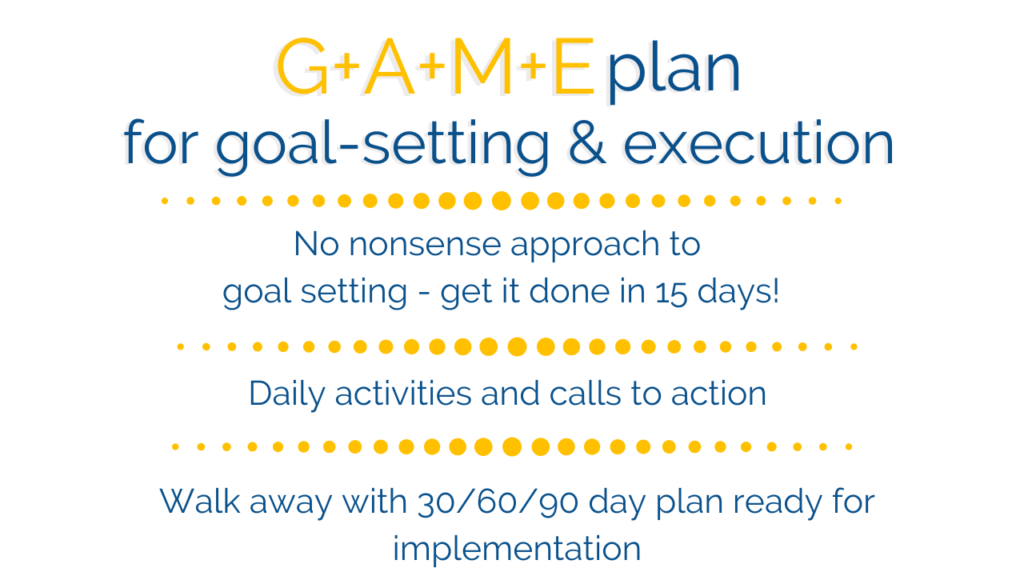
We’ve created the G.A.M.E. approach to goal setting and execution, through clarity and focus, which is designed to help you do this.
Revenue operations is a topic that we are seeing come up more and more often. I want to put my thoughts out there.
So we can get started on the right foot, let’s start with a definition.
What is Revenue Operations?
Revenue Operations, often called RevOps, is the active processes and functions used to generate revenue within a business.
Revenue Operations in practical terms refers to the people, process, technology (systems/tools), that you have in your organization that facilitates revenue growth. This includes demand generation, revenue generation, revenue retention, revenue growth.
Where Most People Start with RevOps
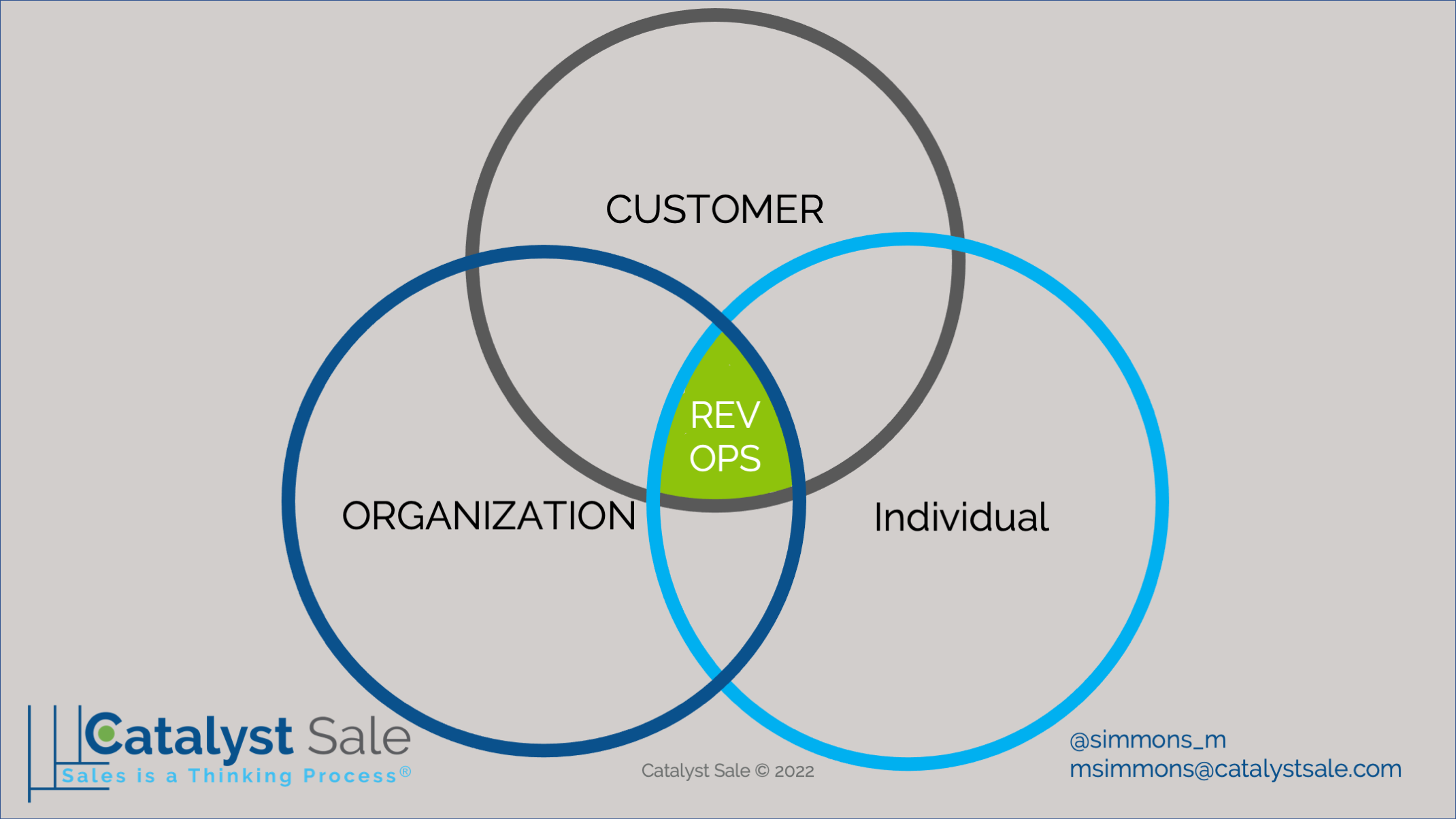
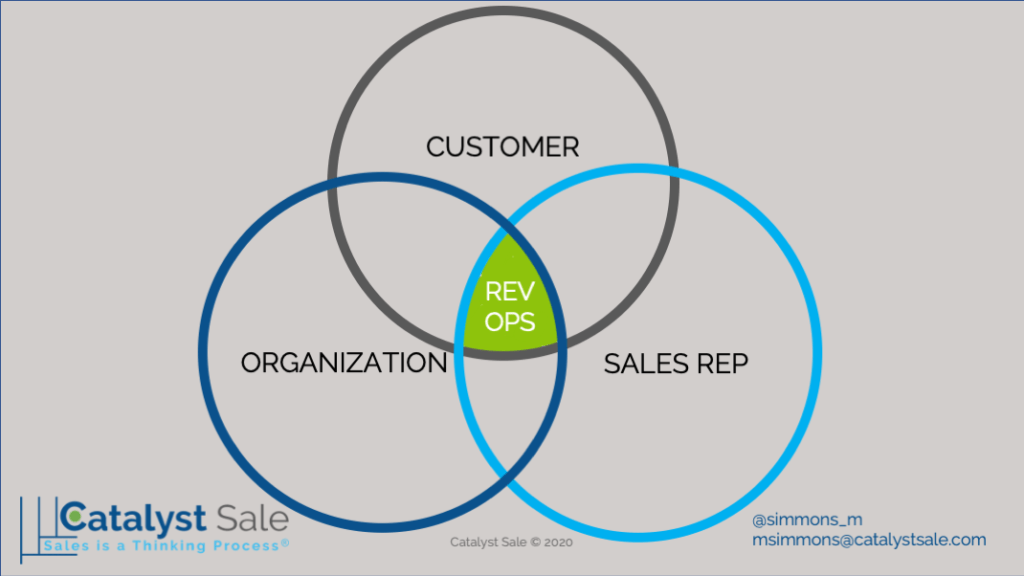
Many organizations attempt to solve this very complex problem through the lens of either the customer, the organization, or the rep. Very few have taken the time to understand this challenge from all three viewpoints.
RevOps – the active processes and functions used to generate revenue within a business.
The Customer
There is a lot of talk these days about empathy. There is a lot of talk about designing for and/or aligning to the buyer journey. As Inigo Montoya famously said in the Princess Bride – “You keep using that word. I do not think it means what you think it means.” This is in response to Vizzini’s “INCONCEIVABLE” after one of many attempts to kill the Man in Black.
This is the scene that comes to mind for me when many folks drone on about Buyer Journey & Empathy.
Questions to ask yourself:
Do you know how your customers make the decision to buy?
Where do they start?
What obstacles do they have to overcome?
I get it – these seem like pretty simple questions – what happens when you start writing the answers down though? Does the scope of your ideal customer expand/creep, or does it get further refined? Do the answers create clarity & focus, or do things get fuzzy?
Your Organization
How does the view change when speaking with marketing, operations, sales, customer success, finance?
Let’s also think about this in the context of the following question.
Where will your business come from in the next 90/180/270/540 Days?
Where will you Invest?
How will you KNOW when to do so?
The Sales Rep
When assessing RevOps from the Sales Rep perspective, consider the following:
What’s unique about how your sales reps operate?
How do they execute?
Do they have an approach that is repeatable?
Is there another perspective on Revenue Operations?
Of course there are multiple perspectives when thinking about the Revenue Operations problem.
We can look at it from the perspective of the person who is feeling, thinking, doing. The individual. We can also look at this problem through the lens of the business challenge we are attempting to solve.
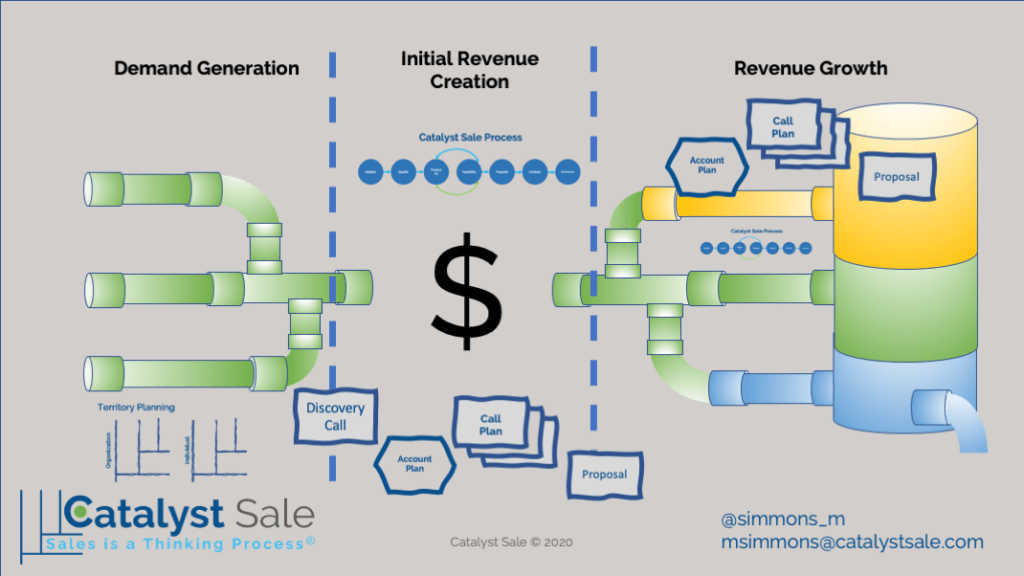
We work with our clients to address these challenges in three buckets. Demand Generation, New Customer Acquisition, and Retention and Growth. If you have been following the blog or the podcast – you’ll be familiar with the following image.
This can be a bit overwhelming. What happens if we remove some of the noise, and focus on one problem – “Initial Revenue Creation” or New Customer Acquisition.
If this is the problem we are solving for, there are a couple of ways we can address the challenge.
For Instance, what if we are solving for Demand Generation?
Let’s say that the issue is specific to pipeline development – meaning you are executing well further down the funnel. We can take a look at the three demand generation pipes.
1:Many – Marketing/Demand Generation (Gen)
1:1 – Sales Rep Outreach/Referral Demand Gen
Channel – Demand Gen via Referrals and Partners
Problem Solving Techniques
The above are some examples of how we can isolate for specific variables, and apply problem-solving techniques to complex challenges.
You do not solve complex problems with complex solutions. You solve them with simple solutions. Simple solutions that you can test, repeat, and iterate as necessary.
Some questions that can help you get on the right track when thinking about Problem Solving
What Problem Are We Solving For? – Define the problem, identify and clarify the “WHAT”
Why Is It Important for US to Solve this problem? – The WHY behind it
How have we attempted to solve the problem? – HOW have we attempted to solve, but failed?
How might we solve the problem in the future? – HOW can we change our approach, and test new things?
It’s time to think differently about the Revenue Operations problem and take a clinical approach to solve it in your organization.
I was fortunate enough to work with a retired Col. early in my career. There are a number of statements Chuck made that have stuck with me over my career.
The first – “Be Bright, Be Brief, Be Gone” – when briefing others. This was likely borrowed from President Woodrow Wilson’s “Be Brilliant, Be Brief, Be Gone”.
Providing Guidance, Direction, and Motivation
The second – “Leaders provide Guidance, Direction, and Motivation” – Col. Charles Schluter
My personal leadership journey has gone from…
Theory X to Theory Y –> to People follow charismatic folks –> to do as I say, not as I do –> to my way or the highway –> … I think you get the point.
I’ve evolved, we all evolve.
Throughout my work and life, I’ve been fortunate enough to work with and be around some amazing leaders. Work for amazing leaders. And, work with some really bad leaders.
Fortunately, I have learned something from each of these experiences.
Back when I was at UPS, in my first “supervisor” role, I was focused more on the operation than on the people. It was so bad that someone on the leadership team felt compelled to give me a book “Managing from the HEART.” It was a good read, and timely for me.
Today, we have a VOID in leadership. This is felt inside some early-stage companies, it’s felt in some really large companies, among teams, and it’s felt across our country. It’s a global challenge.
So – how do we address the challenge. As usual, let’s break the problem down into a smaller set of items, and focus on a couple of keywords.
Some Context and Expectation Setting
There are many ways to look at leadership. “Thought Leadership” is a term that is thrown around often these days. Regardless of whether we are talking about thought leadership, leading people, leading yourself, leading teams, leading your dog, leading your community, leading with technology, the following words and concepts will apply to each.
The weighted impact of each word may vary depending on your focus. Ultimately when you put each of these words together – you can create your own Leadership Stack.
This is a carry over from the series started on LinkedIn earlier this week.
The Leadership Stack – What are Your Words?
Leadership
Leadership is a topic that is very important to me. So much so that we have covered it multiple times, through many lenses, with many people on the Catalyst Sale Podcast.
What is Leadership?
According to the Oxford Dictionary – Leadership is…
the action of leading a group of people or an organization
the state or position of being a leader.
the leaders of an organization, country, etc.
Let’s break that down a little further.
Leader (Noun) “the person who leads or commands a group, organization, or country.”
Lead (Verb) “be in charge or command of.” (organize and direct.)
Let’s agree – for the purpose of this blog post – that leadership is an action, an action of leading self (1:1), leading other people (1:1), and leading teams (1:many).
Communication
When you hear the word communication, what comes to mind?
For me, it is the act of conveying information. This information can be conveyed (moved from one place/person to another) via a number of different formats. Voice (think podcast, phone calls, radio), Visual (video, animation, images, whiteboards, body language), or Written (blog post, email, books, articles).
There are a number of ways to communicate (think non-verbal vs verbal) – we communicate with ourselves, our family, our pets, our teams, yet as Jody Maberry states in the following podcast – one of the most common mistakes in communication is “believing it happened”.
What checks can you put in place to help make sure that communication has actually happened?
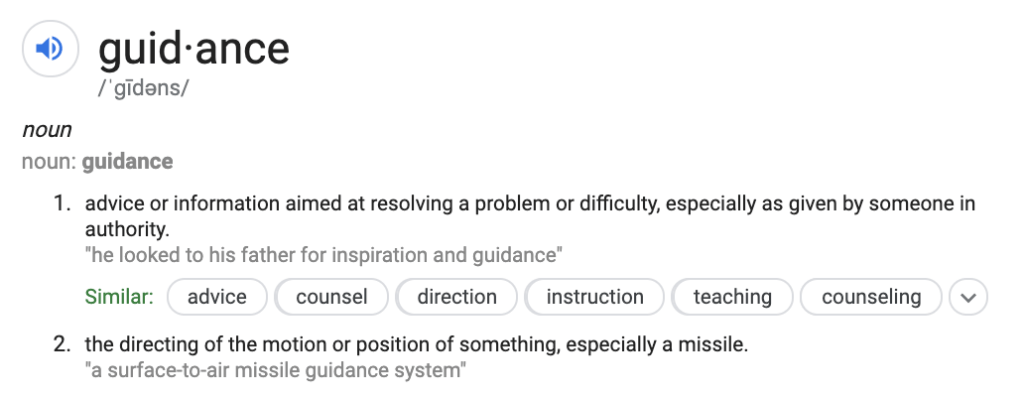
Guidance
Oxford Dictionary Definition
When you think of the word Guidance, what comes to mind? There are three core ideas that come to mind for me.
Guide – to provide some type of advice or direction (see next definition)
Guidance Systems – mechanical processes/technology – such as the ones used in GPS systems
Help – provide some level of assistance based on your understanding – this is not doing – it is more like showing.
I think it is critical to repeat and highlight that guidance is not doing. It is showing, it is nudging, it may even be as deliberate and direct as providing guardrails that help guide something in a given positive direction.
Imagine the gutter-rails that you can put up in a bowling alley.
How are you applying guide rails when you provide guidance to yourself, individuals, or your team?
Direction
So, if we are providing some level of guidance – it’s important that we know which way we are going – right?
If you are at the helm of a boat, and you want to go both east and west – how likely are you going to get where you want to go? How much progress will you make if you alternate between east and west?
What happens if folks inside your organization think you are going one way – i.e. all in on enterprise sales, but you continue to develop product that meets the needs of the SMB maket, because it is easier or faster to develop?
Is it a stretch to think that this might happen? I don’t think so, imagine a situation where the development team is measured on the number of tickets that are closed or features that are developed.
Will they invest more time, energy, resources, in features that ship fast?
Or, will they invest more time, energy, resources, in features that might take longer to develop, but will have a greater impact on success in the enterprise space?
What type of direction are you providing to yourself, the individuals in your organization, the teams within your organization?
Motivation
What is the catalyst that creates movement in your life, the individuals you work with, or the teams within your organization?
Why do they do something different today, than they did last week? Why do they continue to work on hard things?
Does this motivation to move, to progress, come from within them, within the team, within the org?
Clarity
2020 was a year of Clarity and Focus for me – well, and another word that starts with C that has highlighted the void in leadership we are all witnessing.
Clarity is the quality of being easily understood.
When you think of the words “Clarity” or “Clear”, what comes to mind for you? Do you think about a crystal glass that you can see through, or a window that is covered in mud & dirt?
When you communicate with your team – is your message crystal clear, or clear as mud?
Flexibility
Bruce Lee has famously said “Be Like Water” – water is flexible, it can adapt to any shape when it is in it’s liquid state. It can be extremely rigid when it is in its frozen state, it can be extremely powerful when under pressure.
Flexibility – as defined by Oxford is “the quality of bending easily without breaking.” This is further clarified with the following two clauses.
A leader – a good leader – is flexible in their thoughts, approach, ideas. They “learn”. Learn from experience, learn from others – and adapt as necessary.
How do you apply learning to your approach to leadership?
Do you seek to learn what you already know (confirmation bias)?
Does this learning help you adjust or adapt or be flexible in your approach?
Impact
We have covered a number of words in this post. So what? Why does it matter? It doesn’t if you do not apply the words in your thinking and approach, and ultimately change.
Impact is defined in the post below. Impact requires two things, these can be objects, these can be ideas, these can be people.
If you want to lead, you need to make an impact. It’s up to you on whether or not that impact is positive or negative.
2023 is a year of Impact
Speed to impact is more important than going fast. If you find yourself moving from one thing to another, moving fast, but not getting where you want to go. Stop!
Take some time to assess the situation. Leverage your OODA loop. Ask a couple of questions.
Are you closer to the objective?
Are you moving in the right direction?
If not, map out your steps, working backward from the objective. Then identify next logical steps, and start taking them one step at a time.
Going fast is important. Speed to Impact is more important.
Bringing It All Together
As Chuck shared with me, and now with us – Leaders provide Guidance, Direction, and Motivation. For me, this starts with Communication, to communicate well there must be Clarity and Impact. To do this well over time we must be flexible (Flexibility).
Here is my Leadership Stack.
Guidance
Direction
Motivation
Commiunication
Clarity
Flexibility
What is your Leadership Stack?
When you think of leading yourself, leading other individuals, or leading teams – how does this change?
How often are you asking yourself these questions?
How does this change depending on if it is a good decision or a bad one?
How does this change if it is reversible or not reversible?
That’s a lot to think about – some decisions are like that. A lot has been written, read, stated, shared around decision making.
Here are a couple of considerations to help improve your decision making.
To Decide or Not To Decide
“If You Choose Not to Decide, You Still Have Made a Choice” – Rush
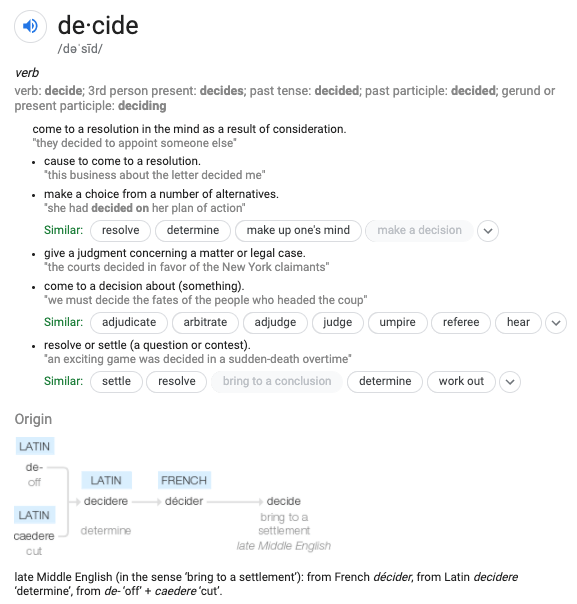
Let’s start, as usual, with a definition – what does it mean to “Decide”?
Definition via Google – From Oxford Languages
How does this change when thinking about the word “Decision”
Net/Net – a Decision is something that requires or comes from, consideration. Depending on the type of decision we are making this consideration, deliberation, evaluation may be deep or surface level.
So – how can we deliberate, or consider things in the process of making a decision?
Frameworks for Decision Making
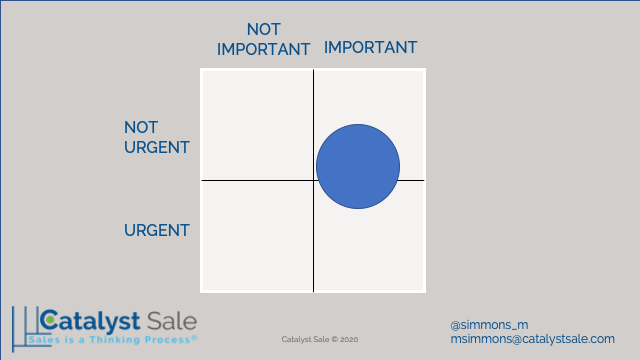
Frameworks are models, tools, systems that we can use to create organization. They are adaptable yet they provide structure. A framework like a traditional Eisenhower Box/Matrix or Franklin T, will not make the decision for you. A solid framework can help provide guidelines, boundaries, and structure.
One of my favorites is the 2×2 or Eisenhower Matrix. Eisenhower used this tool to determine if he should do something, delegate something, eliminate something, or determine if additional deliberation is needed.
Iteration of Eisenhower Matrix – Catalyst Sale
Another framework you can use is the Franklin T – most folks know about this as a traditional Pro/Cons list, For or Against, etc.
Bain created the RAPID® Decision Making Tool. Lt. Col. John Boyd created the OODA Loop (another personal favorite) – Observe, Orient, Decide, Act.
“Chance Favors the Prepared Mind”
Louis Pasteur
There are no shortage of frameworks that you can use or apply to Decision Making, it is helpful to pick one though. By picking one, and sticking to it, you can make decisions that are more predictable, and not left up to chance. As they say “Chance Favors the Prepared Mind” (Louis Pasteur) – prepare yourself with the proper framework.
Thinking Through Your Decisions
How well do you think?
What type of thinking are you applying to a given situation?
Have these questions provoked some thought?
I hope so.
Thinking is important to me, heck, it is in our tagline for the business “Sales is a Thinking Process®”. I wonder sometimes though, are we really thinking, or are we simply reacting? Are we leveraging our OODA loop to observe and orient before we decide?
Critical – Decide (do) – How are you making that decision? (do/do not)
Applied – The commitment to take action on something you have decided. (Commit)
In the following post I share some questions that can help us avoid some of the challenges associated with thinking, and some that can help us be more aware.
“Be a journalist in your research & your thinking”
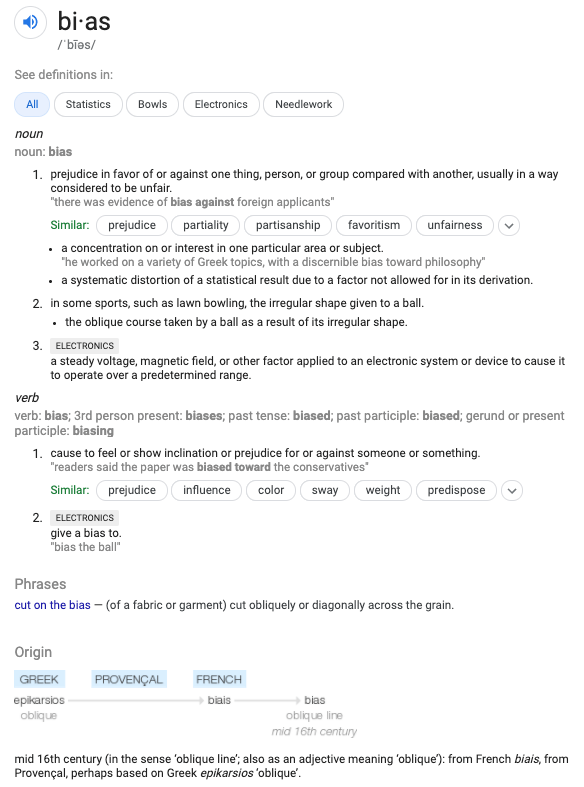
“Prejudice in favor of or against…” Think about it – bias starts with pre-judging. Whether fair or unfair – if we prejudge things – we allow pre-conceived notions to potentially get in the way of our perspective.
This creates blindspots. Blindspots create risk.
You might have a bias toward action – meaning when things are broken you want to fix them. When folks are in trouble, you want to help. When you see a problem, you move into solution mode. You might have a bias toward not acting. You might listen better, wait to respond, consider all aspects.
These biases may change depending on circumstances. Think of the challenges with thinking, how might the impact of bias change when you are in a high stress situation, or you are under a tight clock?
Some of My Favorite Biases
Confirmation Bias – “the tendency to gather evidence that confirms preexisting expectations, typically by emphasizing or pursuing supporting evidence while dismissing or failing to seek contradictory evidence.”
Recency Effect a memory phenomenon in which the most recently presented facts, impressions, or items are learned or remembered better than material presented earlier. This effect can occur in both formal learning situations and social contexts. For example, it can result in inaccurate ratings of a person’s abilities due to the inordinate influence of the most recent information received about that person. Also called law of recency; principle of recency; recency error.
Consistency Motive – the desire to confirm one’s current beliefs about one’s self, including experimentally induced beliefs. Self-consistency strivings are thought to minimize discomfort associated with disjunctions between different aspects of self-knowledge. Compare self-assessment motive; self-enhancement motive. See also self-verification motive.
Fundamental Attribution Error – in attribution theory, the tendency to overestimate the degree to which an individual’s behavior is determined by his or her abiding personal characteristics, attitudes, or beliefs and, correspondingly, to minimize the influence of the surrounding situation on that behavior (e.g., financial or social pressures). There is evidence that this tendency is more common in some societies than in others. Also called correspondence bias; over attribution bias.
The Fundamental Attribution Error is my personal favorite. Think about it this way – you are walking down the street – you see someone walking toward you, they trip over a stick. You think “clutz”. Now what happens if you tripped over the same stick? Is your default thought – “clutz” or “dang stick”?
So What?
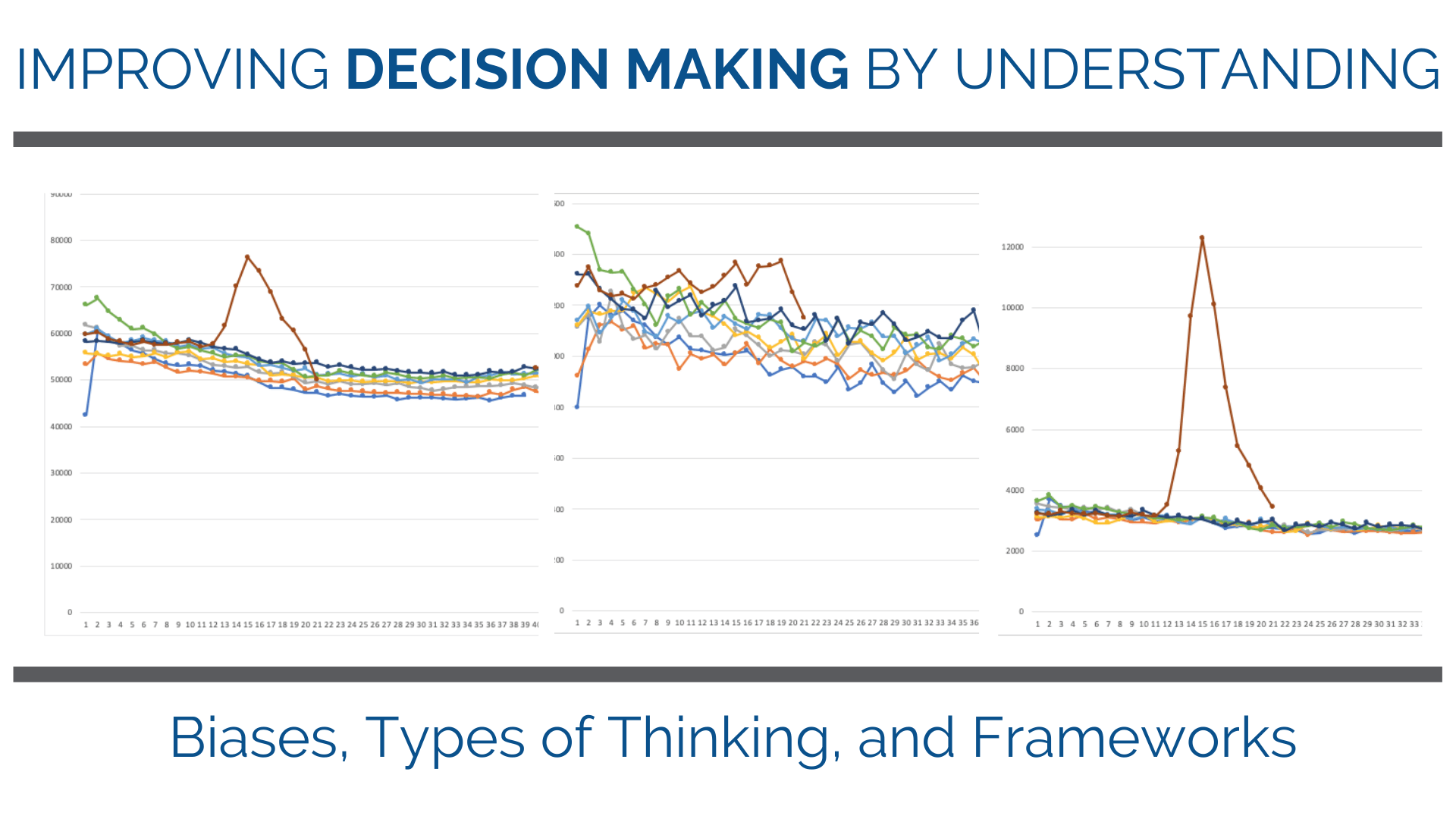
Let’s talk about Decision Making, Thinking, and Bias in the context of data, and more specifically in the context of COVID-19.
This is going to be challenging – two expectations I will set.
I will not make, give, or share an opinion.
It’s really tough to find good data.
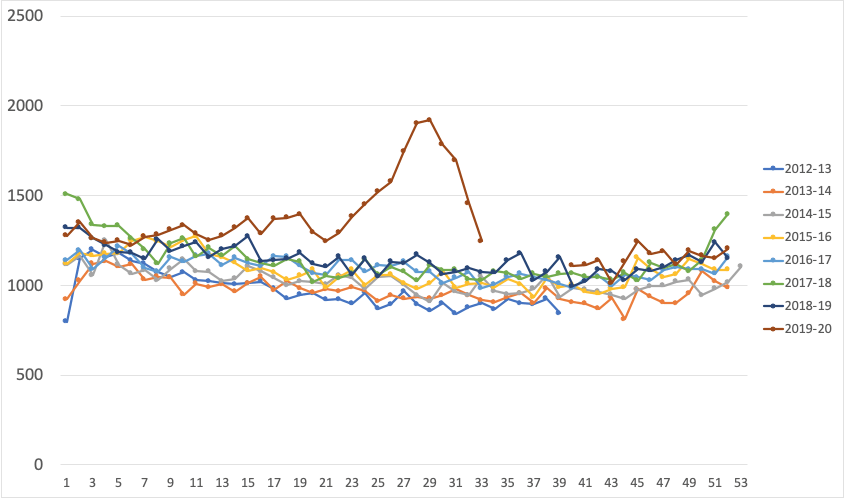
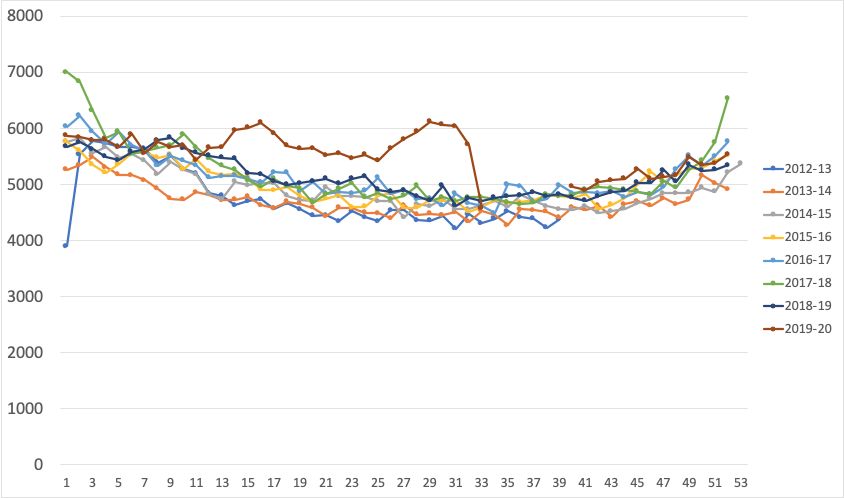
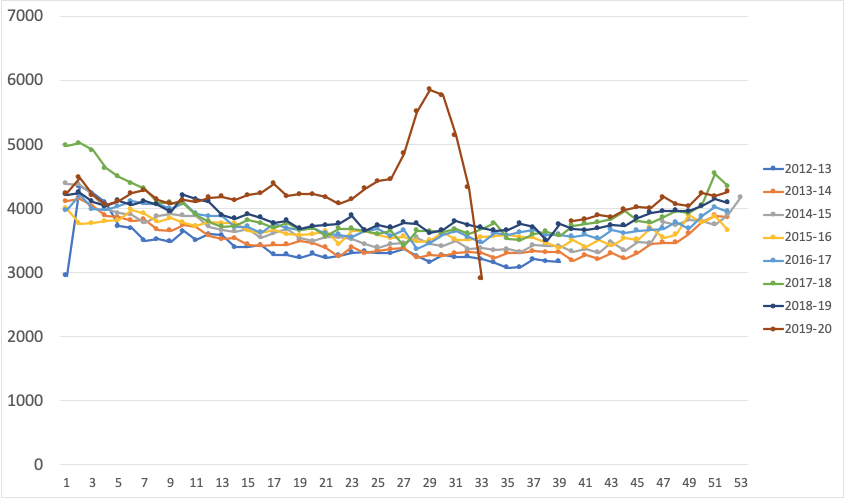
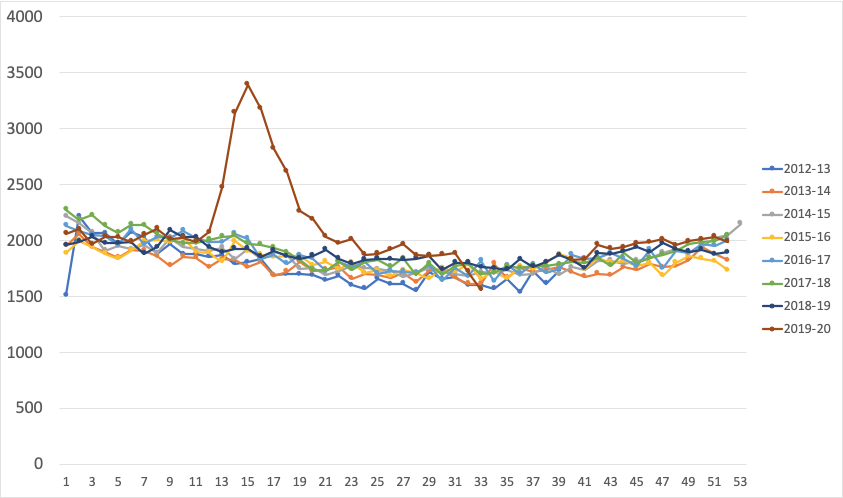
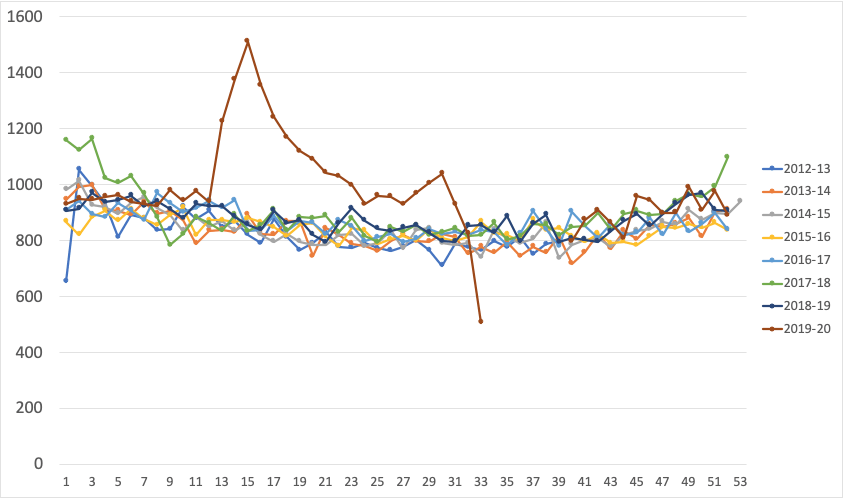
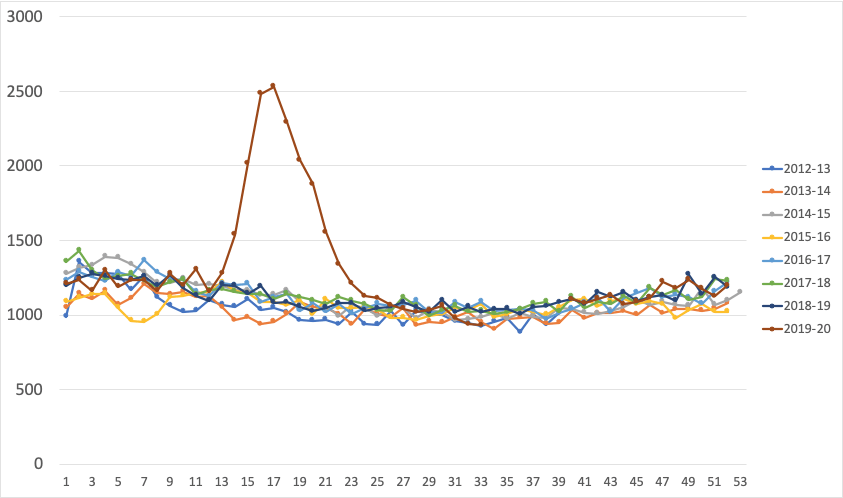
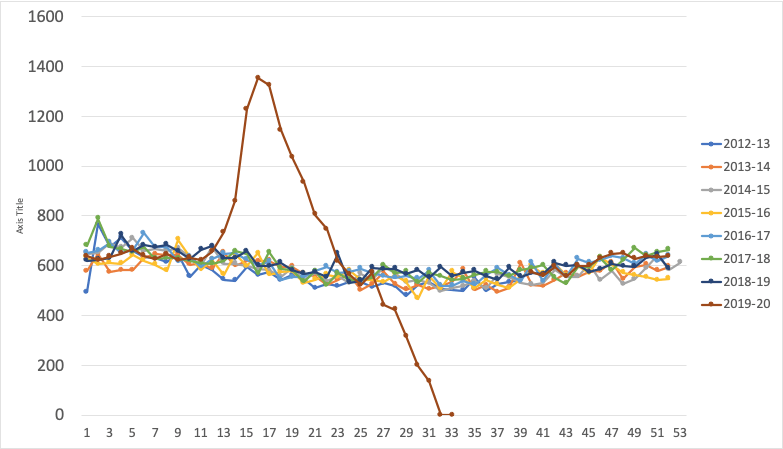
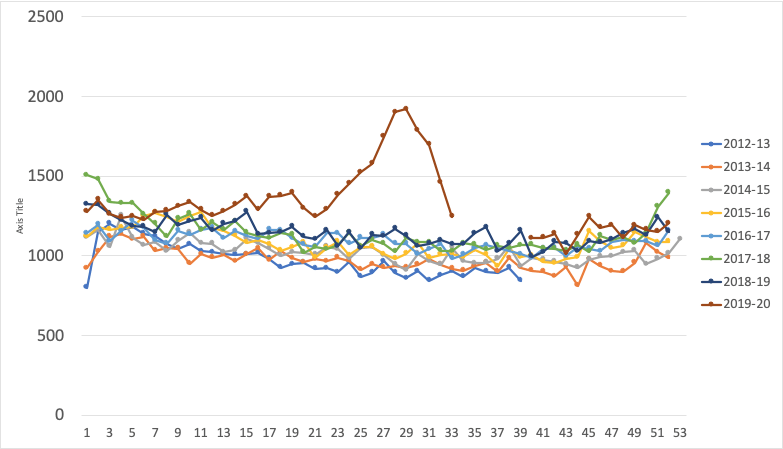
CDC – All Cause Mortality Data – 2012 through 2020 by Flu Season
Data – What’s the source?
The source of the following data is from the CDC, the charts were built using pivot-tables in excel. I will also include some screenshots of data from the Johns Hopkins Coronavirus Resource Center, and data compiled by the NY Times shared via their GitHub folder. All links are provided.
The CDC data is all-cause mortality data – all deaths, by week, separated into flu-seasons. The data used in this post is as of the 5th of July 2020, the reported data is through week 24 of 2020. The CDC Data is completed approximately 4 weeks after actual week of the year.
In other-words, it takes about 4 weeks before the data is 100% reported by each state/region. I will periodically update the data.
Why All-Cause Mortality Data? – well, the way that deaths are reported could insert some type of bias. If we look at all deaths, we should remove that bias. Death is binary.
If you’d like a copy of this data sent to you, along with any additional updates I create – please register here.
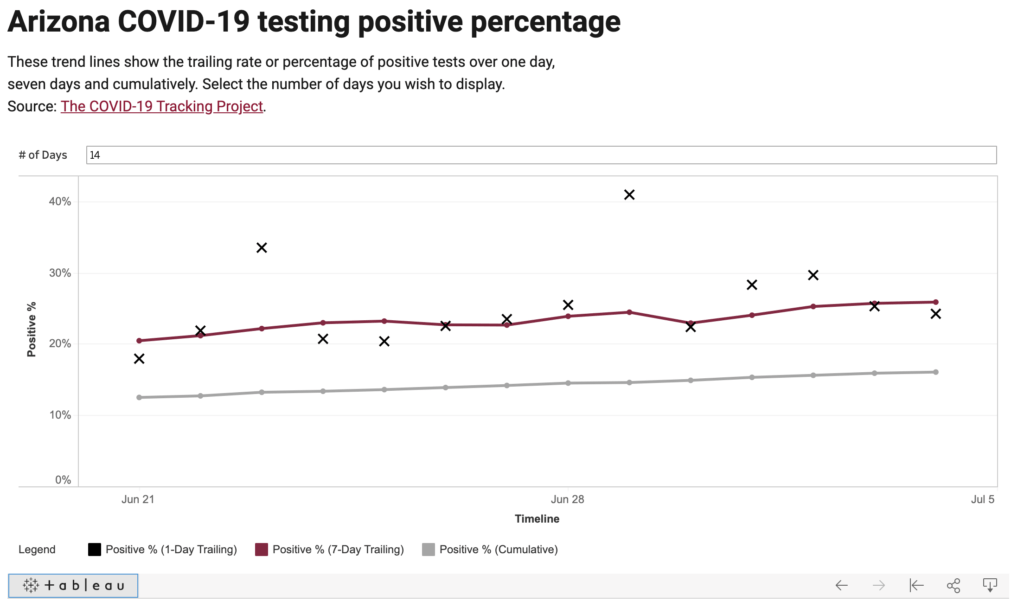
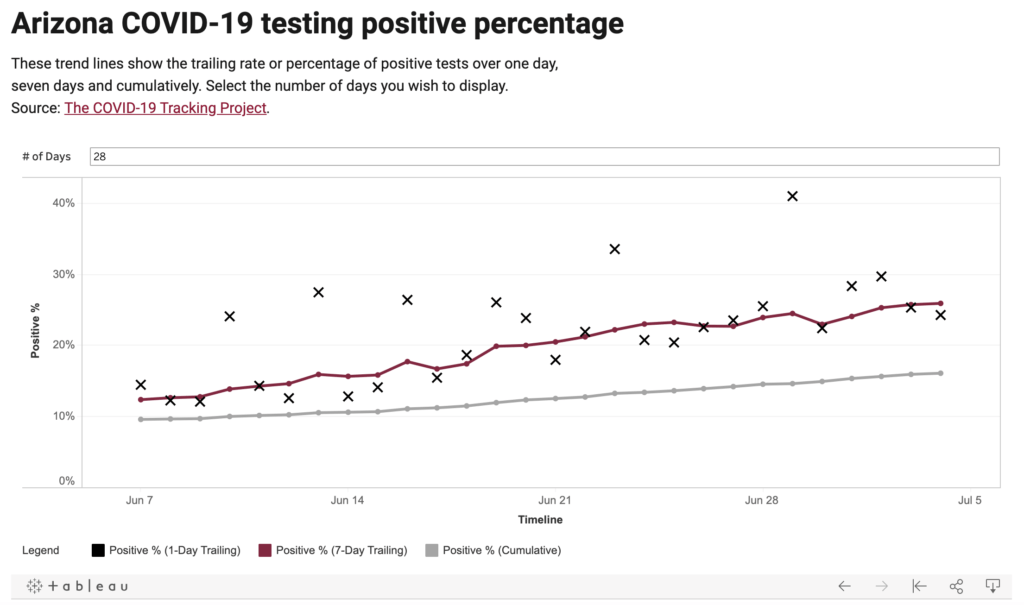
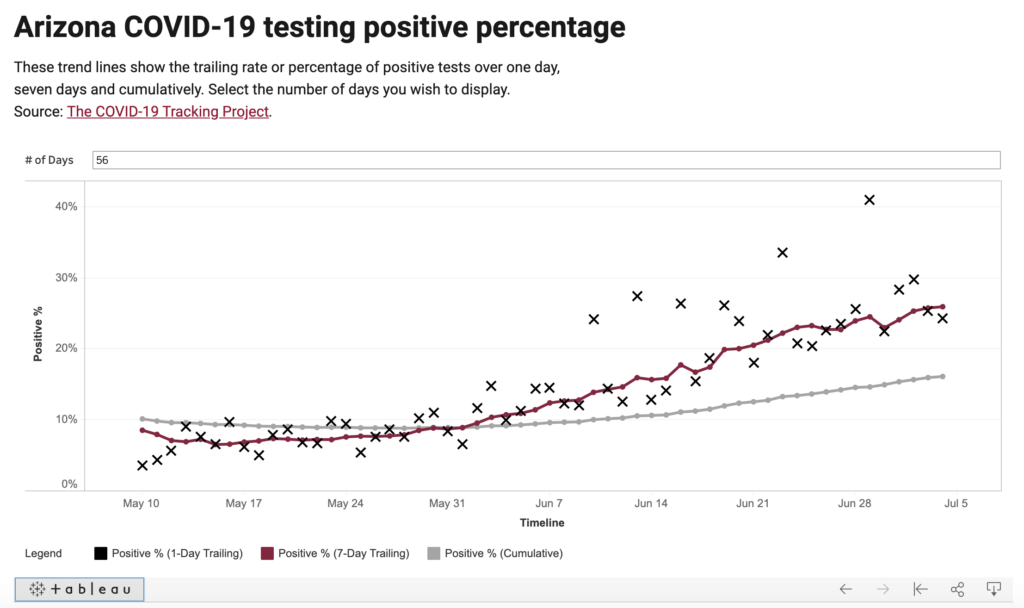
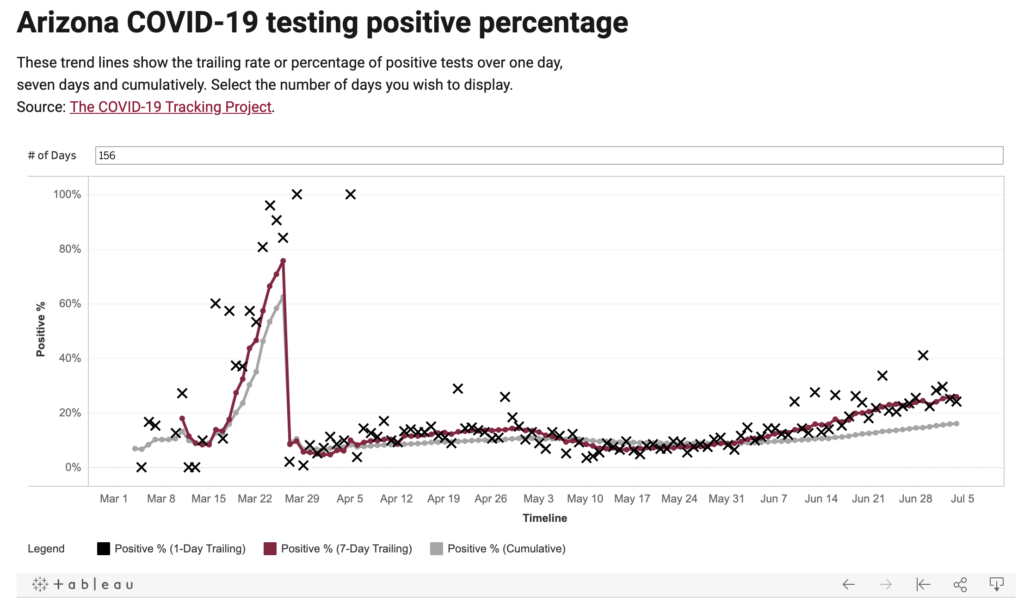
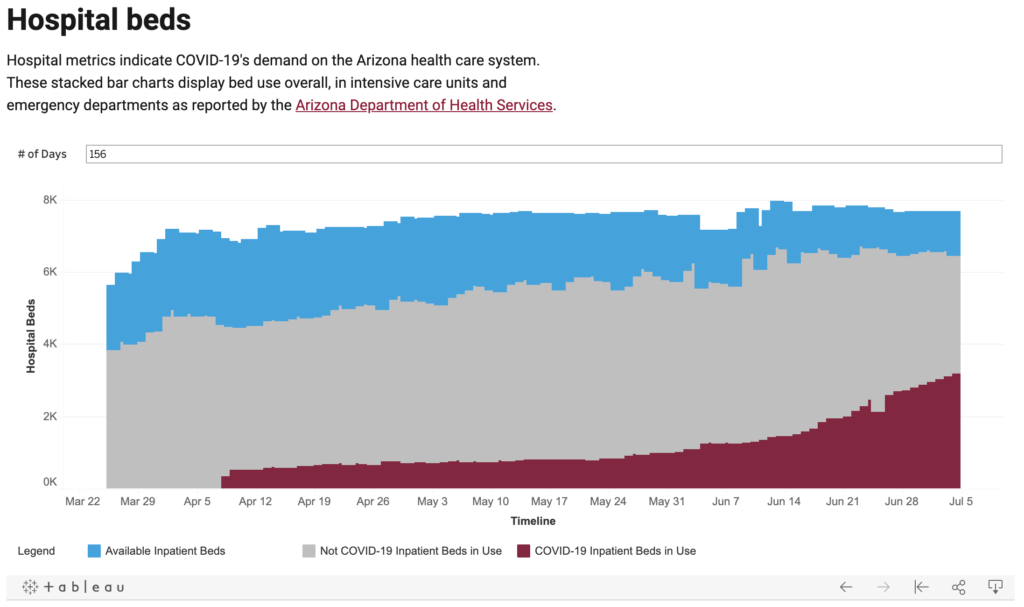
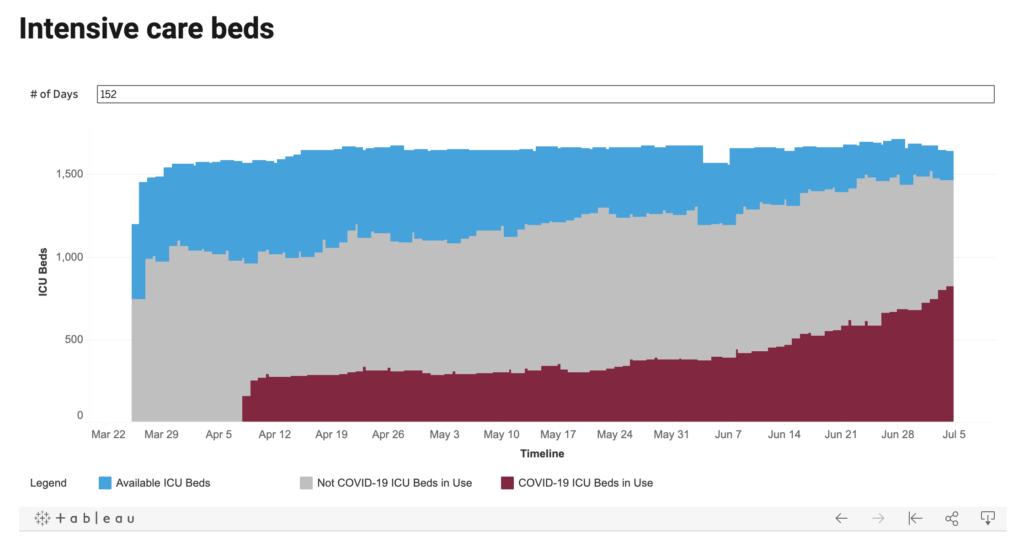
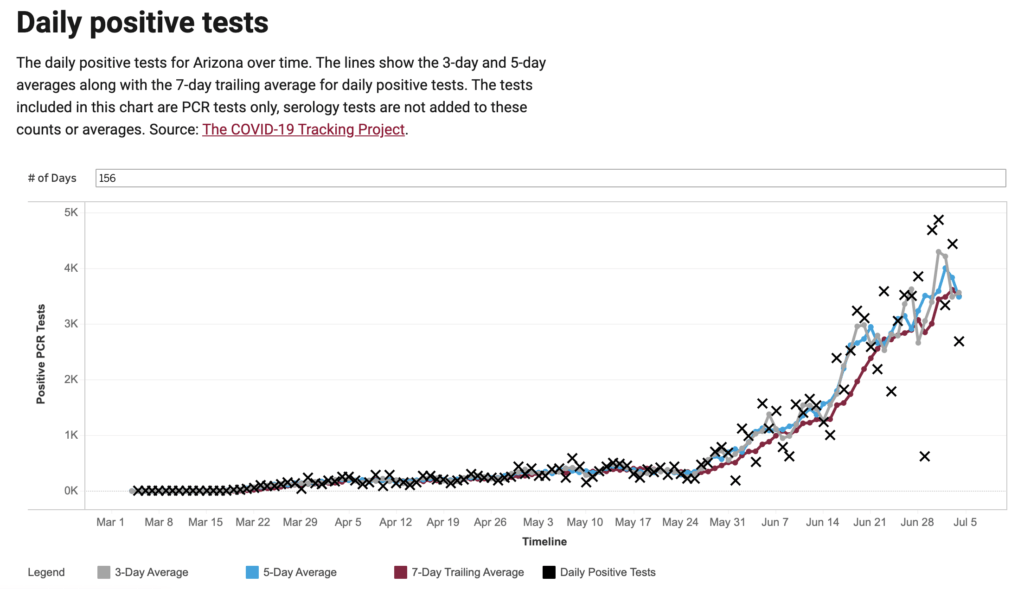
AZ % positive test results past 14 Days (ending 07/04/20)AZ % positive test results past 28 Days (ending 07/04/20)AZ % positive test results past 56 Days (ending 07/04/20)AZ % positive test results past 156 Days (ending 07/04/20)Hospital Beds – % in UseICU Beds – % in UseDaily Positive Test – AZAZ – All Cause Mortality Data – By Week of Year, By Flu Season (08/31/2020)
When looking at the AZ specific data – what do you see? What do you expect to see?
New York Times Data
The following data is current through 08/31/2020 is linked via the ASU COVID-19 Critical Trends site. The direct link follows the chart.
NY Times Gathered Data – Cases vs Deaths w/ Mortality Rate over time
There seems to be a correlation between some states that saw a spike in COVID-19 cases based on the JHU 3-day moving average daily confirmed cases data, and those states that saw an increase in reported deaths.
Some states were hit significantly harder than other states.
It also seems like some states were not really hit at all, relative to year over year changes in mortality.
Mortality stopped in the state of Connecticut recently – I’m not sure why.
The catalyst for me looking into the data was that it also seemed like the primary data being shared in the media was focused on those states hit the hardest.
If we only looked at NY, MA, NJ, IL, MI data – it would be a bit biased. If we only looked at CA, AZ, WA, TX data – that would be a bit biased as well.
Why might folks share biased data? Why might we look for the data that reinforces our perspective?
These are just a couple of interesting questions to consider.
What’s Next
Data can be used to tell whatever story you might like it to tell. Which reminds me of the Mark Twain quote “lies, damn lies, and statistics”
When you are faced with a decision…
Know what type of decision you are making.
Identify the framework you will use to make or inform the decision.
Apply the correct type of thinking to the data, information, etc.
Be aware of the biases that might be influencing or impacting you.
Thanks for reading this – I’d love to hear how you are thinking differently about decision making.
If everyone in the org drew their version of the model, equation, funnel, etc – would it look the same?
This is a challenge I’ve been working on in one way or another for the past 20 years. Replace revenue with “audience or learners”. We could ask the question – Where do learners come from? Where do end-users come from? Where do our customers (internal or external) come from?
These are my thoughts process and perspectives on this.
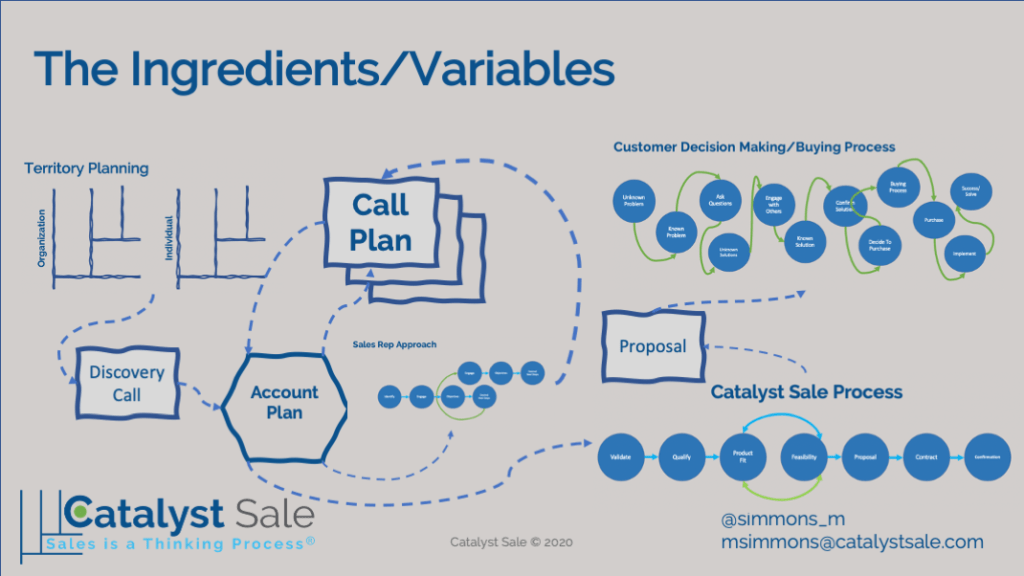
Ingredients in the Revenue Equation
What are the ingredients that make up your revenue equation?
There are a handful from my perspective, and they fall into the following two categories – Tools and Process.
Tools for Revenue Growth
Territory Plan – Knowing who your customer is at an individual and organization level are important distinctions. Tools like a Territory Plan, can help create both clarity and focus.
Call Plan – Preparing for interaction, knowing who will be in the room, anticipating their objectives, knowing your objectives, and having a list of desired next steps, can put you on the path to success.
Account Plan – Knowing the what, who, why, how, and when, followed by creating a plan & executing can help reveal risk, and improve impact.
Proposal – Knowing the problem that exists, why it is important to solve, how you solve it, and how much it will cost.
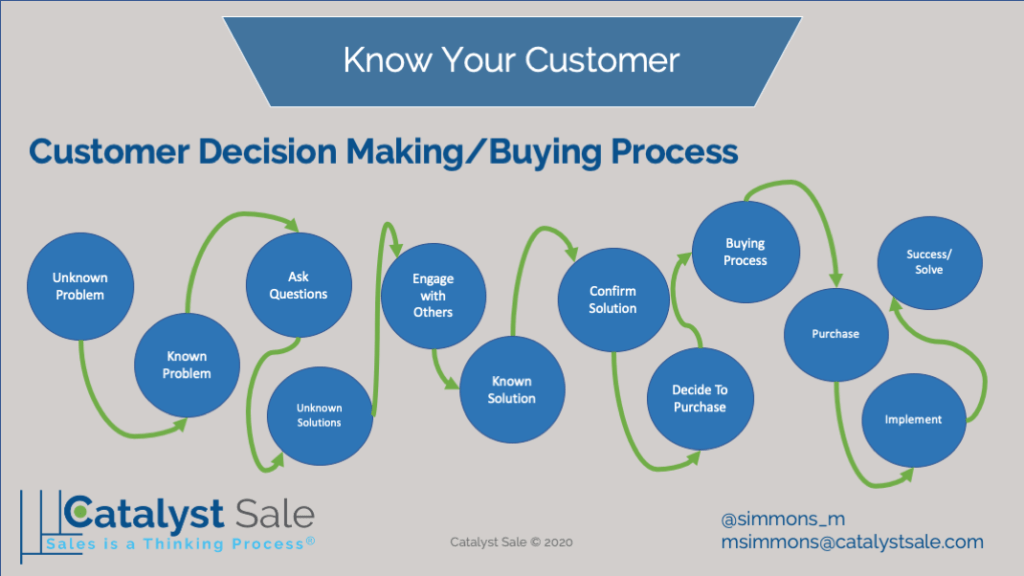
Customer Decision-Making Process – How your customer makes the decision to change, and how they purchase.
Sales Process – How you forecast and improve predictability while reducing risk.
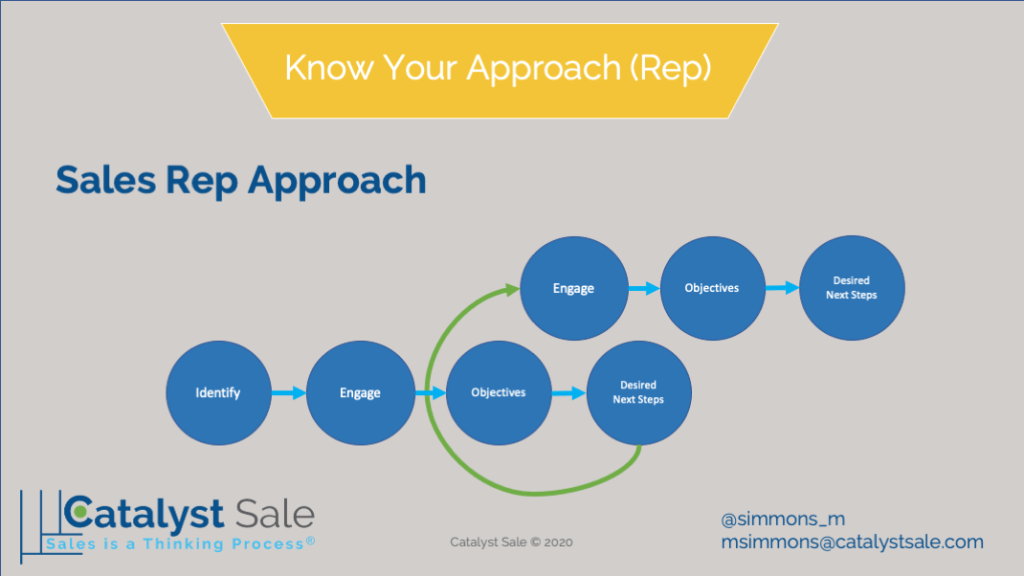
Sales Rep Approach – How you execute.
Revenue Operations & Foundational Skills
“If you know the enemy and know yourself, you need not fear the result of a hundred battles. If you know yourself but not the enemy, for every victory gained you will also suffer a defeat. If you know neither the enemy nor yourself, you will succumb in every battle.”
― Sun Tzu
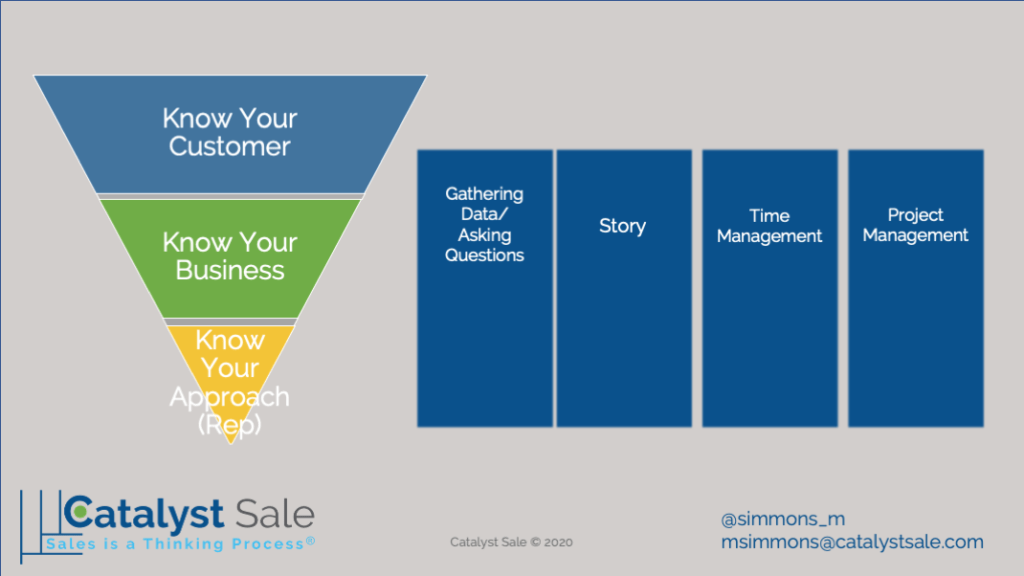
Know Your Customer, Know Your Business, Know Your Approach as a Rep. and apply foundational skills – If you do these things, you will leave fewer things up for chance, and put yourself and your team in a position to be successful.
Know Your Customer
How do your customers go through the process of making a decision to purchase, and how do they actually buy things?
What series of events, obstacles, barriers, traps do they need to navigate?
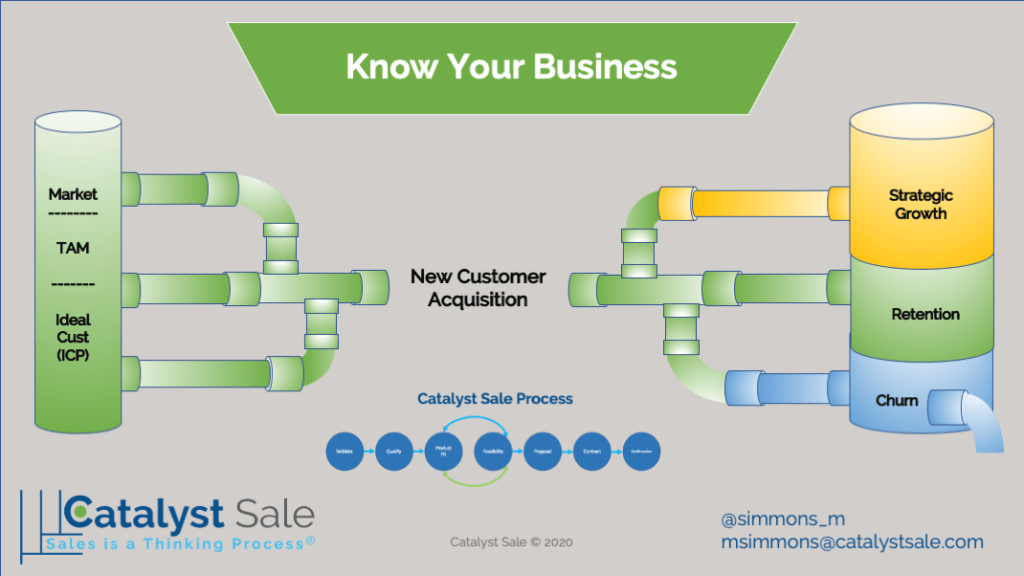
What is the size and scope of the market you serve?
How will you tap into that market?
How do you transition from demand generation to conversion, or initial revenue generation?
What happens next?
How do you grow?
What do you lose?
Where is the balance?
Know Your Approach
How does your team execute?
What repeatable process do they follow?
How is this different from what you might call your “Sales Process“?
Putting the pieces of the puzzle together
Is your ideal customer profile defined?
How does it impact your demand generation strategy?
Is demand fueling your ability to acquire new customers?
Are you growing at a level that excites you?
If not – is there a leak in your people, your process, your tools, your approach?
So What?
I get it, many of these questions are tough to answer. They become more complex when you attempt to solve the problem from different perspectives. When problem-solving, it is important to deconstruct things. Isolate for given variables, test, and adjust.
The above visuals should help you deconstruct, and isolate issues. They help me, and organizations I work with.
Now What?
Put this work into practice, gain the perspective of multiple folks within your teams, see where you are aligned, identify your gaps, and address them one at a time.
I’d like to hear how you apply this in your business, in your role. Sales is a Thinking Process® – How are you Thinking Differently About Yours?
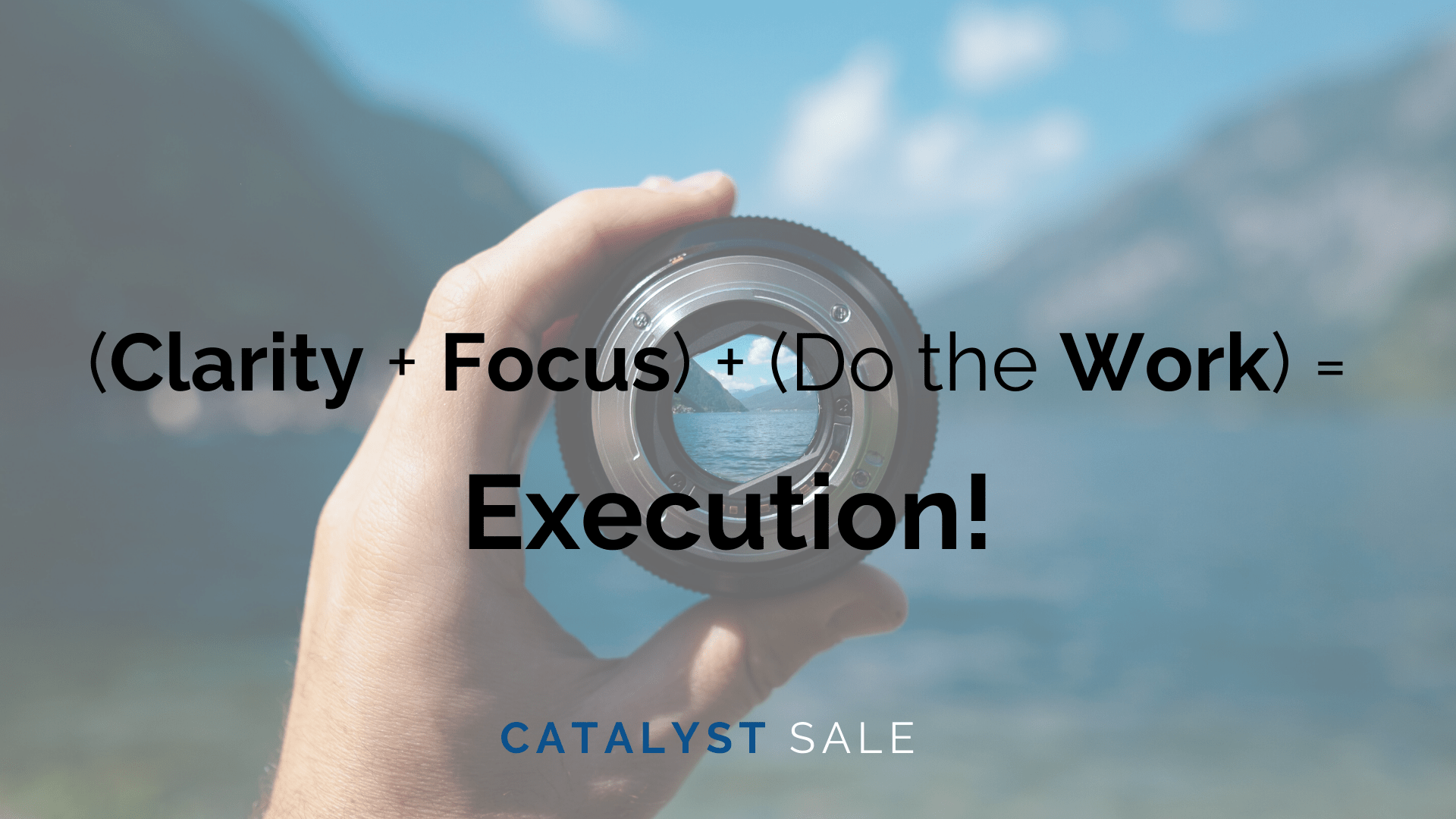
Clarity + Focus, lead to execution. Well – they do, if you do the work…
I get it most of us do not like math. However, there are a couple of us out there who do. I’d like to start this journey by looking at the execution problem as an equation.
This one is going to be a relatively simple equation that will lead to predictable results. Predictable results in relation to goal setting and execution.
(Clarity + Focus) + “Do The Work” = Execution
Net/Net – With Clarity and Focus, we will execute on more of our Goals. Small goals, aligned with big goals, lead to better execution
Think about a time where you established a goal. Maybe the goal was to serve an amazing Thanksgiving Dinner. Did you start by putting a Turkey in the Oven? Likely not.
You likely started with a couple of smaller goals, ideally each were aligned with cooking the dinner. This is a really rough simplification.
Goal #1 – Decide what will be served
Goal #2 – Buy the ingredients
Goal #3 – Cook the Dinner
Three Steps
It probably would help if we define the word Goal. Here is a post I shared on LinkedIn.
If/Then Statements
I’ve talked about this in the context of leading teams. If our individual roles align well with team goals/objectives, and our team goals/objectives align well with organizational goals/objectives, then we create clarity – this clarity reduces friction, reduced friction allows the flywheel to continue to gain speed/momentum.
What is Clarity?
According to the Oxford Dictionary – Clarity is a a quality. When I think about this, I think of clean pane of glass. If it is clean and clear, I can see through it. If it is muddy or murky, I’m not able to see what is on the other side.
Things like jargon, acronyms, industry terms can get in the way of communication – and can ultimately create fiction. This friction can be ok if we are considering change or inspiring change, but it can prevent our ability to build momentum.
Breakthrough the Jargon
The clarity in our goal of serving an amazing Thanksgiving dinner, occurs when we create smaller goals that align with the dinner. It’s clear we need to decide what we are going to cook, when we decide to purchase those ingredients, and start cooking the dinner.
Within each of these goals, we provide additional clarity around the things – let’s think about buying the ingredients. The clarity at the sub-goal allows us to create greater focus/attention on execution.
What is Focus?
Now we get to Focus – focus is the activity of attention – how do you know where we should put our attention? Well, before we go further, let’s define Focus with the help of the Oxford Dictionary.
If focus is about putting attention toward something, how does it apply to the Thanksgiving dinner example? By creating clear goals that are aligned with our broader goals and objectives, we can focus our attention directly on the things that matter. Not only the things that matter, but also working on these things in the order that they should occur.
If we focused our attention on cooking the meal before we had the food in the house, how far would we get?
So What?
Ok, we have talked about 3 words. Goals, Clarity, and Focus. If you want to improve on execution in your business there are three things you can do now.
Identify GOALS that align with where you want to take your business and/or your role within the business.
Create CLARITY on how those goals are defined, what they mean, and how they will impact the business
Determine FOCUS – which goals need to be accomplished and in what order should you apply your attention.
And, DO THE WORK
Now What?
If you’d like some help with Goals Setting and Execution – please enroll in our recent course – “The GAME Plan”
Many of us are making the transition to remote work, work from home, or varied hours as we adopt social distancing and work to combat the current pandemic. We are all in this together. However, some of us are further along the “work from home” journey than others. Some having worked this way for years while others of us are just starting.
Break Through the Noise
There is a fair amount of noise out there. There is also some great advice from experts. One challenge, don’t allow yourself to get caught up in the negative headlines. A number of folks, myself included, have worked in a remote/work from home environment for years. Yes, there are systems we have adopted, there are processes we have adopted and there are checks we have put in place.
However, those of us who have historically worked from home, have done so while our spouse/partner has gone into an office, and/or our kids head to school. We are now faced with working in an environment where work, home, life, and school are all being pushed together.
Again, we are all in this together. So, how do we manage?
Start By Defining the Challenge
When I think of problem solving, one of the first objectives I attempt to accomplish is to define the problem. For instance, many of us face the current problem/challenge/obstacle of how to effectively lead, calm and motivate a remote team in uncertain times. How do we maintain focus and sharpen clarity? What message do we send to our internal as well as external customers? What is the right tone?
In this series, I speak with many experts that help define a number of different topics. We discuss common mistakes, ways to avoid those mistakes, how to take care of ourselves and those we lead, how the topic/concept changes in a work from home environment, and how thinking around the topic changes when we look at it through the lens of our team, our customers, and our self.
I want to extend a heartfelt thank you to the experts who gave their time to contribute to this series. Please note, these recordings are un-edited.
The Experts
Empathy – Dr. Ehrin Weiss
Community – Brent Schlenker
Leadership – Dan Cockerell
Communication – Jody Maberry
Anxiety – Lee Cockerell
Mindset – Jeff Noel
Collaboration – Myra Roldan
Clarity and Focus – Mike, Dan, Jody
This one is unique, it was recorded before putting this series together – this is the one episode where the questions are not the same, and it takes more of a conversational tone.
Support – Eric Harrington
Execution – Mike Simmons
Resilience – Alanna Fincke
Thank you
I hope you found this information valuable. Please let me know via the chat on the Catalyst Sale website, or via direct message on twitter, if there are other topics that you’d like us to discuss on the podcast.