What is the Qualification Step in Sales?

In sales, the qualification step is about gathering information that will help you craft a solution to a specific problem or question that an organization may have. This step is oftentimes regarded as the foundation of any proposal or job. You can’t pitch a perfect idea or do a great job if you’re lacking important information.

Qualification allows you to move beyond feature functionality and how a product would benefit a business and instead look at the consumers--what issues are they having, and what’s important to them, and why is it important? 

How do I Make the Qualification Step Effective? 

Be Conversational

The qualification step is a way to help you get to know your client and what they’re looking for. Qualification doesn’t necessarily have to be formal.

Talking to your clients in a more natural manner will help you build a better understanding of what they need. It also allows you to gear your next steps around their evaluation style and decision-making processes. 

Set the Right Intentions 

It’s important to begin with the right intentions. The intention to learn about your client and determine if you’re able to make a positive impact, or if you should go your separate ways. 

Ask the Right Questions

There are a few key ideas you need to learn during the qualification step that you can get by asking point-blank questions. 

  • What are you working on?
  • What is getting in the way of success?
  • What are you struggling with?
  • What issue are you trying to address?
  • Why is it important to solve these things?
  • What happens if you don’t?
  • Who else cares about this?
  • Why do they care?
  • How are you solving (or have you attempted to solve) the problem today?

Find out, on the client’s terms, what isn’t working and what they think could be improved upon. What aspect are they trying to improve upon?

Then, find out who needs to be involved in discussions about the solution to their issue. This could be one person, or a team of people.

Finally, ask how they evaluate things. Learn how they view success, how they operate, and how they make assessments within their company.

Within the evaluation discussion, it’s vital also that you talk about their budget process so you don’t impact their forecast incorrectly. Learning these things will help you gear your solutions toward their needs.

What are the Risks of an Ineffective Qualification Step?

The most obvious risk of a failed or ineffective qualification step is losing the prospect.

If you forget to ask questions about the three key ideas we talked about earlier, the issue, solution involvement, and evaluation, you run the risk of missing out on a lot of vital information.

You may forget to include someone in solution discussions, or mix up when a budget is going to be made available. Both of which could cause you to lose them as clients.

You also risk missing a key aspect of the company or failing to highlight what could have been a very helpful element in the solution to their problem. In this case, not only is your client not receiving your best work, but you also deflate the value of your services. 

In Conclusion

The qualification step helps you build the foundation you need to work effectively with your clients. It allows you to get to know them, their issues, and how they operate. It’s a vital sales step, and you risk a lot if you aren’t effective in this step.

Moving through the process too quickly could lead you to improperly qualify an opportunity, and put your client in a box. It’s important that you effectively move through the qualification step to be as constructive as you can be with your clients.

An effective step will leave you with a clear understanding of who your client is, and a trusting relationship that will allow you to be successful. 

Qualification is not about qualifying people out. It’s about understanding the problem from the perspective of your client – and then determining if/how you can help (Spoiler alert – if you can help – you may be ready to move to “Fit”)

Ready to get to work? Reach out!

Work with us

Catalyst Sale: The Validation Step (Podcast)

What is the Validation Step?

The validation step helps you determine whether or not there is a business opportunity in front of you. This step is all about getting to know the organization, the people that work there, and their roles. It’s about validating that you have the right information, that you’re working with the right people, and that you’re working with the right organization.


What Does it Mean for an Opportunity to be Valid?

When declaring that an opportunity is valid, there are a few things you have to look at. You need to know who you’re going to be working with, why they think you can help, and what impact they think you could have. A lot of these answers will be conceptual because we aren’t getting into the sales process yet. This step is all about making sure you know who you’re working with, and why they need your services. 

How do I Make the Validation Step Effective?

Ultimately – this is about determining whether or not there is the potential for a business relationship. To do this you need to be able to answer the question, “Can I see a scenario where it would make sense for us to conduct business with each other?”

Do Your Homework 

Before meeting with a new potential client, do some research on them. This will allow you to catch any red flags beforehand that may show that they aren’t who you want to be working with, and will also give you a baseline knowledge to work with during your meeting. Having this knowledge will send the message that you’re prepared and ready to have a productive dialogue from the beginning. 

Be Thorough

Do all of your research, questioning, and investigating diligently at the beginning of the process. If you aren’t thorough, you’ll have to backtrack and ask questions you should have already known the answer to, making you seem unreliable and ineffective. Speeding through the process could lead you to miss out on vital information that could help you retain the client. 

Double Check Your Information

During the validation step, it’s important to make sure your information is correct. This includes information about the company as a whole, and information about the people you’ll be working with. Paying attention to small details helps you avoid unprofessional mistakes like referring to them by the wrong title. 

Gauge Their Engagement

One sure way to make the right decision during this step of the sales process is to properly gauge customer engagement. If they’re responding with questions, setting up meetings, and actively working to resolve the problem, they’re someone you should consider working with. If they seem to lack engagement or keep pushing back meeting dates, you may want to think about utilizing your time elsewhere. 

In the end, the validation step is all about getting to know potential clients before you decide whether or not you want to work with them. This step allows you to gauge how likely they are to work with you, research them, and double-check all of the information you have on them. Successful validation of opportunity makes the qualification step much easier, as you will have already built some form of a relationship with your client. This effect will carry on throughout the entire process, making it much easier and less time-consuming. 

Think Back to the Question

Can I see a scenario where it would make sense for us to conduct business with each other?” If Yes – the threshold is low – and if you are working with your Ideal Customer Profile (ICP) at the organization and individual level – the answer will likely be yes.  If it is “No” – you should move on.

Catalyst Sale

Sales is a Thinking Process.  Catalyst Sale is a learning organization first and foremost. That’s why we care about a thinking process that enables results versus a process that tells people what to do. We aim to add value whenever we can, and our true success is measured by the sustainability of our work long after we complete a project. We surround ourselves with good company and never stop learning.


Work with us


We are Catalysts. We Connect people we know and people we meet to help create opportunity for others. We Challenge ourselves, our clients and our team, to discover what is possible. We Learn from others, others learn from us and that never stops. We Contribute our expertise to deliver results with meaningful projects that are aligned with our values. We care about the people we work with every day and get great satisfaction from seeing them thrive.


Mike Simmons on Twitter

Mike Simmons on LinkedIn

Catalyst Sale Twitter

Catalyst Sale on LinkedIn

Coaching – Is a Coach the Right Fit?

Is this a job for Coaching, Training, or Mentoring?

Getting better every day is something that many people discuss, however they fail in execution. The greatest athletes in the world rely on coaches every day – do you?

It is one thing to aspire to grow, aspire to improve, it is another thing to take action. Action starts with a single step, it requires movement. How do you know which direction to go? How do you know if you are taking the right actions?

“I suppose it is tempting, if the only tool you have is a hammer, to treat everything as if it were a nail.” – Abraham Maslow

A coach could be the critical tool in your toolset, but like most projects, you need to assess the situation and determine the best tool. It has been said that when you have a hammer, everything looks like a nail.  Other tools for consideration include training and mentoring, but how do you determine which is the best fit for the situation?

When I think about coaching, I think about finding someone who can help me make the subtle adjustments necessary to improve the things I do well today.  This could be as simple as foot position on a bike pedal, or as detailed as body language and voice inflection when speaking in front of a crowd. A coach is there to help you see the things that you cannot see yourself.  Sure, you can look in the mirror, but that is one perspective.  The mission of the coach, from my perspective, is to accelerate growth and performance. This happens by improving technique.  In order to make these improvements and recommendations, the coach must be there.


Talk with a Coach


What if it is too soon for a Coach?

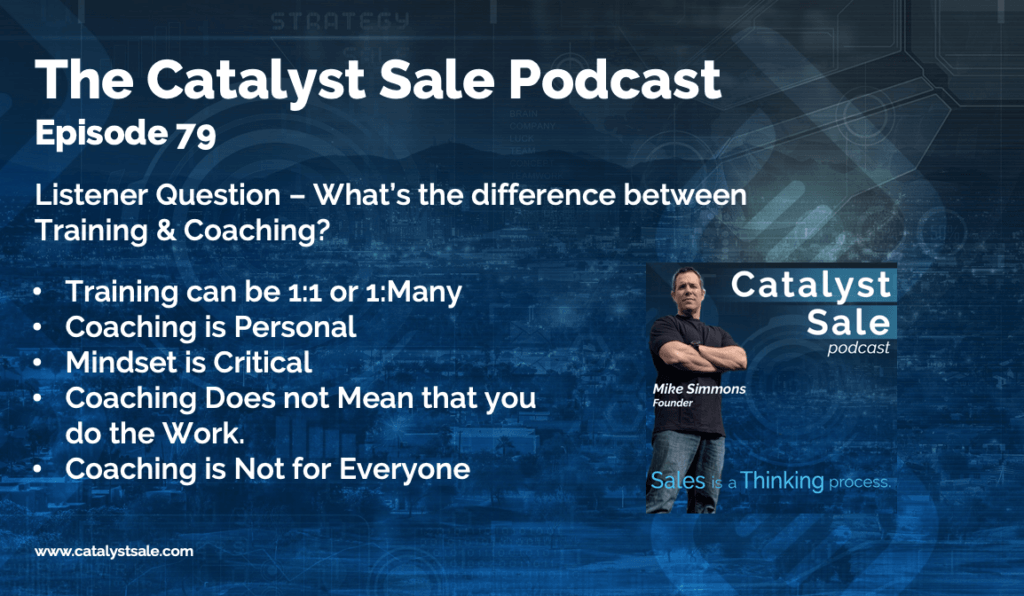
Sometimes, you are too early in your career progression or the skill development progression to leverage the value of a great coach. You may be just starting out with a new skill or in a new role. If this is the case, training may be a better fit. Training provides a structured opportunity to learn a new skill or capability. The training should be focused on the reason behind the skill. It can be designed to introduce you to the topic, create an environment to put concepts into practice, and test retention.  Training can work really well 1:1 or 1:many.  Coaching, on the other hand, is better in a 1:1 environment.  Even with large groups or teams, the specific coaching you receive is personal.

What about a Mentor?

Mentoring is much more relationship-driven than coaching or training.  Sure, a coach should have a solid presence, however, it is not critical that you get along with your coach or the trainer.  The relationship you build with your mentor is critical. This relationship is mutual, it evolves over time. The mentor is there to help inspire thought, provide guidance, and share their personal and direct experience.

This is the first post of a series of posts focused on the differences between coaching, training, and mentoring.  Share your comments and personal experience with us at hello@catalystsale.com.

Interested in learning more – please check out this episode.

Fundamentals in Sales

The Fundamentals in Sales are Fundamental

Zig Ziglar is known for a number of things, including the foundational sales skills he shared with others.  How have the fundamental skills changed or evolved over time?  Have they, or are we simply repackaging many of the same old concepts?

Here are some notable Zig Ziglar quotes.

  • Your Attitude, not your aptitude, will determine your Altitude – Ziglar
  • You can have anything you want in life if you help others get what they want in life – Ziglar
  • If you can dream it, you can achieve it – Ziglar

We discussed Zig and the fundamentals in the above podcast – here are some of the questions addressed

  • How do the timeless classics impact development today?
  • How important is it to look back to the fundamentals of selling?
  • How did you cut your teeth in sales?
  • Who are the new leaders in this type of content?
  • Community Question – who do you recommend?

Key Takeaways

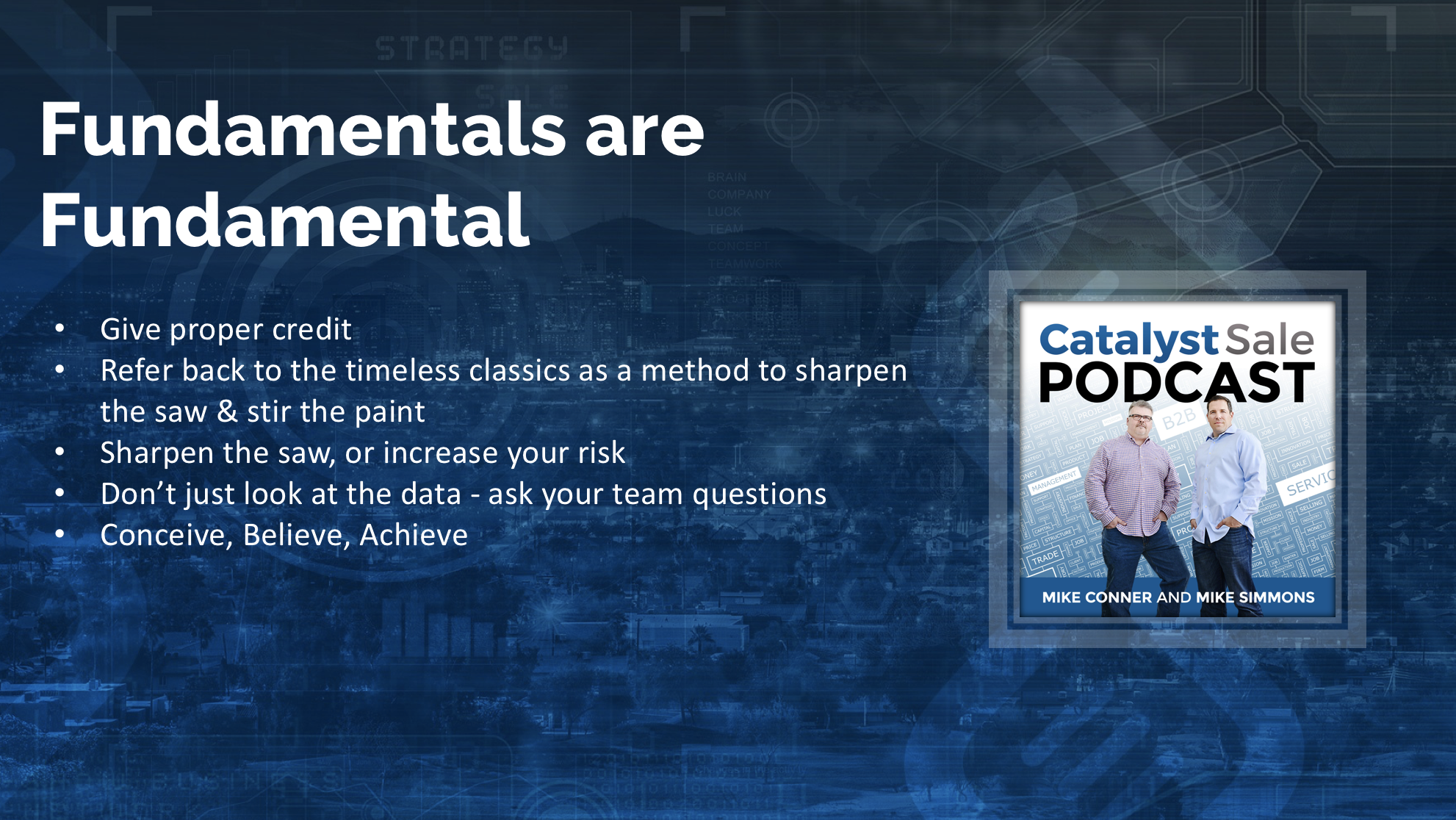
  • Give proper credit
  • If you do not go back and sharpen the saw, you increase your risk
  • Refer back to the timeless classics as a method to sharpen the saw & stir the paint
  • Ask the leaders in your organization for their thoughts on the fundamentals that have helped them get to where they are today. Ask them for their story.
  • Zig would not take 100K for his cassette player if he could not replace it – what are some of the things you would not give up for 100K, if you could not replace them?
  • Don’t just look at the data – ask your team questions
  • Conceive, Believe, Achieve

Thank you for sharing this episode.  If you like what you heard, please provide a rating and/or review via Apple Podcasts, Google Play Music, Stitcher, or your favorite podcast app.

Related Links

———————-

Catalyst Sale

In every business, in every opportunity, there is someone who can help you navigate the internal challenges and close the deal. There is a Catalyst.  We integrate process (Catalyst Sale Process), technology and people, with the purpose of accelerating revenue. Our thoughtful approach minimizes false starts that are common in emerging markets and high growth environments. We continue to evolve our practice based on customer needs and emerging technology. We care about a thinking process that enables results versus a process that tells people what to do.

Sales is a Thinking Process.

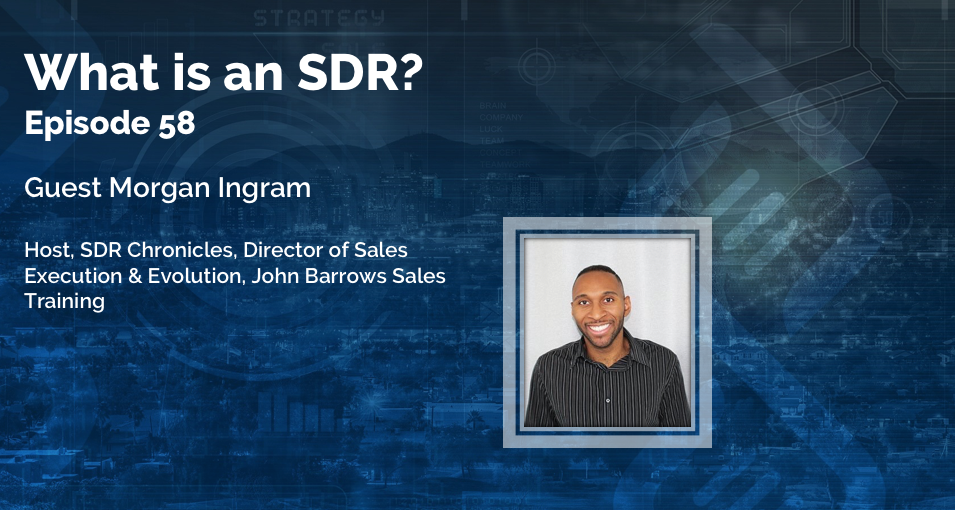
Episode 58 – What is an SDR? Guest Morgan Ingram

SDR - Morgan Ingram

Guest – Morgan Ingram, Host of the SDR Chronicles

The Sales Development Representative (SDR) role is another level of specialization within the sales function.  Some organizations have adopted this role and successfully integrated the position into their teams, while others struggle with success.  Many of the organizations who struggle with success have identified a breakdown in transition process between the SDR and the Account Executive role.  Sometimes this hand-off feels forced and is not customer focused.

This week on the Catalyst Sale Podcast, Morgan Ingram, host of the SDR Chronicles joins us to discuss the SDR, the evolution of the role, mindset, and being persistent.

What is an SDR?

SDR stands for Sales Development Representative (SDR) this is the tip of the spear from a sales team perspective.  In many organizations, the SDR is the first person the prospect speaks with.  The SDR is responsible for gathering initial qualification data from the customer.  Who are they, what do they do, what brought them to your website, what are they looking to accomplish, etc.

Once the initial information is gathered, the focus moves to establishing next steps, including scheduling the next call and transitioning the prospect to an Account Executive.

Where Does the Transition Fail

This seems pretty straightforward and should be seamless to the customer/prospect.  However, this is where things can get awkward.  Think about those times when you are working with customer service, you speak with the first rep, they escalate to the second or the third, and each time you have to repeat your story.  Don’t make this your customer’s problem.

Share clear notes with your teammates, set expectations with the customer/prospect, and execute.

Onboarding a new SDR/AE

When onboarding an SDR within your team, or an Account Executive, start with clarifying success criteria and expectations.  Each AE/SDR will have their own personality to apply to their role.  If you are an SDR and a new AE has joined the team, schedule a 1:1 conversation with the new rep.  Gain perspective from them regarding what type of data they would like to see on each customer as part of the hand-off.  Find out why the information is important to them, and how they plan to use it.

If you are a new Account Executive in an organization, and the SDR role is part of the structure of the sales team, get to know the team.  Ask what has worked in the past when it comes to SDR/AE transitions.  Be clear about your expectations, and how the information that is transferred impacts the sales process.

Remember you are a team – teams perform well when roles are defined, communication is clear, expectations are set, and adaptation is allowed to occur based on changing information.

Building Rapport

Building rapport is a skill, a skill that is customer focused, and requires that you take a personal interest in others.   Who are they, where do they live, why do they do what they do, etc?  This is not about pitching your product, you’ve not earned the right.  Take a breath, and learn about what is important to your customer.  (Dan Tyre talks about this in a previous post)

Making the transition from Colleague to Manager

The transition from colleague to manager is common.  Unfortunately, many people make this transition for the wrong reasons.  If your transition is driven by ego, and not based on a foundation of service, you are likely setting yourself up for failure.  As you make the transition into leadership, focus on how you can work for others.  Leadership is a service, not a mandate or right.

Success

Throughout this Morgan shared a number of concepts that have led to his success.  Some of these are mantras we all may want to consider integrating into our approach.

  1. Consistency Brings Results – If you don’t show up, you can’t show out.  You have to be there to be successful.  Yes, it’s a grind, but if you don’t show up, you cannot succeed.
  2. Sweat the details – the little things count
  3. Expand your view of Data – Monthly data may skew your perception of results, look at the quarterly numbers to help minimize the impact of anomalies.
  4. Steady mindset – good things will happen, or bad things will happen – know that the one constant is change. Trust your process.

———————-

Thank you

Thank you for rating and reviewing the podcast via iTunes, Google Play, or your favorite podcast platform.  Ratings & reviews help others discover the podcast – thank you for helping us get the message out to the community.

Please send listener questions and feedback to hello@catalystsale.com or contact us directly on twitterfacebook or LinkedIn.

Catalyst Sale Service Offerings

Growth Acceleration – Plateau Breakthrough

Product Market Fit

———————-

Subscribe to the Catalyst Sale Podcast

Subscribe via iTunes

Subscribe via Google Play

Catalyst Sale

In every business, in every opportunity, there is someone who can help you navigate the internal challenges and close the deal.  There is a Catalyst.  We integrate process (Catalyst Sale Process), technology and people, with the purpose of accelerating revenue. Our thoughtful approach minimizes false starts that are common in emerging markets and high-growth environments. We continue to evolve our practice based on customer needs and emerging technology. We care about a thinking process that enables results versus a process that tells people what to do.

Sales is a Thinking Process.

Sales Territory Planning That Works

the catalyst sale territory template

Territory Planning – A Catalyst Sale Approach

Territory planning is where it all begins.  You establish the outer guideposts for where you will focus your attention.  The broader this range is, the higher the risk.  The more targeted, based on data, the lower the risk.

How to Create a Sales Territory Plan from Scratch

Let’s say you have joined a new team, you have picked up a new territory, or you are asked to build your plan from a clean slate.  In this scenario, we’ll start with a blank whiteboard.

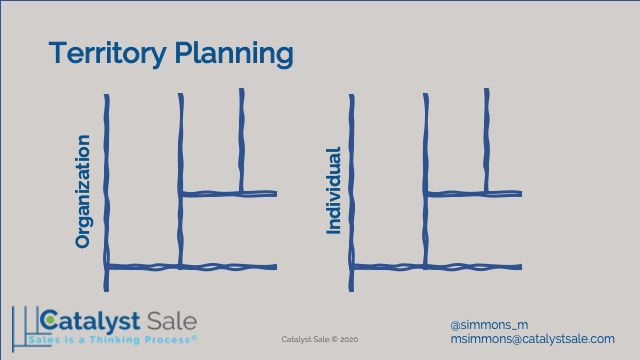
On the left side of the whiteboard, write down what you know about your “Ideal Customer”.  Who are they, why do they buy, what do they care about, why do they care about it, how does it impact their company (team, line of business, their role)?  (the who & the why.)

On the right side of the whiteboard, start with what you do really well.  Not an all-encompassing everything you do for your customers, but the three to five things that you do really well. (the what)

Use the middle of the board to start refining your target.  In the following scenario, we are delivering a sales enablement technology that supports onboarding of new sales professionals & educating existing professionals on new products that the company is bringing to market. Follow along to see how to complete your planning board.

Remember – Don’t Boil the Ocean

Who is your ideal customer?  The optimistic rep might say “anyone who has a sales team”.  This likely describes most organizations you are familiar with, and sounds good, but targeting this base would be the equivalent of trying to boil the ocean.

There are a number of organizations out there that have seen minimal growth in their sales teams over the past 24 months.  Some, through technology and specialization, may be shrinking this audience.  Others may be selling the same product to the same market for the past five to 10 years. These organizations are neither expanding their team nor rolling out new products to market.  They likely do not have a need for a sales enablement platform that supports onboarding new team members or educating existing team members on new products.

1. Defining Your Target Audience

Now draw a vertical line down the center of the whiteboard – ask a Yes/No question that helps you distinguish between those who are in your market, and all others.  Your targets should fall to the right.  (An illustration follows)

Draw a perpendicular line to the first line, just to the right of your first line. Then, ask a second Y/N question that helps to further distinguish your target market. Your targets should now fall above the second line.  You are further segmenting your target market, and creating focus.  Repeat this process with a minimum of 4 questions.  This will help keep you and your team focused.

For Example
  • Question #1 – Organization has a sales team (Y/N)?
  • Question #2 – Sales team has grown in the past year, and based on organization growth, looks like they will continue to do so (Y/N)?
  • Question #3 – Organization continues to roll out new product capabilities to the market (Y/N)?
  • Question #4 – Organization has a “Sales Enablement” function (Y/N)?
  • Question #5 – Organization is located within my territory (Y/N)?
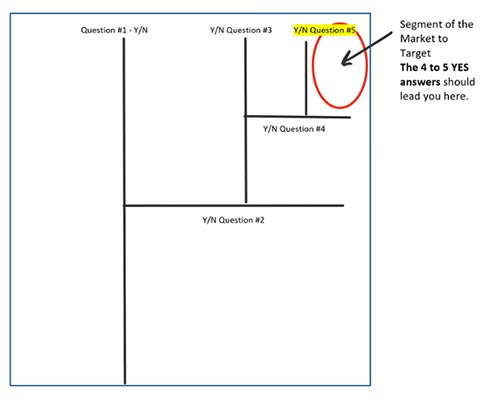
Territory segmentation

Our goal is to identify a singular target customer profile. Through this we will be able to focus our attention on a segment instead of attempting to boil the ocean.

The benefit of taking this type of focus is that customers who fit this segment should care about the same things. Their vocabulary may differ, but their business requirements are likely very similar.

2. Set Your Focus

Now you have identified your ideal customer.  The next step is to determine how many of these customers you should focus your attention on.  Again, the first response might be “every one of them” – why would I limit my success by only going after a handful?  This gets back to some of the discussions we have had around time management and to paraphrase a quote from Gary Keller & Jay Papasan in “The One Thing,” if you prioritize everything, you prioritize nothing.

If little is known about the market, I like to start with a simple number such as 10.  I will research 10 organizations, identify 10 targets, and focus there for the first 30 days.  For this example, let’s assume you already know these important things:

  • Average deal size is 250K
  • The length of Sales Cycle is 6 months
  • Your number for the year is 800K in new business.
  • Historically, you’ve closed 25% of the deals you have moved into Qualification
  • Your pipeline is empty

You will need to close 4 deals at an average of ~250K to hit your number this year to exceed your quota or close 3 deals to live to fight another day.  At a 25% success rate historically, you will need to have 16 opportunities in qualification by the mid-year point.  Based on taking a targeted approach, expect that 50% of the companies you target will move through validation to qualification.  This is the benefit of segmenting your market.  Using this math, within the first 6 months, you will need to engage with 32 companies.

You’ll notice – we worked the math out to target ~10 companies per month in the first quarter of the year.  This is intentional, it allows focus on 3 companies per week in the first month.

This approach scales, if the average deal size is 500K and the number is 1.2M, you need 3 deals.  If the average deal size is 10K, and your number if 300K for the year, you will need ~90 deals over the course of the year.  On the lower end of the spectrum the sales cycle is likely shorter.  On the higher end, it may be longer.

Contact us if you would like to schedule some time to discuss territory planning in your organization or your individual territory.

Let’s Talk

3. What if?

The numbers look great on paper, anyone can come up with some math to support an approach, but what happens if things change?  What if, when you begin engaging with your first 10 targets, you find that a competitor is in the market, and has already penetrated this target?  What if you find that no one is interested in the story, or the pain is not what you expect?

Adapt, Iterate, Repeat

John Boyd introduced us to the OODA loop – Observe, Orient, Decide, Act – REPEAT.  Today, we talk about Agile in the context of software development.  Historically, we have discussed agile in the context of sales.

Your territory plan is a living breathing document, just like the account plan. Take time to adjust and adapt your plan based on the things you learn, as you engage with your customers.

Is the sales cycle shifting to a 9 to 12-month sales cycle?  Increase the number of customers you engage with.

Are deal sizes larger than expected, but more complex than anticipated? Back off your number of targets, and focus on those who are further along in the sales process.

4. Dedicate the Time

The territory plan impacts your long term success.  It is something you control.  Yet so many of us look at this as a one-time event, driven by sales management at the beginning of each year.

Take 30 min to an hour, each week to revisit your territory plan.  Ask yourself what’s changed?  How is the plan working?  Is it still relevant?  If you do this for 1 hour a week, it is less than 2.5% of your workweek, assuming a 40-hour workweek.

As sales professionals, we do not clock in and clock out.  We ultimately are not measured by the number of hours we work, but by the sales we close.

Do the important things. 

If you do not have an hour per week to revisit your territory plan, I would argue that you probably need to allocate two to three times as much time to re-build your territory plan, or you need to expand your team because you are missing out on opportunities.

Looking for more direction? Let’s Talk.

SHOW LINKS
THANK YOU

Thank you for rating and reviewing the podcast via iTunes, Google Play, or your favorite podcast platform.  Ratings & reviews help others discover the podcast – thank you for helping us get the message out to the sales, account management, startup, sales enablement and customer experience community.

Please send listener questions and feedback to hello@catalystsale.com or contact us directly on twitterfacebook or LinkedIn.

Catalyst Sale Offerings

Growth Acceleration – Plateau Breakthrough

Product Market Fit

G+A+M+E Plan

Click Here to see our additional Catalyst Sale Podcast Topics

———————————-

Subscribe to the Catalyst Sale Podcast

Subscribe via Apple Podcasts

Subscribe via Google Play

Catalyst Sale

In every business, in every opportunity, there is someone who can help you navigate the internal challenges and close the deal. There is a Catalyst. We integrate process (Catalyst Sale Process), technology and people, with the purpose of accelerating revenue. Our thoughtful approach minimizes false starts that are common in emerging markets and high growth environments. We continue to evolve our practice based on customer needs and emerging technology. We care about a thinking process that enables results versus a process that tells people what to do.

Sales is a Thinking Process.

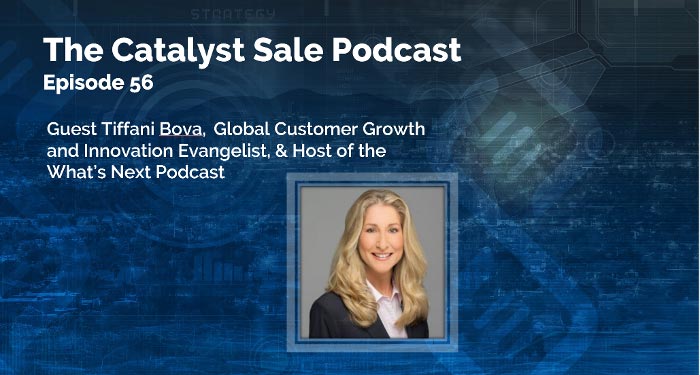
Episode 56 – Innovation in Sales with Tiffani Bova

dealing false start

Tiffani Bova, Global, Customer Growth, Sales and Innovation Evangelist at Salesforce and host of the What’s Next Podcast joins us on the Catalyst Sale Podcast this week to discuss innovation within the sales profession, customer experience, taking ownership of your personal development, and a number of other topics.

“You control how you interact with your customers” – Tiffani Bova

Have you thought about the transition from optimization to transformation to reimagining the customer experience?  Customers and prospects are looking for sales professionals who understand their objectives, needs, requirements, and their business.  Successful sales professionals do right by the customer and build relationships for the long-term

Reimagining Sales

Does your organization describe itself as innovative?  Tiffani thinks about this in the context of three phases.  The first is optimization, followed by transformation, then finally reimagining the business.  When you reimagine the business it is critical that you consider the perspective of the customer or your target audience.

Some questions you may want to consider…

  • How would you reimagine their customer experience?
  • How would you reimagine the way they interact with your business/product/service?
  • How would you reimagine the way your team interacts with your customers?
Diversity in Teams

Diversity in teams is something on Tiffani’s mind, but not just from a human perspective.  She discusses diversity from many angles, including the impact of machines on team diversity.  If your current team is made up of humans, what happens when you incorporate an AI component?

This is something we are just starting to see in the market, and it will be very interesting to see how it improves the customer experience.

“How you Sell Matters”

As Sales professionals, there is very little we control.  Leadership many times provides rails, or even specific direction on process items, templates or scripts.   On a previous episode, we discussed how process, scripts, and rigor stifle the creativity of the sales professional.

There is something we do control.  Tiffani says, “You control how you are in front of the customer”  You control how you interact with the customer, how you engage with the customer, how you empathize with the customer.  Through the noise, remember to show up with your best self, understand what’s important to the customer, and adapt.

What’s Next in Sales Technology

There are a couple of things Tiffani is excited about when it comes to technology and sales.  The idea of integrated systems into workflow, including auto logging of activities,which  is something that will help us improve in efficiency.

Don’t be afraid of technology.  From a sales management perspective, we should be thinking less about how can our team make “100 calls” and more about how can we provide tools that help our team identify the “best 20” to call.  Sales management needs to loosen up metrics,  and we need to move faster when it comes to metrics that matter.

One exciting aspect of machine learning & AI in the sales space, is that the machine can learn at scale from multiple experiences.

Gong.io story – 4 Tips for Nailing Your Sales Discovery Calls

Key Takeaways –
  • Innovation comes when you reimagine the business and the customer experience.
  • There is a technical consideration when it comes to team diversity, it’s not just about gender or experience. Diverse teams may also include AI/Machines as well as a human component.
  • As a sales professional, you control how you interact with your customers, how you communicate, how you serve them.
  • The greatest salesperson is the customer who advocates on behalf of the organization.
  • Build trust, you have to earn the right to ask your customer/prospect for help.
  • Founders – get good at selling – is their life richer because of your product (when do I hire, what role do I hire) good enough, how do I transfer from product led to customer oriented sales org
  • New sales – invest in yourself, learn from others, make it your own
  • Everyone – get comfortable with tech, be conscious of what you put out there
Show Links
Plateau Breakthrough

Are you an organization generating between 10 and 250M in annual sales?  Has growth slowed?  Do you know how you will break through your current plateaus?  Catalyst Sale has established process to help with this.  Contact us today to learn more.

If you have questions about the Catalyst Sale approach, how we help organizations validate and identify product market fit and break through plateaus, you can reach us at hello@catalystsale.com

Thank you for sharing this episode.  If you like what you heard, please provide a rating and/or review via Apple Podcasts, Google Play Music, Stitcher, or your favorite podcast app.

Please send listener questions and feedback to hello@catalystsale.com or contact us directly on TwitterFacebook or LinkedIn.

——————————

Subscribe to the Catalyst Sale Podcast

Subscribe via iTunes

Subscribe via Google Play

Let’s Talk

Catalyst Sale Service Offerings

Growth Acceleration – Plateau Breakthrough

Product Market Fit

Data Analysis

Catalyst Sale

In every business, in every opportunity, there is someone who can help you navigate the internal challenges and close the deal. There is a Catalyst. We integrate process (Catalyst Sale Process), technology and people, with the purpose of accelerating revenue. Our thoughtful approach minimizes false starts that are common in emerging markets and high growth environments. We continue to evolve our practice based on customer needs and emerging technology. We care about a thinking process that enables results versus a process that tells people what to do.

Sales is a Thinking Process.


You can find us via LinkedIn, Twitter, & The Catalyst Sale Website on the links below

Mike Simmons on Twitter

Mike Simmons on LinkedIn

Catalyst Sale Twitter

Catalyst Sale on LinkedIn

Catalyst Sale Website

Episode 55 – Buy vs Build Lists – What should you Do?

tracking key performance indicators on a website

Listener Question – When Does it Make Sense to Buy a Mailing List or List of Leads?

Buy vs Build is one of the most common questions facing business leaders today.  Jordan, a listener in Texas, asks when does it make sense to purchase a list?

This week on the Catalyst Sale podcast we discuss how to create a list when prospecting, as well as how to improve your success when buying a list from many of the services that are out in the marketplace.

The question sparks an additional discussion around buy vs build in general.  When we consider buying vs building, the key factors that play into the decision are time and budget.  Risk, experience, and opportunity costs also play a role in this discussion.   Listen to this week’s podcast, and share your comments with us via twitter.

Questions Discussed
  • When does it make sense to buy a list vs building a list?
  • What factors do we consider when it comes to buying vs building a list?
  • What are the risks with either approach?
  • How does Catalyst Sale evaluate lists?

Work with us

Key Takeaways
  • Whether buying or building – make sure you take the time to test.
  • Identify your buyers and influencers before investing resources.  Who is the buyer?  What are their roles?
  • Create the list based on what you know about the company/market you are targeting.
  • It may make sense to buy in an environment when your expertise is lacking, time is critical, cost/benefit analysis supports the investment, the budget is available.
Show Links

Thank you

Thank you for rating and reviewing the podcast via iTunes, Google Play, or your favorite podcast platform.  Ratings & reviews help others discover the podcast – thank you for helping us get the message out to the community.

Please send listener questions and feedback to hello@catalystsale.com or contact us directly on twitterfacebook or LinkedIn.

Catalyst Sale Service Offerings

Growth Acceleration – Plateau Breakthrough

Product Market Fit

Click Here to see our additional Catalyst Sale Podcast Topics

——————————

Subscribe to the Catalyst Sale Podcast

Subscribe via iTunes

Subscribe via Google Play

Catalyst Sale

In every business, in every opportunity, there is someone who can help you navigate the internal challenges and close the deal. There is a Catalyst. We integrate process (Catalyst Sale Process), technology and people, with the purpose of accelerating revenue. Our thoughtful approach minimizes false starts that are common in emerging markets and high growth environments. We continue to evolve our practice based on customer needs and emerging technology. We care about a thinking process that enables results versus a process that tells people what to do.

Sales is a Thinking Process.

You can find us via LinkedIn, Twitter, & The Catalyst Sale Website on the links below

Mike Conner on Twitter

Mike Simmons on Twitter

Mike Conner on LinkedIn

Mike Simmons on LinkedIn

Catalyst Sale Twitter

Catalyst Sale on LinkedIn

Catalyst Sale Website

Episode 54 – Podcasting to Share Knowledge

sales territory planning

CatalystSalePodcast

Special Episode – Lessons learned in Podcasting with Jody, Mike & Mike

We launched our podcast in October 2016, and we have learned a lot since the launch.  We originally started recording in June, to build up our backlog of content.  It was important to us to be consistent in the delivery of content.  We have delivered new episodes on a weekly basis since the launch, and will continue to do so.

We could not have executed on this endeavor as well as we have, without Jody MaBerry’s partnership.   Jody has provided technical guidance, professional guidance, and has helped us improve our capabilities throughout the journey.

This week on the Catalyst Sale Podcast we discuss why we started the podcast, what we have learned along the way, and what’s to come.

Questions Discussed
  • What have we learned?
  • How does the Podcast fit into the Catalyst Sale Process?
  • What is Sales?
  • Why Podcasting?

Click Here to see our additional Catalyst Sale Podcast Topics

Key Takeaways
  • Nerves got the best of us early on, we finally found our stride when we went off script.  Over time we have gotten more comfortable.
  • We have received great feedback on the many guests we have had on the show.  In hindsight, we would have invited guests early in the process.
  • Consistency is critical – it helps build set expectations, build trust, and has helped us continue on on a positive growth curve.
  • Find the right partner, there is no need to go it alone.
  • Be yourself, don’t try to be someone or something else.
Show Links

We chose podcasting as a way to document our journey, share best practices with the broader community, and create a knowledge base of information that we wish was available to us when we started our careers in sales. We hope you find the content, interviews, and resources valuable.

Thank you

Thank you for rating and reviewing the podcast via iTunes, Google Play, or your favorite podcast platform.  Ratings & reviews help others discover the podcast – thank you for helping us get the message out to the community.

Please send listener questions and feedback to hello@catalystsale.com or contact us directly on twitterfacebook or LinkedIn.

Catalyst Sale Service Offerings

Growth Acceleration – Plateau Breakthrough

Product Market Fit

Work with us

——————————-

Subscribe to the Catalyst Sale Podcast

Subscribe via iTunes

Subscribe via Google Play

Catalyst Sale

In every business, in every opportunity, there is someone who can help you navigate the internal challenges and close the deal. There is a Catalyst. We integrate process (Catalyst Sale Process), technology and people, with the purpose of accelerating revenue. Our thoughtful approach minimizes false starts that are common in emerging markets and high growth environments. We continue to evolve our practice based on customer needs and emerging technology. We care about a thinking process that enables results versus a process that tells people what to do.

Sales is a Thinking Process.

You can find us via LinkedIn, Twitter, & The Catalyst Sale Website on the links below

Mike Conner on Twitter

Mike Simmons on Twitter

Mike Conner on LinkedIn

Mike Simmons on LinkedIn

Catalyst Sale Twitter

Catalyst Sale on LinkedIn

Catalyst Sale Website

Episode 53 – Does Your Process Get in the Way of Progress?

Time Management

Is Your Process Slowing your Progress or Improving Performance?

Process supports scalability and execution.  An effective process is important when creating predictable growth.  Lack of process usually results in higher risk, confusion, and inconsistency.  An ineffective process creates waste.

This week on the Catalyst Sale podcast we discuss how process potentially prevents or limits progress. We also discuss how process for the sake of process may be driven by ego or a lack of understanding.

Evaluating process is a requirement for leadership.  Evaluation requires and understanding of the why behind the process, understanding of the role, understanding of the expected outcomes, and an understanding of what has changed.  The what’s changed could be technology, team mix, customer expectations, etc.

Questions for Consideration

  • What if a rep/team member challenges you on a current process?
  • Constantly ask yourself – why are we doing this?
  • Where Can I Improve?
  • Is this process for you, or is it for the benefit of the team/organization?
  • When is the last time you evaluated your current process to determine if it is yield expected results?

Click Here to see our additional Catalyst Sale Podcast Topics

Key Takeaways

  • This is how we have always done it – should not be your fall back.
  • Create a culture where asking questions is expected – your team should trust you, you should trust your team.
  • When establishing process, begin with the end in mind & establish guideposts.  Give your team the flexibility, the creativity to work within the guideposts.
  • Leverage the strength and experience of your team.  We are smarter than me – Barry Libert and Jon Spector
  • Process for the sake of process stifles creativity, and may take the focus of the team away from the things that really matter.
Show Links
Thank you

Thank you for rating and reviewing the podcast via iTunes, Google Play, or your favorite podcast platform.  Ratings & reviews help others discover the podcast – thank you for helping us get the message out to the community.

Please send listener questions and feedback to hello@catalystsale.com or contact us directly on twitterfacebook or LinkedIn.

Catalyst Sale Service Offerings

Growth Acceleration – Plateau Breakthrough

Product Market Fit

Work with us

——————————-

Subscribe to the Catalyst Sale Podcast

Subscribe via iTunes

Subscribe via Google Play

Catalyst Sale

In every business, in every opportunity, there is someone who can help you navigate the internal challenges and close the deal. There is a Catalyst. We integrate process (Catalyst Sale Process), technology and people, with the purpose of accelerating revenue. Our thoughtful approach minimizes false starts that are common in emerging markets and high growth environments. We continue to evolve our practice based on customer needs and emerging technology. We care about a thinking process that enables results versus a process that tells people what to do.

Sales is a Thinking Process.

You can find us via LinkedIn, Twitter, & The Catalyst Sale Website on the links below

Mike Conner on Twitter

Mike Simmons on Twitter

Mike Conner on LinkedIn

Mike Simmons on LinkedIn

Catalyst Sale Twitter

Catalyst Sale on LinkedIn

Catalyst Sale Website