

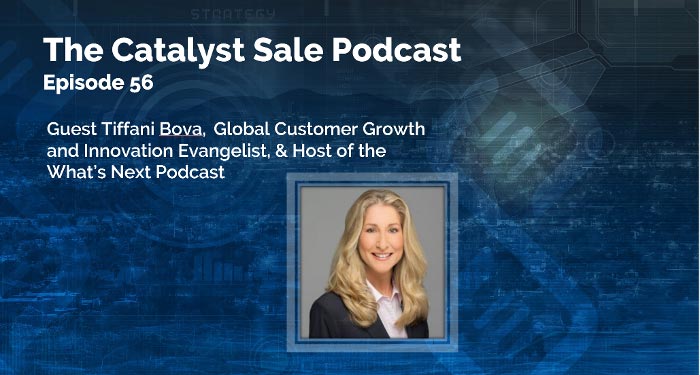
Episode 56 – Innovation in Sales with Tiffani Bova

dealing false start

Tiffani Bova, Global, Customer Growth, Sales and Innovation Evangelist at Salesforce and host of the What’s Next Podcast joins us on the Catalyst Sale Podcast this week to discuss innovation within the sales profession, customer experience, taking ownership of your personal development, and a number of other topics.

“You control how you interact with your customers” – Tiffani Bova

Have you thought about the transition from optimization to transformation to reimagining the customer experience?  Customers and prospects are looking for sales professionals who understand their objectives, needs, requirements, and their business.  Successful sales professionals do right by the customer and build relationships for the long-term

Reimagining Sales

Does your organization describe itself as innovative?  Tiffani thinks about this in the context of three phases.  The first is optimization, followed by transformation, then finally reimagining the business.  When you reimagine the business it is critical that you consider the perspective of the customer or your target audience.

Some questions you may want to consider…

  • How would you reimagine their customer experience?
  • How would you reimagine the way they interact with your business/product/service?
  • How would you reimagine the way your team interacts with your customers?
Diversity in Teams

Diversity in teams is something on Tiffani’s mind, but not just from a human perspective.  She discusses diversity from many angles, including the impact of machines on team diversity.  If your current team is made up of humans, what happens when you incorporate an AI component?

This is something we are just starting to see in the market, and it will be very interesting to see how it improves the customer experience.

“How you Sell Matters”

As Sales professionals, there is very little we control.  Leadership many times provides rails, or even specific direction on process items, templates or scripts.   On a previous episode, we discussed how process, scripts, and rigor stifle the creativity of the sales professional.

There is something we do control.  Tiffani says, “You control how you are in front of the customer”  You control how you interact with the customer, how you engage with the customer, how you empathize with the customer.  Through the noise, remember to show up with your best self, understand what’s important to the customer, and adapt.

What’s Next in Sales Technology

There are a couple of things Tiffani is excited about when it comes to technology and sales.  The idea of integrated systems into workflow, including auto logging of activities,which  is something that will help us improve in efficiency.

Don’t be afraid of technology.  From a sales management perspective, we should be thinking less about how can our team make “100 calls” and more about how can we provide tools that help our team identify the “best 20” to call.  Sales management needs to loosen up metrics,  and we need to move faster when it comes to metrics that matter.

One exciting aspect of machine learning & AI in the sales space, is that the machine can learn at scale from multiple experiences.

Gong.io story – 4 Tips for Nailing Your Sales Discovery Calls

Key Takeaways –
  • Innovation comes when you reimagine the business and the customer experience.
  • There is a technical consideration when it comes to team diversity, it’s not just about gender or experience. Diverse teams may also include AI/Machines as well as a human component.
  • As a sales professional, you control how you interact with your customers, how you communicate, how you serve them.
  • The greatest salesperson is the customer who advocates on behalf of the organization.
  • Build trust, you have to earn the right to ask your customer/prospect for help.
  • Founders – get good at selling – is their life richer because of your product (when do I hire, what role do I hire) good enough, how do I transfer from product led to customer oriented sales org
  • New sales – invest in yourself, learn from others, make it your own
  • Everyone – get comfortable with tech, be conscious of what you put out there
Show Links
Plateau Breakthrough

Are you an organization generating between 10 and 250M in annual sales?  Has growth slowed?  Do you know how you will break through your current plateaus?  Catalyst Sale has established process to help with this.  Contact us today to learn more.

If you have questions about the Catalyst Sale approach, how we help organizations validate and identify product market fit and break through plateaus, you can reach us at hello@catalystsale.com

Thank you for sharing this episode.  If you like what you heard, please provide a rating and/or review via Apple Podcasts, Google Play Music, Stitcher, or your favorite podcast app.

Please send listener questions and feedback to hello@catalystsale.com or contact us directly on TwitterFacebook or LinkedIn.

——————————

Subscribe to the Catalyst Sale Podcast

Subscribe via iTunes

Subscribe via Google Play

Let’s Talk

Catalyst Sale Service Offerings

Growth Acceleration – Plateau Breakthrough

Product Market Fit

Data Analysis

Catalyst Sale

In every business, in every opportunity, there is someone who can help you navigate the internal challenges and close the deal. There is a Catalyst. We integrate process (Catalyst Sale Process), technology and people, with the purpose of accelerating revenue. Our thoughtful approach minimizes false starts that are common in emerging markets and high growth environments. We continue to evolve our practice based on customer needs and emerging technology. We care about a thinking process that enables results versus a process that tells people what to do.

Sales is a Thinking Process.


You can find us via LinkedIn, Twitter, & The Catalyst Sale Website on the links below

Mike Simmons on Twitter

Mike Simmons on LinkedIn

Catalyst Sale Twitter

Catalyst Sale on LinkedIn

Catalyst Sale Website

Episode 55 – Buy vs Build Lists – What should you Do?

tracking key performance indicators on a website

Listener Question – When Does it Make Sense to Buy a Mailing List or List of Leads?

Buy vs Build is one of the most common questions facing business leaders today.  Jordan, a listener in Texas, asks when does it make sense to purchase a list?

This week on the Catalyst Sale podcast we discuss how to create a list when prospecting, as well as how to improve your success when buying a list from many of the services that are out in the marketplace.

The question sparks an additional discussion around buy vs build in general.  When we consider buying vs building, the key factors that play into the decision are time and budget.  Risk, experience, and opportunity costs also play a role in this discussion.   Listen to this week’s podcast, and share your comments with us via twitter.

Questions Discussed
  • When does it make sense to buy a list vs building a list?
  • What factors do we consider when it comes to buying vs building a list?
  • What are the risks with either approach?
  • How does Catalyst Sale evaluate lists?

Work with us

Key Takeaways
  • Whether buying or building – make sure you take the time to test.
  • Identify your buyers and influencers before investing resources.  Who is the buyer?  What are their roles?
  • Create the list based on what you know about the company/market you are targeting.
  • It may make sense to buy in an environment when your expertise is lacking, time is critical, cost/benefit analysis supports the investment, the budget is available.
Show Links

Thank you

Thank you for rating and reviewing the podcast via iTunes, Google Play, or your favorite podcast platform.  Ratings & reviews help others discover the podcast – thank you for helping us get the message out to the community.

Please send listener questions and feedback to hello@catalystsale.com or contact us directly on twitterfacebook or LinkedIn.

Catalyst Sale Service Offerings

Growth Acceleration – Plateau Breakthrough

Product Market Fit

Click Here to see our additional Catalyst Sale Podcast Topics

——————————

Subscribe to the Catalyst Sale Podcast

Subscribe via iTunes

Subscribe via Google Play

Catalyst Sale

In every business, in every opportunity, there is someone who can help you navigate the internal challenges and close the deal. There is a Catalyst. We integrate process (Catalyst Sale Process), technology and people, with the purpose of accelerating revenue. Our thoughtful approach minimizes false starts that are common in emerging markets and high growth environments. We continue to evolve our practice based on customer needs and emerging technology. We care about a thinking process that enables results versus a process that tells people what to do.

Sales is a Thinking Process.


You can find us via LinkedIn, Twitter, & The Catalyst Sale Website on the links below

Mike Conner on Twitter

Mike Simmons on Twitter

Mike Conner on LinkedIn

Mike Simmons on LinkedIn

Catalyst Sale Twitter

Catalyst Sale on LinkedIn

Catalyst Sale Website

Episode 54 – Podcasting to Share Knowledge

sales territory planning

CatalystSalePodcast

Special Episode – Lessons learned in Podcasting with Jody, Mike & Mike

We launched our podcast in October 2016, and we have learned a lot since the launch.  We originally started recording in June, to build up our backlog of content.  It was important to us to be consistent in the delivery of content.  We have delivered new episodes on a weekly basis since the launch, and will continue to do so.

We could not have executed on this endeavor as well as we have, without Jody MaBerry’s partnership.   Jody has provided technical guidance, professional guidance, and has helped us improve our capabilities throughout the journey.

This week on the Catalyst Sale Podcast we discuss why we started the podcast, what we have learned along the way, and what’s to come.

Questions Discussed
  • What have we learned?
  • How does the Podcast fit into the Catalyst Sale Process?
  • What is Sales?
  • Why Podcasting?

Click Here to see our additional Catalyst Sale Podcast Topics

Key Takeaways
  • Nerves got the best of us early on, we finally found our stride when we went off script.  Over time we have gotten more comfortable.
  • We have received great feedback on the many guests we have had on the show.  In hindsight, we would have invited guests early in the process.
  • Consistency is critical – it helps build set expectations, build trust, and has helped us continue on on a positive growth curve.
  • Find the right partner, there is no need to go it alone.
  • Be yourself, don’t try to be someone or something else.
Show Links

We chose podcasting as a way to document our journey, share best practices with the broader community, and create a knowledge base of information that we wish was available to us when we started our careers in sales. We hope you find the content, interviews, and resources valuable.

Thank you

Thank you for rating and reviewing the podcast via iTunes, Google Play, or your favorite podcast platform.  Ratings & reviews help others discover the podcast – thank you for helping us get the message out to the community.

Please send listener questions and feedback to hello@catalystsale.com or contact us directly on twitterfacebook or LinkedIn.

Catalyst Sale Service Offerings

Growth Acceleration – Plateau Breakthrough

Product Market Fit

Work with us

——————————-

Subscribe to the Catalyst Sale Podcast

Subscribe via iTunes

Subscribe via Google Play

Catalyst Sale

In every business, in every opportunity, there is someone who can help you navigate the internal challenges and close the deal. There is a Catalyst. We integrate process (Catalyst Sale Process), technology and people, with the purpose of accelerating revenue. Our thoughtful approach minimizes false starts that are common in emerging markets and high growth environments. We continue to evolve our practice based on customer needs and emerging technology. We care about a thinking process that enables results versus a process that tells people what to do.

Sales is a Thinking Process.


You can find us via LinkedIn, Twitter, & The Catalyst Sale Website on the links below
Mike Conner on Twitter

Mike Simmons on Twitter

Mike Conner on LinkedIn

Mike Simmons on LinkedIn

Catalyst Sale Twitter

Catalyst Sale on LinkedIn

Catalyst Sale Website

Episode 53 – Does Your Process Get in the Way of Progress?

Time Management

Is Your Process Slowing your Progress or Improving Performance?

Process supports scalability and execution.  An effective process is important when creating predictable growth.  Lack of process usually results in higher risk, confusion, and inconsistency.  An ineffective process creates waste.

This week on the Catalyst Sale podcast we discuss how process potentially prevents or limits progress. We also discuss how process for the sake of process may be driven by ego or a lack of understanding.

Evaluating process is a requirement for leadership.  Evaluation requires and understanding of the why behind the process, understanding of the role, understanding of the expected outcomes, and an understanding of what has changed.  The what’s changed could be technology, team mix, customer expectations, etc.

Questions for Consideration

  • What if a rep/team member challenges you on a current process?
  • Constantly ask yourself – why are we doing this?
  • Where Can I Improve?
  • Is this process for you, or is it for the benefit of the team/organization?
  • When is the last time you evaluated your current process to determine if it is yield expected results?

Click Here to see our additional Catalyst Sale Podcast Topics

Key Takeaways

  • This is how we have always done it – should not be your fall back.
  • Create a culture where asking questions is expected – your team should trust you, you should trust your team.
  • When establishing process, begin with the end in mind & establish guideposts.  Give your team the flexibility, the creativity to work within the guideposts.
  • Leverage the strength and experience of your team.  We are smarter than me – Barry Libert and Jon Spector
  • Process for the sake of process stifles creativity, and may take the focus of the team away from the things that really matter.
Show Links
Thank you

Thank you for rating and reviewing the podcast via iTunes, Google Play, or your favorite podcast platform.  Ratings & reviews help others discover the podcast – thank you for helping us get the message out to the community.

Please send listener questions and feedback to hello@catalystsale.com or contact us directly on twitterfacebook or LinkedIn.

Catalyst Sale Service Offerings

Growth Acceleration – Plateau Breakthrough

Product Market Fit

Work with us

——————————-

Subscribe to the Catalyst Sale Podcast

Subscribe via iTunes

Subscribe via Google Play

Catalyst Sale

In every business, in every opportunity, there is someone who can help you navigate the internal challenges and close the deal. There is a Catalyst. We integrate process (Catalyst Sale Process), technology and people, with the purpose of accelerating revenue. Our thoughtful approach minimizes false starts that are common in emerging markets and high growth environments. We continue to evolve our practice based on customer needs and emerging technology. We care about a thinking process that enables results versus a process that tells people what to do.

Sales is a Thinking Process.


You can find us via LinkedIn, Twitter, & The Catalyst Sale Website on the links below

Mike Conner on Twitter

Mike Simmons on Twitter

Mike Conner on LinkedIn

Mike Simmons on LinkedIn

Catalyst Sale Twitter

Catalyst Sale on LinkedIn

Catalyst Sale Website

Episode 52 – Cultivating Partners – Jen Spencer

the proposal step

CatalystSalePodcast

“One of the advantages of partnerships…together you are stronger” – Jen Spencer

Jen Spencer, VP Sales and Marketing – SmartBug Media, joins us on the Catalyst Sale Podcast this week to discuss partners.  She brings her insight to the podcast, and discusses important concepts to keep in mind when identifying partners.  Mike & I also share our experience both from the perspective of an organization looking for partners, and as a partner working inside organizations.

Jen is a wealth of knowledge, we hope you enjoy the discussion.

Determining if a Partner Approach is the Way to Go

Focus on the business outcome.  Are you looking to expand to a new market/vertical? Are you looking to expand the size of your team? How do you plan to grow?  What’s the risk in testing new markets?  What’s the risk in hiring too fast for an emerging market? Is there a benefit to “buying” experience, instead of building capability internally?  These are a number of the questions you should consider as you think about your objectives, and begin to design your plan.

Partners can deliver experience and expertise in verticals and geographies.  They also can provide direct access to a network of potential customers, where your product has the potential to add to their current solution.

Identifying Good Partners

A good partner is one where you can clearly identify a fit with your culture and their culture.  A good partner understands your product fit in the context of their market expertise, and their customer base.  Strong partnerships are built on a foundation of trust and mutual respect for objectives of each other’s organization.

Leverage your network, ask for referrals, check with referrals, and ask to speak with existing customers.  Customers can provide insight into what it is like to work with the partner.

When is it Time to Exit a Partnership

Like any relationship, partnerships may run their course. Once you have identified that the partnership is no longer beneficial to both parties, you should consider your exit strategy.  An exit from a partnership should be handled with the same level and care that you took in the onboarding process.

The exit should never become the problem of the customer.

What Should a Partner Onboarding Program Include?

Onboarding a new member of your sales team is critical when you consider the potential for their success, or risks associated with failure.  Treat your partner onboarding program with the same, if not higher, level of respect.  As Jen mentions in the podcast, partners should have access to the same resources your sales team has access to. They are an extension of your team, treat them like part of your team.

Don’t forget that you are likely one of many things your partner reps have in their bag.  FAQ information, access to a customer success representative or account manager, sharing best practices and case studies, are some of the assets that can help your partners improve success. Remeber – their success is your success.

Remember to set expectations, schedule planning, and review calls, and establish an appropriate communication cadence to keep your partners engaged.  The market continues to change.  If you are meeting with your partner once per year, or once every 6 months, the gap between what they know and what you know, will increase significantly.

Common Errors When Considering Partners

Partnerships fail when you forget to treat the partners as a natural extension of your team. Share sales enablement resources, marketing information, and data analytics.

Some organizations, when setting up partnerships, fail to consider channel conflict.  Channel conflict will happen – plan for it.  Some founders look at partners as a way to access a customer list, gain access to a network, then seek to bring those customers in house. This is a surefire way to alienate a partner and create a horrible reputation.

Think about the trades that occur with partnerships.  You, as the vendor may be trading direct access to the customer.  The partner may be trading the confidence in knowing that their organization has control over the solution, end to end.

Key Takeaways –
  • Begin with the end in mind (This is an ongoing theme that most listeners will recognize)
  • What does success look like? – Design the plan, communicate regularly, use the same cadence as with your sales team
  • Treat your partners like you would treat your direct sales team
  • Establish expectations and execute on those expectations
  • Continue to evaluate success and adapt the relationship as necessary.
  • When it comes to the “Cost of a Partnership” – You get out of it what you put in.

Partners can accelerate your path to growth.  They can open up new markets, and provide an opportunity to test feasibility and fit.

Show Links
Plateau Breakthrough

Are you an organization generating between 10 and 250M in annual sales?  Has growth slowed?  Do you know how you will break through your current plateaus?  Catalyst Sale has established process to help with this.  Contact us today to learn more.

If you have questions about the Catalyst Sale approach, how we help organizations validate and identify product market fit and break through plateaus, you can reach us at hello@catalystsale.com

Thank you for sharing this episode.  If you like what you heard, please provide a rating and/or review via Apple Podcasts, Google Play Music, Stitcher, or your favorite podcast app.

Please send listener questions and feedback to hello@catalystsale.com or contact us directly on TwitterFacebook or LinkedIn.

———————-

Subscribe to the Catalyst Sale Podcast

Subscribe via iTunes

Subscribe via Google Play

Click Here to see our additional Catalyst Sale Podcast Topics

Catalyst Sale Service Offerings

Growth Acceleration – Plateau Breakthrough

Product Market Fit

Catalyst Sale

In every business, in every opportunity, there is someone who can help you navigate the internal challenges and close the deal. There is a Catalyst. We integrate process (Catalyst Sale Process), technology and people, with the purpose of accelerating revenue. Our thoughtful approach minimizes false starts that are common in emerging markets and high growth environments. We continue to evolve our practice based on customer needs and emerging technology. We care about a thinking process that enables results versus a process that tells people what to do.

Sales is a Thinking Process.


You can find us via LinkedIn, Twitter, & The Catalyst Sale Website on the links below
Mike Conner on Twitter

Mike Simmons on Twitter

Mike Conner on LinkedIn

Mike Simmons on LinkedIn

Catalyst Sale Twitter

Catalyst Sale on LinkedIn

Catalyst Sale Website

Episode 51 – Why Patience Matters in Sales

agile sale

CatalystSalePodcast

Patience is a Critical When it Comes to Strategic Sales

An aggressive mentality tends to be something we look for when identifying sales potential.  It is a characteristic that we reinforce when recognizing top performers and one we tend to highlight during an interview process.  What about patience though?  Where does patience fit in?  Can you be patient and aggressive?  Is there a difference between patience when it comes to your career versus how you manage sales cycles?

This week on the Catalyst Sale podcast we discuss patience, revealing urgency, and the importance of planning. We also discuss how a lack of patience may be driven by ego and the risk of letting your ego get in the way.

Planning is Key  

Planning is critical in sales.  When it comes to managing sales cycles, a project plan can help you help your customers navigate the decision process. Develop a plan, and work the plan. When it comes to your career, an honest assessment of where you are and where you want to go are important for your long term success, and determining if you are on the right track.

Is it You or Them?

When you feel a lack of patience is getting in the way, take a breath, and ask yourself is this for the benefit of your customer, or for the benefit of you/your organization.  Self-awareness is a characteristic of good sales professionals and leaders.

Sometimes the delay is due to something out of the customer’s control.  Maybe they recently heard that layoffs are going to occur in the next 90 days.  Maybe something has changed in their budget cycle, maybe something has changed in their personal life.

Click Here to see our additional Catalyst Sale Podcast Topics

Best Practices.
DON’T
  • React
  • Lean on tricks and gimmicks to drive urgency (You can’t create urgency, you can reveal it).
  • Let your perceptions get in the way.
DO
  • Establish what is driving the lack of patience or the urgency from your perspective
  • Establish what is important to your customer
  • Establish a timeline
  • Establish a plan
  • Execute, Evaluate, and Adapt
What’s Next?

Plan the work, work the plan.  This is where 30/60/90/180, past 90, documentation can really help.  Over time your Account Plan should be able to tell a story about where you are going and where you have been.  Communicate with your customer/contact, validate that the plan is still accurate, iterate as necessary.

Take the same approach when thinking about your career.  Communicate with your leadership and mentors, validate that you are on the right track, identify when scenarios have changed, and adjust as necessary.

Thank you

Thank you for rating and reviewing the podcast via iTunes, Google Play, or your favorite podcast platform.  Ratings & reviews help others discover the podcast – we really appreciate your help.

Also, thank you for listening to this week’s podcast. Please send listener questions and feedback to hello@catalystsale.com or contact us directly on twitterfacebook or LinkedIn.

———————-

Catalyst Sale Service Offerings

Growth Acceleration – Plateau Breakthrough

Product Market Fit

———————-

Subscribe to the Catalyst Sale Podcast

Subscribe via iTunes

Subscribe via Google Play

Catalyst Sale

In every business, in every opportunity, there is someone who can help you navigate the internal challenges and close the deal. There is a Catalyst. We integrate process (Catalyst Sale Process), technology and people, with the purpose of accelerating revenue. Our thoughtful approach minimizes false starts that are common in emerging markets and high growth environments. We continue to evolve our practice based on customer needs and emerging technology. We care about a thinking process that enables results versus a process that tells people what to do.

Sales is a Thinking Process.


You can find us via LinkedIn, Twitter, & The Catalyst Sale Website on the links below

Mike Conner on Twitter

Mike Simmons on Twitter

Mike Conner on LinkedIn

Mike Simmons on LinkedIn

Catalyst Sale Twitter

Catalyst Sale on LinkedIn

Catalyst Sale Website

Episode 50 – Highs and Lows of Sales and Life

Highs and lows

Dealing with the Roller Coaster that comes with Sales & Life

Emotions are part of the game in life, and certainly in sales.   Don’t let yourself get too high or too low.  If you read the press clippings or listen to the noise, remember that you are never as good as they say you are, nor are you as bad as you might think you are.  The inverse also applies.

On this week’s podcast, we discuss how we regain focus, and avoid getting too high or too low when it comes to dealing with successes and failures.

Avoid the Peaks & Valleys – Never Get too High, Never Get too Low

A former colleague and I would say this often – be like Eli Manning.  Don’t allow yourself to get too high or too low.  Perform with confidence, have high expectations on the outcomes, and do the right things.  Know that peaks and valleys are just part of the process.  Rejection will happen, and it is part of the path to winning.

Hit the Reset Button

In sales, the common question comes up – “what have you done for me lately?” – when thinking about your number.  Last year was last year, last quarter was last quarter.  Look at each day, week, month, quarter, year, as a new opportunity to succeed.  If last year was great, build on the previous success.

Hit Reset – Take the Course

Best Practices

This is all well and good, and sounds a bit fluffy, but how do you put it into practice.  Here are some things we try to keep in mind when getting out of a rut, overcoming slumps, dealing with false starts, or overcoming a bad year.

DO NOT

  • Let the last strike or miss beat you again.
  • Dwell on the past – whether it was good or bad – it’s in the past.  Learn from it, and move on.
  • Assume you know what is going on inside the head of your customer, prospect, person you are speaking with.

DO

  • Trust your process
  • Seek help
  • Share success and failure
  • Get back in the game
  • Focus on the things you can control
  • Have a pre-game/pre-call routine – We hit on some hockey superstitions in the podcast this week

What’s Next?

Focus.  Trust your process.  Get back in the game, on the dance floor, in the kitchen, on the bike, on the horse, in the moment.    Review your account plan, review your call plan, review your 30/60/90, review your KPIs, use data to help you get unstuck.  Do work.

The Distress of Busyness

Remember – the only thing that you can truly count on is change.  Like many say, if you don’t like the weather in Hawaii or Florida, just wait 10 min.  The good times will not be there forever, nor will the bad times.  If you learn from each opportunity, you will continue to progress in your role.

Please share your personal stories of success or failure, and how you have kept yourself on track.  You can do this in the comments below, via comments in LinkedIn or via Twitter.

Continue reading “Episode 50 – Highs and Lows of Sales and Life”

Episode 49 – Working with Recruiters

dealing false start

CatalystSalePodcast

Listener Question – What are some best practices to consider when working with recruiters?

Mike Conner is back this week, he and I tackle a listener question from Max in California.  Max is interested in our perspective on working with recruiters.  Specifically best practices, best approach & some ideas around what has worked for us in the past.

On this week’s podcast, Mike & I discuss some of the following considerations when working with recruiters and how to identify a great recruiter.

Recruiters – The Key to your Success?

Recruiters can be the key to a successful job hunt, or perceived as a barrier that prevents success.  Keep in mind, the objectives of the recruiter, from my perspective.

  • Identify the right candidate
  • Identify someone who will be in the role for at least 12 months
  • Keep their customer happy (happy customers lead to more business)
  • Make the process easy on their customer
  • Filter out those who are not the right fit
  • Build a network of viable candidates

The recruiter is not there to get you the job.  They identify prospects for a role, qualify the prospect, determine fit/feasibility, and help you navigate the interview/hiring process.  The most successful recruiters I’ve had an opportunity to work with approach their job as a sales professional working on behalf of their customer.  This could be their employer, or they could be a freelance recruiter.  The comp structure changes in each scenario, but the objective remains the same.

In previous episodes we also discuss hiring sales reps, finding your next sales role, and our sales process in general.

Click Here to see our additional Catalyst Sale Podcast Topics

Common Mistakes & Some Best Practices

We also discuss some horror stories we have experienced as part of a hiring project we are currently working on.  It is amazing how early career sales professionals (and even those later in their careers) can miss the easy things, like personalizing their email/cover letter.   Some of the most common DO’s & DONT’s when it comes to working with a recruiter follow.

DO NOT


  • Make you “getting the job”, their problem.
  • Pester the recruiter – just checking in/following up is a bad approach.
  • Spray and pray.
  • Expect them to do your job
  • Diminish their value
DO


  • Personalize your communication
  • Deliver information in context
  • Deliver value in each of your engagements (customer news, news about the recruiter, something informative)
  • Help them establish fit
  • Be clear about your objectives, what you enjoy doing, what you want to do, why you want to do it
  • Be Realistic
  • Treat the relationship like you would treat your most important relationships
  • Leverage your network
  • Your Job – finding a new company to work with or identifying a job (when you decide to do so) is likely your most important sales cycle.
Finding a Good Fit

Identifying a couple of go to recruiters has been critical to our success.  Building a relationship is important, and takes time.  It also requires cultivation.  You should treat this like you would any other complex sale you have managed.  Remember the recruiters’ objectives.  Be transparent about yours.  Keep the recruiter updated on how your career is progressing.  Stay in the know about how their business or their career is progressing.  They are not just a vehicle or a roadblock to your next opportunity.  They can be the oracle that brings that next opportunity to your attention.

Please let us know if you would like us to have a recruiting expert join us on a future episode of the Podcast.  A good recruiter can be worth their weight in gold.  If the foundation is not based on trust and clear expectations, how can you expect them to execute?

Thank you

Thank you for rating and reviewing the podcast via iTunes, Google Play, or your favorite podcast platform.  Ratings & reviews help others discover the podcast – thank you for helping us get the message out to the community.

Also, thank you for listening to this week’s podcast. Please send listener questions and feedback to hello@catalystsale.com or contact us directly on twitterfacebook or LinkedIn.

Catalyst Sale Service Offerings

Growth Acceleration – Plateau Breakthrough

Product Market Fit

———————-

Subscribe to the Catalyst Sale Podcast

Subscribe via iTunes

Subscribe via Google Play

Catalyst Sale

In every business, in every opportunity, there is someone who can help you navigate the internal challenges and close the deal. There is a Catalyst. We integrate process (Catalyst Sale Process), technology and people, with the purpose of accelerating revenue. Our thoughtful approach minimizes false starts that are common in emerging markets and high growth environments. We continue to evolve our practice based on customer needs and emerging technology. We care about a thinking process that enables results versus a process that tells people what to do.

Sales is a Thinking Process.


You can find us via LinkedIn, Twitter, & The Catalyst Sale Website on the links below

Mike Conner on Twitter

Mike Simmons on Twitter

Mike Conner on LinkedIn

Mike Simmons on LinkedIn

Catalyst Sale Twitter

Catalyst Sale on LinkedIn

Catalyst Sale Website

Episode 48 – Onboarding – Ira Bernstein – Rampt Consulting

tracking key performance indicators on a website

CatalystSalePodcast

“Slow down to Speed Up” – Ira Bernstein

Ira Bernstein joins us on the Catalyst Sale Podcast this week to discuss onboarding.  He brings his insight to the table and discusses the common issues and challenges associated with looking at onboarding as a one-time event vs. a continuous progression.

Perspective is critical – start first with where you want the employee to be.

As Covey said, and we have referenced many times in the past, “begin with the end in mind”.  Start first with where you want the employee to be at 2 weeks, 4 weeks, 8 weeks down the road, and work backward.

Where does it Fit?

We have talked historically about the disconnect between sales and marketing.  We have discussed Sales Enablement and Sales Ops.  Often times, onboarding is looked at as a learning and development function and rolls up to Human Resources.  There are many options to consider and pros/cons to each.  There is a practical application component when it comes to onboarding being driven by the sales org.  This is something to consider when thinking about onboarding sales professionals.  The same should hold true for having it sit within marketing for marketing pros, operations for operations pros, etc.  When designing your onboarding plan, don’t forget the SME (Subject Matter Expert).  Is there value in the designer “carrying a bag”?  Yes, but it is probably not realistic – at a minimum current reps should have some level of influence/impact on how your onboarding program evolves.

What’s the purpose of assessment in the onboarding process?

Ira looks at this as a way to determine if the person was paying attention to the lessons/information discussed.  Daily and weekly assessments can help with this.  You should look for ways to test in a client environment if possible.  Consider role plays, recording videos, and job-shadowing in your design.

What about manager accountability?

Something to consider here is how you are supporting the sales management team.  An effective onboarding program should have tracking in place and specific milestones.  The data should help your managers evaluate success, and identify areas of risk.  Ira recommends a calendar, with scheduled checkpoints and milestones in place.

Key Takeaways –
  • When considering building your onboarding program – design with an expected set of outcomes.
  • Determine if knowledge transfer is occurring – set tests to validate assumptions.
  • Beware of jargon, and focus on what you want them to learn.  As an example – How often do you want them to use the acronyms in their engagement with the customer base?
  • Simplifying the onboarding process – can have a positive impact.
  • Have a calendar/timeline in place and execute.
Show Links
Product Market Fit

Is your sales team not generating revenue at the rate you expect?  Are you sure that your fit within the market is still valid/correct?  How oftern do you gather data from your team & your client base?  Catalyst Sale has established process to help with this.  Contact us today to learn more.  If you have questions about the Catalyst Sale approach, how we help organizations validate and identify product market fit and break through plateaus, you can reach us at hello@catalystsale.com

Thank you for sharing this episode.  If you like what you heard, please provide a rating and/or review via Apple Podcasts, Google Play Music, Stitcher, or your favorite podcast app.

Please send listener questions and feedback to hello@catalystsale.com or contact us directly on TwitterFacebook or LinkedIn.

———————-

Click Here to see our additional Catalyst Sale Podcast Topics

Catalyst Sale Service Offerings

Growth Acceleration – Plateau Breakthrough

Product Market Fit

Data Analysis

Subscribe to the Catalyst Sale Podcast

Subscribe via iTunes

Subscribe via Google Play

Catalyst Sale

In every business, in every opportunity, there is someone who can help you navigate the internal challenges and close the deal. There is a Catalyst. We integrate process (Catalyst Sale Process), technology and people, with the purpose of accelerating revenue. Our thoughtful approach minimizes false starts that are common in emerging markets and high growth environments. We continue to evolve our practice based on customer needs and emerging technology. We care about a thinking process that enables results versus a process that tells people what to do.

Sales is a Thinking Process.


You can find us via LinkedIn, Twitter, & The Catalyst Sale Website on the links below

Mike Conner on Twitter

Mike Simmons on Twitter

Mike Conner on LinkedIn

Mike Simmons on LinkedIn

Catalyst Sale Twitter

Catalyst Sale on LinkedIn

Catalyst Sale Website

Episode 46 – Your Data Tells a Story – Matt Ostanik – CEO FunnelWise

dealing false start

CatalystSalePodcast

Guest – Matt Ostanik – Founder, CEO, FunnelWise

Matt Ostanik is our guest on this week’s podcast.  Matt is the CEO of FunnelWise. He previously founded and grew Submittal Exchange, a provider of web-based collaboration tools for commercial construction projects. In a five-year period, Matt grew the company from two employees to more than 100 and more than 100,000 users of their software. He sold Submittal Exchange to Textura Corporation (NYSE: TXTR) in 2011 and remained its president. He served on the executive team at Textura when the company completed a successful IPO on the New York Stock Exchange in 2013.

Sales and Marketing – Addressing the Disconnect

One of the most common disconnects between sales and marketing are the measurements of success.  Marketing may be measured by the number of people who enter the stadium, while sales is measured on the revenue generated at the concession stands, the souvenir shop, the increase in season tickets.  This metaphor applies in B2C, B2B, sports, culture, etc.

Beyond the metrics, there is usually a disconnect in vocabulary.  MQL vs SQL vs Nurturing vs Qualification vs Discovery vs Fit/Feasibility vs … the list can go on and on.  A Funnel Blueprint can help you address these gaps.

Click Here Discuss Using Data to Address the Disconnect Between Sales & Marketing

The Revenue Funnel Science Framework

Revenue Funnel Science is a methodology to help businesses better measure, forecast and optimize their revenue funnels. It documents and teaches best practices, while combining the application of data and science to effectively manage the revenue funnel. Think of it as data science for the revenue funnel.

  1. Build the Foundation – To build the foundation, a funnel blueprint is needed to define the requirements for each stage of the buyer’s journey (from the top of the funnel to the paying customer at the bottom)
  2. Connect the Dots – Once businesses have the tools in place to properly monitor the funnel and connect the dots, they can now take the next action to optimize the revenue funnel
  3. Operationalize the Funnel – Establishing a Revenue Leadership Team with a defined cadence of weekly, monthly and quarterly meetings is the starting point. By gathering the relevant information, leadership and key stakeholders – such as marketers, sales leaders, CFOs, CEOs, board members or investors – can strategically plan to grow their business.
How “Your Data Always Tells a Story”

Are you listening to what it is saying?  There are a couple of things your data should do.  First, it should answer a question, then it should ask two more, according to Matt.  What is your data doing for you?  How are you interpreting it?

Confirmation Bias

Are you looking to your data to reinforce your current assumptions or expectations?  If so, are you stopping your analysis too soon?  This creates a significant amount of risk, and reduces the chance of identifying potential growth opportunities.  This also creates a potential scenario where you direct the organization down a path based on assumptions that could set you back several months.  Measure twice – cut once.

Accelerate Growth

Your data may be the key that will unlock your growth potential.  Is there a team or individual rep that is outperforming the norm?  Do you know why?  What if that performance could be transferred?  What about within a specific product or vertical?  This is where sub-funnel analysis can help.

Thank you for sharing this episode.  If you like what you heard, please provide a rating and/or review via Apple Podcasts, Google Play Music, Stitcher, or your favorite podcast app.

Show Links

Revenue Funnel Science

FunnelWise

Data – Disconnect between Sales & Marketing – Catalyst Sale

Matt Ostanik on Twitter – @funnelwisematt

FunnelWise on Twitter – @funnelwise

Learn More About FunnelWise

Since FunnelWise launched in early 2014, we have created a single source of truth for sales and marketing to rely on for revenue funnel metrics, allowing businesses to determine future outcomes, set attainable goals and predict revenue. But it’s our discipline, Revenue Funnel Science, and our dedicated team of experts who have established FunnelWise as the industry leader in full-funnel intelligence.

If you have questions about the Catalyst Sale approach, how we help organizations validate and identify product market fit and break through plateaus, you can reach us at hello@catalystsale.com

Please send listener questions and feedback to hello@catalystsale.com or contact us directly on TwitterFacebook or LinkedIn.

Contact us today to learn more.

————————

Please send them to hello@catalystsale.com or contact us directly on twitter, facebook or LinkedIn.

Subscribe to the Catalyst Sale Podcast

Subscribe via iTunes

Subscribe via Google Play

Click Here to see our additional Catalyst Sale Podcast Topics

Catalyst Sale

In every business, in every opportunity, there is someone who can help you navigate the internal challenges and close the deal. There is a Catalyst. We integrate process (Catalyst Sale Process), technology and people, with the purpose of accelerating revenue. Our thoughtful approach minimizes false starts that are common in emerging markets and high growth environments. We continue to evolve our practice based on customer needs and emerging technology. We care about a thinking process that enables results versus a process that tells people what to do.

Sales is a Thinking Process.


You can find us via LinkedIn, Twitter, & The Catalyst Sale Website on the links below

Mike Conner on Twitter

Mike Simmons on Twitter

Mike Conner on LinkedIn

Mike Simmons on LinkedIn

Catalyst Sale Twitter

Catalyst Sale on LinkedIn

Catalyst Sale Website