
Sales Territory Planning That Works

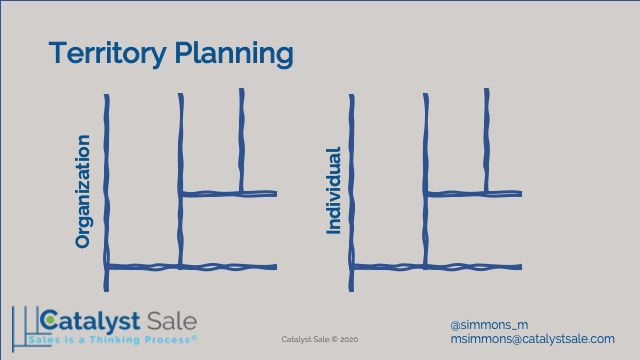
the catalyst sale territory template

Territory Planning – A Catalyst Sale Approach

Territory planning is where it all begins.  You establish the outer guideposts for where you will focus your attention.  The broader this range is, the higher the risk.  The more targeted, based on data, the lower the risk.

How to Create a Sales Territory Plan from Scratch

Let’s say you have joined a new team, you have picked up a new territory, or you are asked to build your plan from a clean slate.  In this scenario, we’ll start with a blank whiteboard.

On the left side of the whiteboard, write down what you know about your “Ideal Customer”.  Who are they, why do they buy, what do they care about, why do they care about it, how does it impact their company (team, line of business, their role)?  (the who & the why.)

On the right side of the whiteboard, start with what you do really well.  Not an all-encompassing everything you do for your customers, but the three to five things that you do really well. (the what)

Use the middle of the board to start refining your target.  In the following scenario, we are delivering a sales enablement technology that supports onboarding of new sales professionals & educating existing professionals on new products that the company is bringing to market. Follow along to see how to complete your planning board.

Remember – Don’t Boil the Ocean

Who is your ideal customer?  The optimistic rep might say “anyone who has a sales team”.  This likely describes most organizations you are familiar with, and sounds good, but targeting this base would be the equivalent of trying to boil the ocean.

There are a number of organizations out there that have seen minimal growth in their sales teams over the past 24 months.  Some, through technology and specialization, may be shrinking this audience.  Others may be selling the same product to the same market for the past five to 10 years. These organizations are neither expanding their team nor rolling out new products to market.  They likely do not have a need for a sales enablement platform that supports onboarding new team members or educating existing team members on new products.

1. Defining Your Target Audience

Now draw a vertical line down the center of the whiteboard – ask a Yes/No question that helps you distinguish between those who are in your market, and all others.  Your targets should fall to the right.  (An illustration follows)

Draw a perpendicular line to the first line, just to the right of your first line. Then, ask a second Y/N question that helps to further distinguish your target market. Your targets should now fall above the second line.  You are further segmenting your target market, and creating focus.  Repeat this process with a minimum of 4 questions.  This will help keep you and your team focused.

For Example
  • Question #1 – Organization has a sales team (Y/N)?
  • Question #2 – Sales team has grown in the past year, and based on organization growth, looks like they will continue to do so (Y/N)?
  • Question #3 – Organization continues to roll out new product capabilities to the market (Y/N)?
  • Question #4 – Organization has a “Sales Enablement” function (Y/N)?
  • Question #5 – Organization is located within my territory (Y/N)?
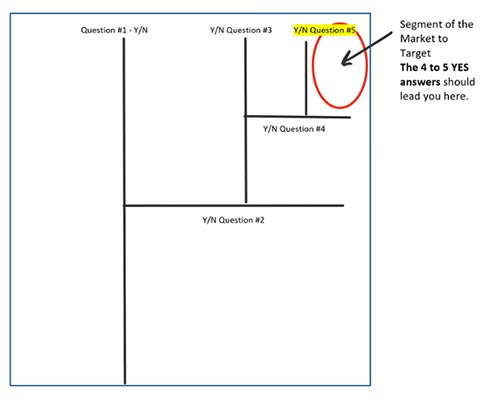
Territory segmentation

Our goal is to identify a singular target customer profile. Through this we will be able to focus our attention on a segment instead of attempting to boil the ocean.

The benefit of taking this type of focus is that customers who fit this segment should care about the same things. Their vocabulary may differ, but their business requirements are likely very similar.

2. Set Your Focus

Now you have identified your ideal customer.  The next step is to determine how many of these customers you should focus your attention on.  Again, the first response might be “every one of them” – why would I limit my success by only going after a handful?  This gets back to some of the discussions we have had around time management and to paraphrase a quote from Gary Keller & Jay Papasan in “The One Thing,” if you prioritize everything, you prioritize nothing.

If little is known about the market, I like to start with a simple number such as 10.  I will research 10 organizations, identify 10 targets, and focus there for the first 30 days.  For this example, let’s assume you already know these important things:

  • Average deal size is 250K
  • The length of Sales Cycle is 6 months
  • Your number for the year is 800K in new business.
  • Historically, you’ve closed 25% of the deals you have moved into Qualification
  • Your pipeline is empty

You will need to close 4 deals at an average of ~250K to hit your number this year to exceed your quota or close 3 deals to live to fight another day.  At a 25% success rate historically, you will need to have 16 opportunities in qualification by the mid-year point.  Based on taking a targeted approach, expect that 50% of the companies you target will move through validation to qualification.  This is the benefit of segmenting your market.  Using this math, within the first 6 months, you will need to engage with 32 companies.

You’ll notice – we worked the math out to target ~10 companies per month in the first quarter of the year.  This is intentional, it allows focus on 3 companies per week in the first month.

This approach scales, if the average deal size is 500K and the number is 1.2M, you need 3 deals.  If the average deal size is 10K, and your number if 300K for the year, you will need ~90 deals over the course of the year.  On the lower end of the spectrum the sales cycle is likely shorter.  On the higher end, it may be longer.

Contact us if you would like to schedule some time to discuss territory planning in your organization or your individual territory.

Let’s Talk

3. What if?

The numbers look great on paper, anyone can come up with some math to support an approach, but what happens if things change?  What if, when you begin engaging with your first 10 targets, you find that a competitor is in the market, and has already penetrated this target?  What if you find that no one is interested in the story, or the pain is not what you expect?

Adapt, Iterate, Repeat

John Boyd introduced us to the OODA loop – Observe, Orient, Decide, Act – REPEAT.  Today, we talk about Agile in the context of software development.  Historically, we have discussed agile in the context of sales.

Your territory plan is a living breathing document, just like the account plan. Take time to adjust and adapt your plan based on the things you learn, as you engage with your customers.

Is the sales cycle shifting to a 9 to 12-month sales cycle?  Increase the number of customers you engage with.

Are deal sizes larger than expected, but more complex than anticipated? Back off your number of targets, and focus on those who are further along in the sales process.

4. Dedicate the Time

The territory plan impacts your long term success.  It is something you control.  Yet so many of us look at this as a one-time event, driven by sales management at the beginning of each year.

Take 30 min to an hour, each week to revisit your territory plan.  Ask yourself what’s changed?  How is the plan working?  Is it still relevant?  If you do this for 1 hour a week, it is less than 2.5% of your workweek, assuming a 40-hour workweek.

As sales professionals, we do not clock in and clock out.  We ultimately are not measured by the number of hours we work, but by the sales we close.

Do the important things. 

If you do not have an hour per week to revisit your territory plan, I would argue that you probably need to allocate two to three times as much time to re-build your territory plan, or you need to expand your team because you are missing out on opportunities.

Looking for more direction? Let’s Talk.
SHOW LINKS
THANK YOU

Thank you for rating and reviewing the podcast via iTunes, Google Play, or your favorite podcast platform.  Ratings & reviews help others discover the podcast – thank you for helping us get the message out to the sales, account management, startup, sales enablement and customer experience community.

Please send listener questions and feedback to hello@catalystsale.com or contact us directly on twitterfacebook or LinkedIn.

Catalyst Sale Offerings

Growth Acceleration – Plateau Breakthrough

Product Market Fit

G+A+M+E Plan

Click Here to see our additional Catalyst Sale Podcast Topics

———————————-

Subscribe to the Catalyst Sale Podcast

Subscribe via Apple Podcasts

Subscribe via Google Play

Catalyst Sale

In every business, in every opportunity, there is someone who can help you navigate the internal challenges and close the deal. There is a Catalyst. We integrate process (Catalyst Sale Process), technology and people, with the purpose of accelerating revenue. Our thoughtful approach minimizes false starts that are common in emerging markets and high growth environments. We continue to evolve our practice based on customer needs and emerging technology. We care about a thinking process that enables results versus a process that tells people what to do.


Sales is a Thinking Process.

The LinkedIn SSI Score – Does it Correlate to Sales Success?

the proposal step

Host Question – What is an SSI Score?

Jody threw us a curveball this week, with his own question.  He has heard Mike and I give each other a hard time about our individual SSI score, and finally asked – what is an SSI score?  This prompted a discussion and a Catalyst Sale Research Project.

There’s an old saying in business – “Be careful what you measure, because what you measure is what you will get”. In the sales profession, we measure a number of things – from booked revenue, which is a lagging indicator of success, to several leading indicators tied to sales process velocity and opportunity valuations based on sales process execution.

We discussed some of these metrics on a previous podcast with Matt Ostanik

Click Here To Discuss How You Can Use Data to Address the Disconnect Between Sales & Marketing
There are also a slew of other things we measure, many of which are activity-based metrics. Ideally, these are things that if we complete them in a consistent way, can become predictors of our eventual sales success.

This final category can be the most daunting as we have to be certain that what we measure actually drives desired outcomes. For example, if we think that making a hundred outbound calls a day will result in our desired sales results, we will begin setting expectations and measuring outbound call activity. Or, we could measure the number of opportunities a sales development representative hands off to an account executive on a weekly basis. The possibilities are endless, and normally, the devil is in the details as a single metric rarely tells the whole story.

Not only do we measure certain activities, but we then model compensation plans and incentives around these metrics to ensure sales reps are focused on the right things. In some cases, we have gone as far as adding a “gamification” element into the mix to leverage our sales reps competitive nature. When done right, this can be a good thing. When done poorly, we can drive the wrong behaviors and ultimately miss our most important objective which is generating revenue.

LinkedIn SSI Score

Which brings us to a topic we have found very interesting in recent years. The LinkedIn Social Selling Index score. From a product perspective, it is a brilliant idea. Most sales leaders have bought into the fact that leveraging tools like LinkedIn to help drive social selling strategies is a necessary component of any B2B selling strategy, and the Social Selling Index score is designed to reward sales reps with a higher score if he or she engages with the platform. Due to our competitive nature as sales reps, we seem pretty motivated to obtain a higher score. In fact, for some people, it has become a badge of honor – many “social selling experts” often tout their scores, and mention how they rank among other gurus.

So this begs a few questions – and the reason for the Catalyst Sale SSI score survey. We want to answer the following question: Is there an optimal SSI score?  Some would suggest that the higher the better, but in our own experience in managing sales teams, we hypothesize there is a point of diminishing return in attempting to elevate your SSI score.

On this week’s episode of the Catalyst Sale Podcast, we discuss a research project we are kicking off at Catalyst Sale.  We are interested in gathering industry data on the LinkedIn SSI score.  Is there a direct correlation between the SSI score and individual or team sales performance?  Is there an ideal SSI score?

Important Links

Thank you for participating in the survey.  We will share the results with all participants who provide their contact information.  Data will be reported anonymously.

Thank you for listening to this week’s podcast. Please send listener questions and feedback to hello@catalystsale.com or contact us directly on twitterfacebook or LinkedIn.

Thank you for rating and reviewing the podcast via iTunes, Google Play, or your favorite podcast platform.  Ratings & reviews help others discover the podcast – thank you for helping us get the message out to the community.

———————-

Click Here to see our additional Catalyst Sale Podcast Topics

Catalyst Sale Service Offerings

Growth Acceleration – Plateau Breakthrough

Product Market Fit

Subscribe to the Catalyst Sale Podcast

Subscribe via iTunes

Subscribe via Google Play

Catalyst Sale

In every business, in every opportunity, there is someone who can help you navigate the internal challenges and close the deal. There is a Catalyst. We integrate process (Catalyst Sale Process), technology and people, with the purpose of accelerating revenue. Our thoughtful approach minimizes false starts that are common in emerging markets and high growth environments. We continue to evolve our practice based on customer needs and emerging technology. We care about a thinking process that enables results versus a process that tells people what to do.
Sales is a Thinking Process.

Why Your Leadership is Crushing Your Sales Culture

Why-Your-Leadership-is-Crushing-Your-Sales-Culture

When you are building a sales team, you want to give them an advantage, so it makes sense to lay out your sales process, step by step, right?

You provide scripts, checklists, and a playbook to outline the process so your sales team can follow every step of the way. This is how to build a successful sales team, right?

Wrong.

Your processes are killing your sales culture, but – What is Sales?

Sales is a thinking process.

Too many companies teach their sales team how to execute a process, rather than to think.

Your scripts, checklists, and playbooks are getting in the way. Your team is just doing what they are told to do. You are effectively telling your team how to think.

Directions work for Hot Pockets; remove the wrapper, place Hot Pocket in the sleeve, microwave 2 minutes. It makes sure your Hot Pocket comes out exactly as it should.

A detailed playbook works for McDonald’s. Burgers come out the same every time at every location. People are served quickly, but they are all served the same.

You would never use step-by-step directions or a detailed playbook at a gourmet restaurant. Your staff takes the time to interact with the customer and find out their tastes and preferences. Each meal is created as a unique solution for the diner’s experience. Serving customers in this restaurant is not a no-brainer. It takes discretion and creativity. You have to think.  You should build rapport.

The same is true for how your sales team should serve customers.

To build an effective sales team, your culture has to support a thinking process. Give your team room to be creative. A sales professional needs to think about a customer’s problems. Be creative. Forget about a process that requires you to execute steps A through Z.

Instead, a successful sales culture allows a sales team to use a process that allows them to think.

SCHEDULE A PLATEAU BREAKTHROUGH DISCUSSION

Why is this more effective than a clearly defined process?

When you give people the ability to think and be creative, they can become more effective with their clients. They no longer worry about what is the next step in the process. Instead, they consider what they are doing with their clients.

Your sales team will think about a customer’s problem and work for a solution. As this becomes practice, your sales culture will be centered on your team’s ability to think.

The problem is not a sales problem or a problem with your processes. It is a leadership problem. Sales leadership is not about doing the work for your team. Sales leadership is not about creating a playbook that shows exactly how to execute every sales call with specific questions to ask.

Sales Leadership is about focusing on concepts and objectives the team as a whole is trying to accomplish. Then, you give your team the ability to be creative and use a thinking process to solve their customer’s problems. A thinking salesperson will align a solution with what is most important to the customer.

By taking this role, you as a leader, become a catalyst for your sales team to become themselves in their role in the company. It is rewarding for a salesperson to feel they are creative and a providing a solution for the customer, not just following directions.

The One Step You Miss With Every Sale

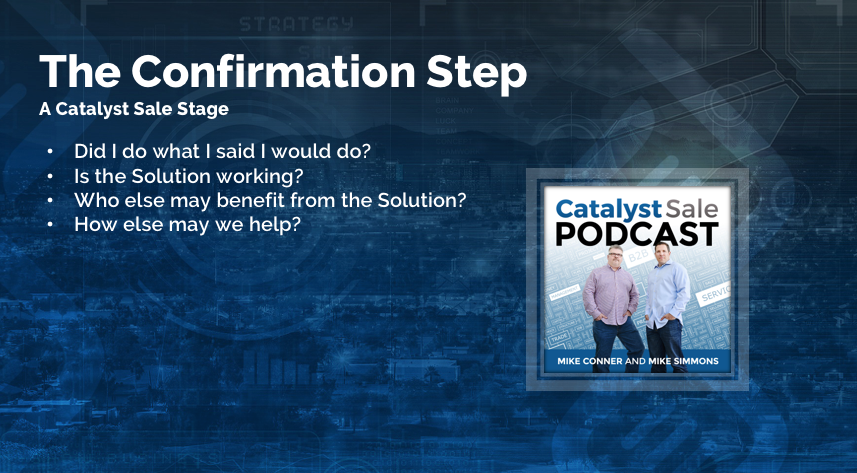
Confirmation Step - Catalyst Sale Process

What is the mindset of most salespeople when they close a sale?

Be honest, if you are like 99% of people in sales when you close a sale you consider your responsibilities are over.

Most salespeople think, “I’ve done my job. Time to move on to the next thing.”

To be fair, in some companies you technically may not have responsibility for the account or relationship once the sale is made. Perhaps the account is handed off to an account manager or a customer success manager.

Even in those cases, where the responsibility passes to someone else in the organization, there is something you can do to put you in the top 1% of sales professionals.

By now, you probably expect to learn a groundbreaking tip or a new system to put in place, but it is nothing new, and it is not complex. It is one simple step.

Follow up with the customer.

I am not talking about calling to say “Thank you for your business.” Nor am I talking about a nice handwritten note.

You need to have an honest conversation with the customer to make sure the commitments you made during the sales process have been met by you and your team. And here is the hard part… then you listen.

Your follow up call can begin with a few simple questions;

“During the process when we talked about the problem we’re going to solve for you, I made personal commitments. I committed my company to do some things that are out of my reach personally. I want to know, how did we do? Did we meet your expectations? Was there anything we missed? Are any of our commitments still pending?”

You are looking for closure for the commitments you made to the customer. Did you deliver? Did you do what you said you would do?

In short, you are simply asking “Did I do what I said I would do?”

Your personal credibility with that organization and the buyer will become the foundation for long-term business. Even if you will not manage the account after making a sale, this is important. This simple step will give a good start to the relationship with the customer. And you give your counterpart or peer, who is inheriting the account, a solid launching point to build on the relationship.

Can you really set yourself apart with something so simple?

Think about your experience as a buyer. How many times has a salesperson followed up with you like this? In the last ten years, I have experienced this two, maybe three times. It is rare.

Usually, when you hear from a salesperson after a transaction, how often do they ask about you? How often do they ask if you as satisfied, or if they met your needs?

Instead, they may ask you for referrals. Or they remind you to fill out a survey, which is really about them, not you. Surveys are usually tied to bonuses. If a salesperson asks “what can I do to earn a 10-star rating?” they are not asking what they can do for you. Instead, they are telling you what you can do for them.

Try this today. Call the customer you last sold to. Simply ask “Did I meet your expectations?”

Listen to what they say. Act on what they tell you. Expect nothing in return.

Qualification is the step most rushed by sales rep
Click here to learn why its costing you sales