
What is a Process?
A series of steps that when followed, in a particular order leads to the expected results.
The definition of sales process shifts depending on if you are looking at it through the lens of the customer, the business, or the individual.
Most look at the process through the lens of the rep or the customer, or make the mistake of combining all three.
Each process has a distinct Job to be Done.
Benefits of Having a Sales Process
Forecasting
When using a process, you are able to create timelines and know where you are going to stand day, weeks, or months from now.
Creating Predictability
After using a process for awhile and gather data on it, you will be able to make estimates based off numbers.
Identifying Risk
Leaning into your data can help you identify outliers and any potential gaps withing your process.
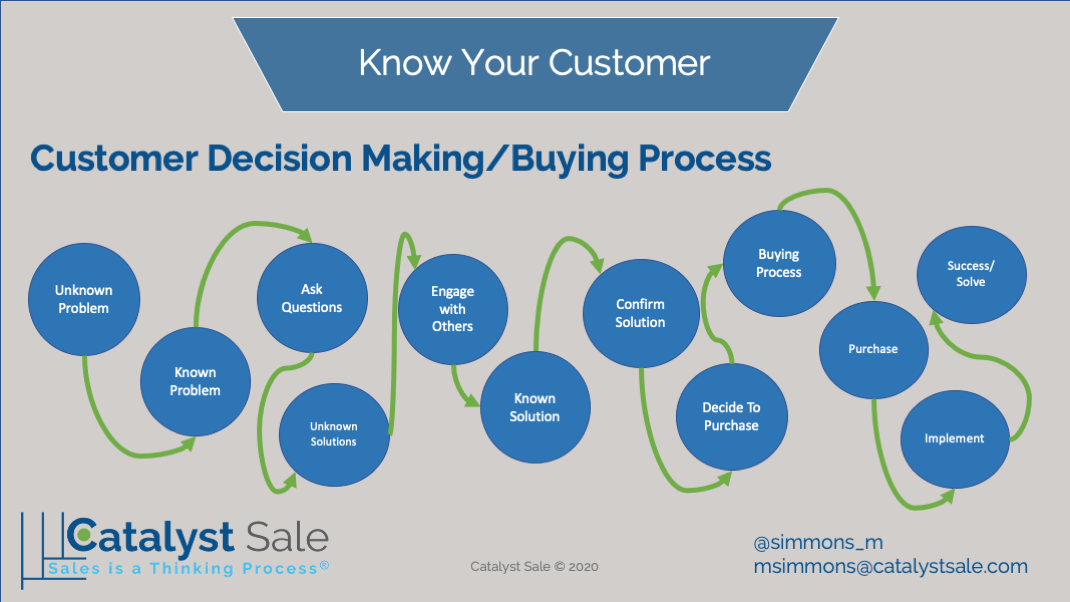
Know your customer
Understand the Buying Process
Before you interject yourself into the process, you've got to know where your customer is coming from. Why are they looking for a solution? What will go into their decisions?
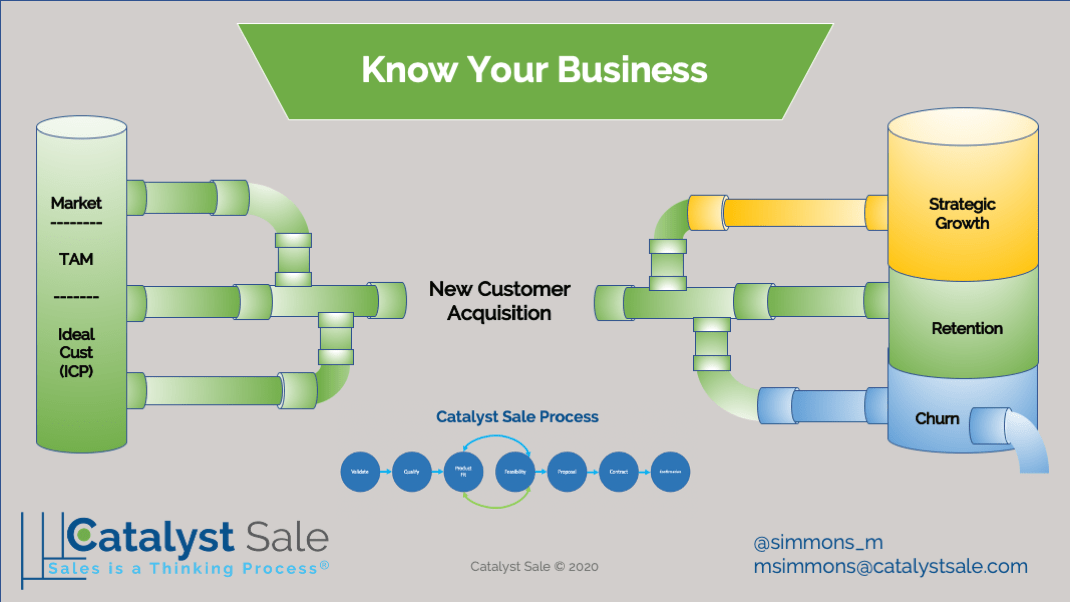
know your business
Know Where You Stand
Knowing who you can serve and how exactly you can serve them, puts you in the driver's seat. When you know the solutions you can offer, you know the problems you can solve.
know your approach
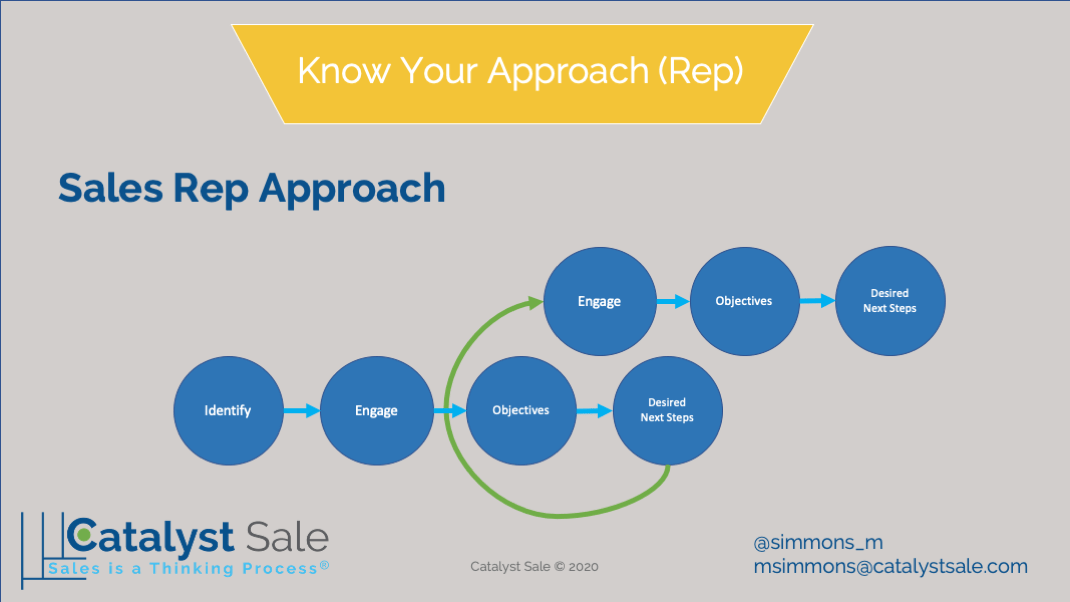
Follow the Sales Rep Approach
Identify prospect, ideal customer profile, engage with the person(s), and establish objectives. Then, we clarify next steps by identifying the next actions, and call the prospect to action (use this as a way to hold the person(s) accountable). This process loops until the deal is closed.
Putting it all together using "Sales is a Thinking Process"

6. Contract Signed
We’ve negotiated terms and conditions, and agreed to these terms and conditions. The deal is now moved into a CLOSED WON status.
Take the Next Steps
Download the sales process worksheet and start testing.

"I strongly recommend this course for every stage of a sales career, from casual contemplation to veteran pro."

Sales is a
Thinking Process®
Most forecasting problems aren't data problems. They're process problems. When your stages are defined by clear exit criteria — past tense, yes or no — you always know exactly where every deal stands.
You might be searching for an architect
when what you need is a plumber.
Inside most organizations, there are multiple processes running at the same time — and they're getting mixed up. The buyer journey and the sales process are different pipes. When you force them through the same one, you get neither hot nor cold water.
What the customer experiences
The buyer's path from awareness to decision. It runs alongside your sales process but through separate pipes. Mixing the two means you never really understand either.
How you forecast with confidence
Your stage-based process for tracking and forecasting opportunities. Past tense stages with yes/no exit criteria mean you always know exactly where every deal stands.
How individuals execute the job
Identify, engage, establish objectives, clarify next steps, call to action. The most overlooked process — and the one that determines whether the other two even matter.
If inside your business you've tried to run the buyer journey and the sales process through the same pipe, you're creating problems. You may not need a revenue engineer or go-to-market architect. You might just need a plumber to come in, look at your pipes, and tell you where things are getting stuck. — MIKE SIMMONS · CATALYST
Each process has a distinct
job to be done.
The buyer journey, the sales process, and the rep approach are three separate pipes — and each has a different job. Understanding the difference is what makes forecasting reliable and execution predictable.
What a real sales process
gives your business.
Seven stages. One clear question
at each exit.
Stages are past tense. You're only in a stage if you can answer Yes to the exit question. If No — go back to the previous stage. That's it. That's the process.
This is where we validate whether or not there is a deal to be had. If you are speaking with someone who is in your ideal customer profile at an individual level, and they work within an organization that is within your ICP, there is a high likelihood that within the first discussion you will be able to validate an opportunity. The opportunity is with the company — not the person.
This step is about understanding the story from the perspective of the customer. Who, What, When, Where, Why, How — you need to identify what problems exist, who cares about those problems, why they care, how they have attempted to fix the problems, and when they need to fix them. If you can answer these questions, you can move to the next stage.
This is our internal review. Based on our understanding of the problem, can we solve it with our existing solution? This is where we qualify out — either because we cannot solve the problem, or we do not want to customize to solve the problem. This test validates that we are working with the right customer and that it makes sense to move forward.
Here the customer's perspective is critical. This is their internal review — do they believe we can solve the problem? Can they afford the solution? Can they implement the technology or service? This is where the customer qualifies out — either they do not believe us, they do not think we can solve it, or they cannot get the deal done.
We have done significant work to get here. We understand the customer and can define the problem from their perspective. We have determined we can solve the problem and they have agreed. Now we list out the Problem, the Solutions, the Costs, and Next Steps in a single document — and confirm approval with our key contacts.
We have negotiated terms and conditions and agreed to them. The deal is now moved into Closed Won status. This is not the end of the relationship — it is the beginning of the next phase. The handoff to the success team is critical.
30 to 60 days post-sale — we go back to the customer and confirm that we did what we said we would do. We confirm that we delivered the solution and solved the problem. If we haven't — we fix it. Once confirmed, we ask if they know others struggling with the same problem. This is where referrals happen.
On renewals, you start here. You already have a relationship — now you need to understand what's changed. Who, What, When, Where, Why, How — has the problem evolved? Are the key contacts still the same? What value have they received and what do they still need?
Our internal check — can we still solve the problem? Has anything changed on our side or theirs that would affect fit? This is still an internal review, even on renewals. Don't skip it.
The customer's review. Do they still believe we can deliver? Are there new stakeholders who need to be brought in? Has budget or authority changed? Don't assume last year's Agreed Fit carries forward automatically.
On renewals the stage is Proposal Sent — not Proposal Approved. The proposal has been delivered; we're now in the customer's hands. Follow up is active, not passive.
Agreement executed. The renewal is confirmed. Document what changed from last year — both in the customer's situation and in your solution — so the next renewal cycle starts with full context.
Did we do what we said we would — again? Confirming success on renewals sets up the next renewal conversation. Ask for referrals within their business or network. This step is how compounding relationships are built.
For most of my 19-year sales career, I've sought to continuously improve my processes. What many of the methodologies I encountered had in common was that they seemed to add complexity when simplicity is what I sought. Enter the "Demystify Sales" course. Through this course, what felt like it should be simple, actually became so. Mike makes such sense of what's necessary to identify gaps in my process, that what I'm learning is immediately actionable and effective. Mike covers everything from thinking and planning, to execution while including essential tools to help accelerate learning. Instead of scripting, Mike introduces an on-point framework that makes gaps evident, prompting me to creatively consider the questions I need to ask to fill them. I strongly recommend this course for every stage of a sales career, from casual contemplation to veteran pro.
Demystify Sales Course
The complete framework — from thinking and planning to execution. Tools, frameworks, and the Catalyst Sale process in full. Available on-demand through Kajabi.
Enroll Now →Book a Discovery Call
If your team is working through a forecasting problem, a misaligned process, or an adoption challenge — a 25-minute call is enough to identify the highest-leverage place to start.
Book a Call →